
A smartwatch is a watch that runs applications and connects to other devices. Its history is a series of attempts to put a computer on the wrist, and the limits in each attempt were the same three: power, input and size. A watch must run for days on a battery the size of a coin, take commands through a screen smaller than a stamp, and fit under a cuff. Each generation moved one of those limits and ran into the next.
The power limit
A quartz movement draws a few microamperes and runs for years on a button cell. A color screen, a radio and a processor draw thousands of times more, and the battery has to supply them for a day or two. Everything in the history below can be read as a different trade between what the watch can do and how often it must be charged. Seiko’s Ruputer of 1998 ran on two standard CR2025 batteries, giving up to three months of standby with aggressive power management, but heavier use could drop that to about 30 hours.
Computers before the smartwatch
Wrist-worn electronics predate the word smartwatch. In 1972 Pulsar introduced the first digital watch. In 1982 Seiko released the TV Watch, which received television and radio signals through a pocket receiver wired to the watch, and Pulsar released the NL C01 databank watch, which stored 24 digits. Around 1983 Seiko’s RC and UC computer watches connected to personal computers by cable, and the RC-20 could run programs written on a PC. In 1990 and 1991 Casio produced the JC-10, which tracked steps, calories and distance, the VDB-1000, a wrist-worn touchscreen PDA, and the BP-400, which monitored heart rate and blood pressure. In 1994 Casio’s VivCel VCL-100 alerted users to incoming phone calls, Seiko’s Receptor Message Watch worked as a wrist pager, and Timex’s Datalink, developed with Microsoft, synced data through barcodes flashed from a computer monitor.
The Ruputer and its successors
Seiko’s Ruputer of 1998 was the first consumer watch that could run applications and connect to a PC through a docking station. A joystick with eight directions sat below a 2-inch LCD of 102 by 64 pixels. Users could write memos, schedule appointments, manage to-do lists, log expenses, play games and use a calculator, and third-party applications were available. It was large and had to be worn over a shirt cuff, and text entry with the joystick and an on-screen keyboard was tedious, which was the input limit. Fossil’s Wrist PDA of the early 2000s ran Palm OS 4 and had a touchscreen. Microsoft launched the SPOT watch in 2003, which received data over the MSN Direct FM network. Production ended in 2008 and the network service ended in 2012. Pebble launched on Kickstarter in 2012. Most of these early watches were commercial failures.
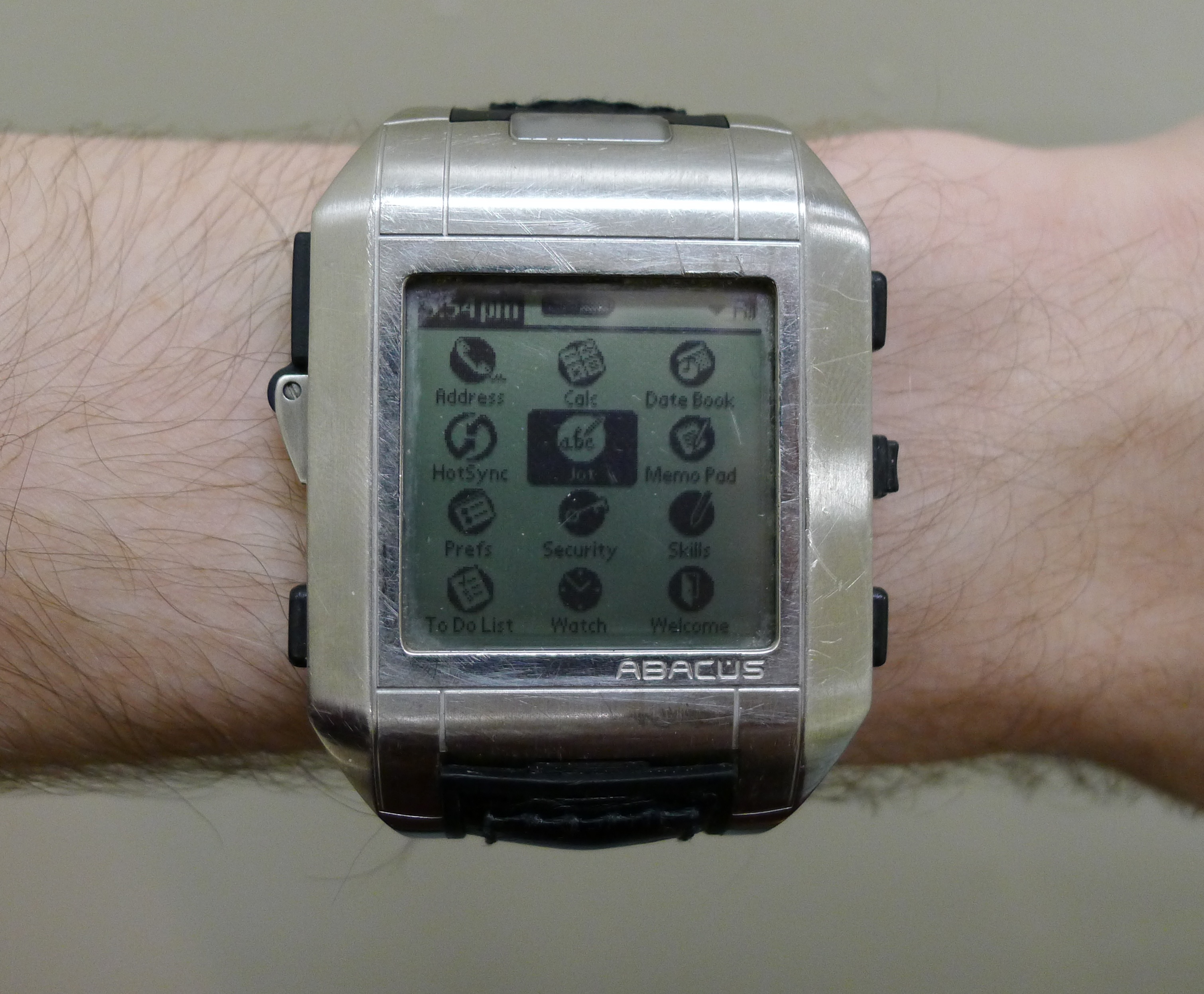
The Fossil Wrist PDA (2003), running Palm OS, stylus included. Photo: Wikimedia Commons, GFDL.
2015
The first Apple Watch was released in April 2015. Swiss watch shipments fell about 12 percent in October 2015, with shipments to Hong Kong down 39 percent and to the United States down 12 percent, and exports had declined 3.2 percent over the first ten months of the year. Whether the Apple Watch caused the decline was argued at the time and is not settled by those figures alone, since October 2015 was compared against a strong October 2014, when exports had risen 5.2 percent.
Two Swiss approaches
Swiss makers answered in two ways: a watch that was a small computer, and a watch that remained a watch with a few connected functions. Frederique Constant introduced its Horological Smartwatch at Baselworld 2015, and it went on sale in June 2015 for 995 euros. It has traditional hour and minute hands. A small counter at 6 o’clock shows data, a small red hand shows the date during the day and the moon during sleep, and a small steel hand shows progress toward an activity or sleep goal as a percentage. A quartz caliber with a built-in MotionX sensor-fusion engine tracks activity and sleep, and the watch syncs with Apple and Android apps. Its battery life is given as more than two years, which is the quartz end of the power limit. TAG Heuer launched the Connected on 9 November 2015 in New York, priced at 1,400 Swiss francs, or 1,500 dollars. It runs Android Wear on an Intel Atom processor, with 4 GB of memory, in a 46 mm grade 2 titanium case. After the two-year warranty, owners can exchange the watch for a mechanical Swiss-made Carrera of identical design by paying an additional 1,400 francs. Montblanc followed in 2017 with the Summit, on sale from May 2017 at 890 dollars for the steel model. It runs Android Wear 2.0 on a Qualcomm Snapdragon Wear 2100 processor and lacks GPS and NFC payments. The case is 46 mm across and 12.5 mm thick, and the watch lasts about a day with normal use, which is the computer end of the same limit.

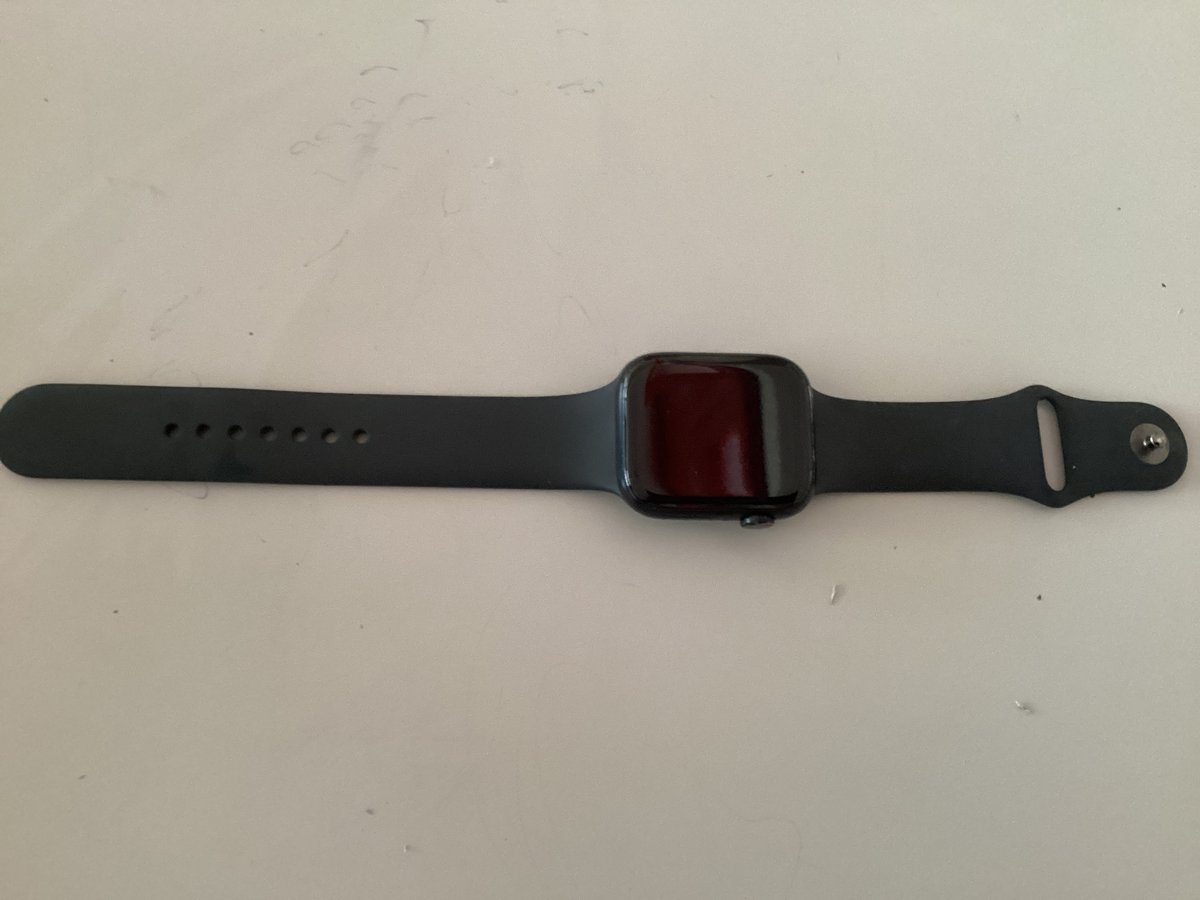
An Apple Watch Series 4, the first to add an electrocardiogram. Photo: Wikimedia Commons, CC BY 4.0.
Sources
- “Seiko Ruputer: The World’s First Smartwatch Had the Same Issues We Have Today,” Engadget
- “The History of the Smartwatch Goes Back Much Further Than You’d Think,” Gear Patrol
- “Apple Watch Effect: Swiss Watchmakers Experience Biggest Sales Drop in Six Years,” BGR
- “Frederique Constant Steel Horological Smartwatch,” Worldtempus
- “Connected to the Future and Eternity,” Fondation de la Haute Horlogerie
- “TAG Heuer Connected,” Europa Star
- “Introducing the Montblanc Summit Smartwatch,” SJX
Thanks for reading this.