
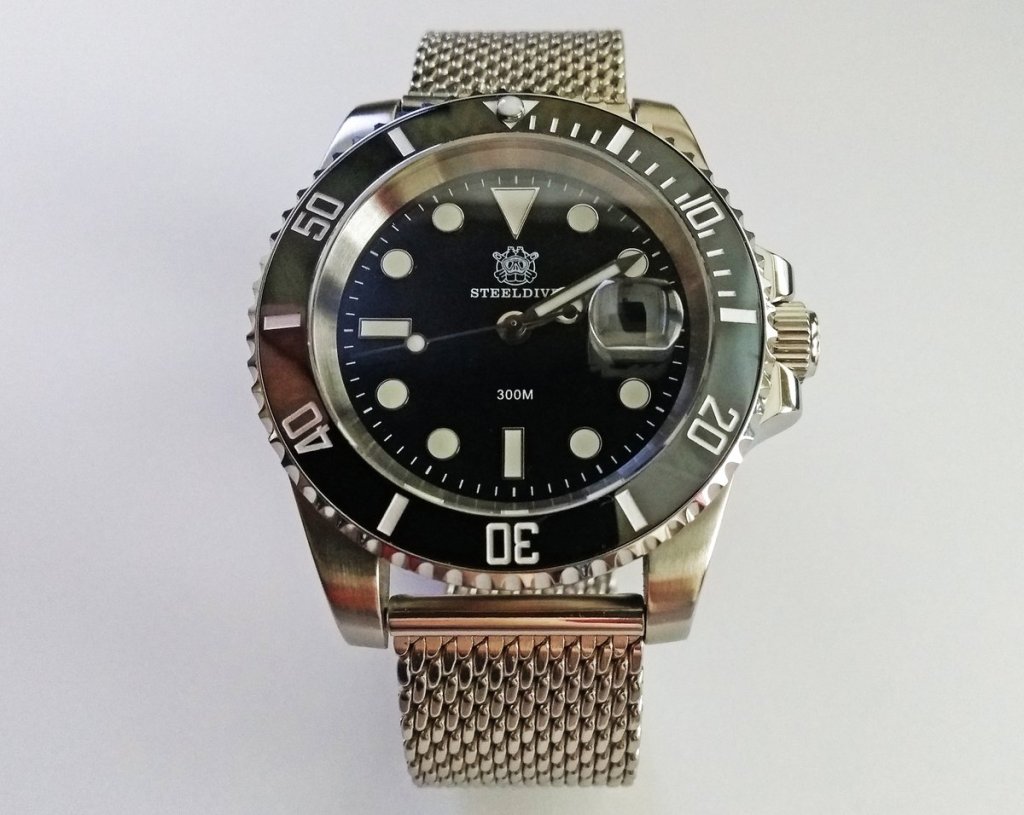
The ceramic in a watch case is zirconium oxide, ZrO2, a technical ceramic closer to a hip implant than a coffee mug. It is extremely hard, light on the wrist, and it never loses its color. Rado pioneered it, Chanel’s J12 made it fashionable in 2000, and today it is everywhere from Omega dive watches to IWC pilot chronographs.
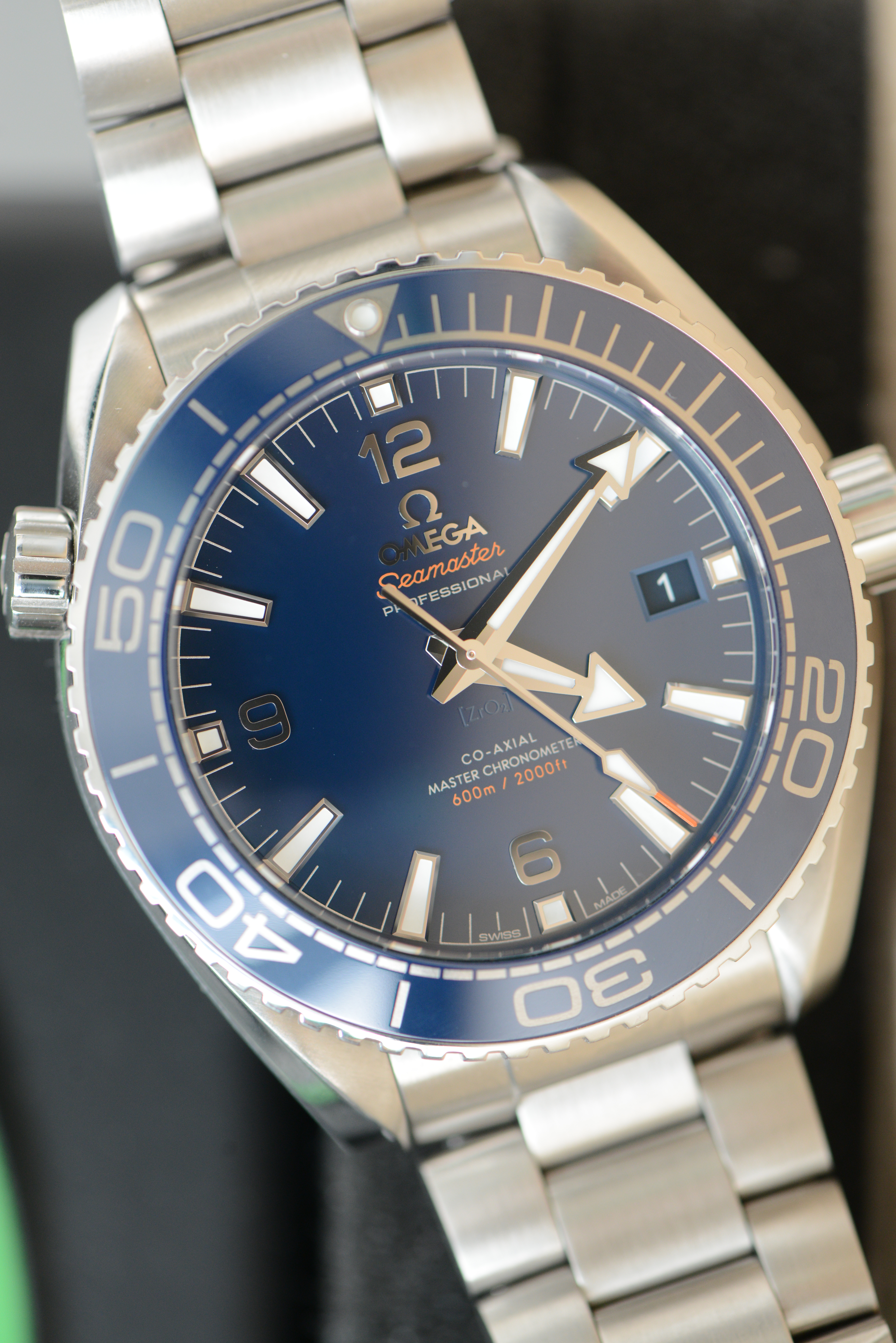
An Omega Planet Ocean with a ceramic bezel, the modern dive-watch standard. Photo: Wikimedia Commons, CC BY-SA.
What it actually is
Watch ceramic starts life as ultrafine zirconium oxide powder, mixed with pigments for color and a polymer binder so it can be molded. The shaped piece is then sintered, meaning baked, at around 1,450 degrees Celsius. During sintering it shrinks by about 25 percent and becomes fully dense, reaching roughly 1,250 Vickers on the hardness scale (Rado’s own figure). For comparison, steel is around 150 to 200 Vickers. That shrinkage is the manufacturing headache: the mold has to be designed oversize with the final dimensions predicted in advance, and holding tight tolerances through a kiln firing is genuinely difficult. Final shaping is done with diamond tooling.
The Rado-to-Chanel pipeline
Rado did the decades of unglamorous groundwork. After the tungsten carbide DiaStar of 1962, Rado introduced the Integral in 1986 with ceramic bracelet links, then the Ceramica in 1990, the brand’s first watch with a ceramic case and bracelet, a stark rectangular design that still looks futuristic. Chanel then did what fashion houses do: it made the material desirable. The J12, launched in 2000 in black ceramic with a white version following in 2003, was designed by Jacques Helleu and proved a luxury sports watch could be black, scratch-resistant, and unisex all at once. From there the industry followed. Omega put ceramic bezels on the Planet Ocean and Speedmaster lines, IWC built ceramic cases for pilot’s watches, and Rolex developed its own Cerachrom ceramic for GMT and Submariner bezels starting in the mid-2000s.
Why people like wearing it
Three things. First, it is essentially scratch-proof against anything short of diamond, so a black watch stays black instead of collecting the hairlines that turn a polished steel case gray at the edges. Second, it is light and hypoallergenic, comfortable for sensitive skin and easy on the wrist in larger sizes. Third, the color goes all the way through the material rather than sitting on the surface, so it cannot wear off, fade in sunlight, or chip down to a different-colored base the way coatings can. A white ceramic watch will still be white in twenty years.

An IWC Aquatimer. IWC is among the brands building ceramic into cases and bezels. Photo: Wikimedia Commons, CC BY-SA.
The tradeoffs
Ceramic is hard, not tough, the same distinction that applies to tungsten carbide. A hard knock against tile or stone can crack a ceramic bezel or case, and this genuinely happens; cracked ceramic bezels on dive watches are a known service-desk sight. Unlike steel, a scratch or chip cannot be polished out, so the fix is a replacement part, and factory ceramic parts are expensive. There is also a subtler complaint: cheap-feeling lightness. Some buyers pick up an all-ceramic watch and read the low weight as insubstantial next to steel, even though the material itself costs more to produce. That is perception, not engineering, but perception sells watches.
Keep digging
See Tungsten for the other scratch-proof pioneer, and Case Construction for how these parts actually fit together. For the bigger picture of what goes on the outside of a watch, Watches 101, Lesson 5: The Outside.
Why it matters
Ceramic changed what a watch can look like after five years of daily wear: basically the same as day one, for better and for worse. It will not pick up character the way steel does, and it will not forgive a bad drop the way steel does either. Know which of those you value and the choice makes itself.
Thanks for reading this.

