
For about three thousand years, the most reliable clock in the world was a bowl with a hole in it. Sundials quit at sunset and sulked on cloudy days, so every civilization that wanted to know the time after dark ended up, independently, at the same solution. Let water drip out at a steady pace, mark how far the level falls, and you have the night shift covered. The Greeks called it the clepsydra, the water thief, and it stole time one drip at a time from Egypt to China.
Egypt: the outflow problem
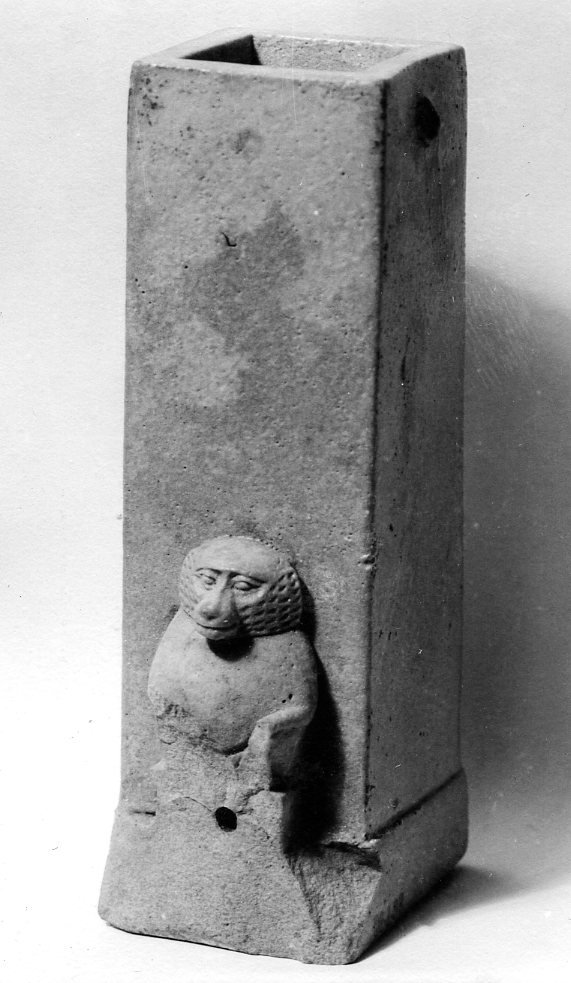
The oldest surviving water clocks come from Egypt. The famous one is a stone vessel found at Karnak, made for a scribe named Amenemhat during the reign of Amenhotep III, around the 14th century BCE. It is an outflow clock. Water drains from a hole near the bottom, the level inside sinks past hour markings carved on the wall, and you read the time off the falling water.
There is a catch, and it is a good one. As the water level drops, the pressure drops, so the flow slows down. The last hour drips out slower than the first. The Egyptians handled this the practical way, by spacing the markings to compensate, with different scales for different months, since the night hours were longer in winter. It worked. It was also fiddly, and the fiddliness never really went away. Every water clock ever built was a negotiation with physics.

Cross-sections of Egyptian clepsydrae. Photo: Wikimedia Commons, public domain.
Greece: Ctesibius makes it readable
The Greeks used the clepsydra for everything, including courtroom speeches. In Athens, a speaker’s time was measured by water draining from a vessel, which meant justice literally ran on a drip. Plato mentions the practice, and you have to admire a legal system with a built-in shut-up mechanism.
Around 270 BCE, an Alexandrian engineer named Ctesibius rebuilt the water clock into something you could actually read. His version was an inflow clock. Water flowed in at a constant rate, a float rose with the level, and a little figure on the float pointed at hour markings on a column. Constant inflow meant constant pressure, which meant even hours, which meant the outflow problem was finally solved. Ctesibius also invented the force pump and the water organ, which makes him one of those ancient engineers who seems to have invented half the plumbing in the ancient world before lunch.
The Tower of the Winds
Around 50 BCE, a Macedonian astronomer named Andronicus of Cyrrhus built an eight-sided marble tower in Athens that was, as far as anyone can tell, the world’s first combination weather station and clock tower. Sundials were carved on the outside faces, one for each direction. Inside sat a water clock, fed by a stream running down from the Acropolis. On top, a bronze Triton spun in the wind to show the direction, which is why the whole thing is called the Tower of the Winds.
Think about what that building is. One structure that told the time by sun, the time by water, and the weather by wind. The modern smartwatch wants to be exactly this, and the Athenians were doing it in marble two thousand years early.

The Tower of the Winds in Athens, sundials outside and a water clock within. Photo: Wikimedia Commons, CC BY-SA 2.5.
China: Su Song’s tower
The greatest water clock ever built went up in Kaifeng, China, in the 1090s. The emperor commissioned the official and engineer Su Song in 1088 to build an astronomical clock tower, and the result was a structure about forty feet tall containing a waterwheel, an armillary sphere, a celestial globe, and mechanical figures that struck bells and drums to announce the hours. Su Song documented the whole machine in his 1092 treatise Xin Yi Xiang Fa Yao.
The remarkable part is the drive. The waterwheel was regulated by what Su Song called the celestial balance, a mechanism that let the wheel advance one step at a time as each bucket filled. The historian Joseph Needham identified this as the world’s first known mechanical escapement, the same basic idea Europe would reinvent centuries later for its tower clocks. Scholars still debate the details of how the mechanism worked, since the tower was dismantled after the Jin captured Kaifeng in 1127 and only the book survives, but the treatise is detailed enough that modern reconstructions have been built and they run.
Su Song’s tower also contained what is believed to be the oldest known endless chain drive, powering the armillary sphere from the main wheel. A water clock that quietly invented the chain drive as a side project.

Su Song’s clock tower, as drawn in his 1092 treatise. Photo: Wikimedia Commons, public domain.
The long drip ends
Water clocks had a good run, roughly three millennia, but they had enemies. Water freezes. Algae grows. Somebody has to haul the buckets and refill the tank, and if they forget, your clock stops. In the Islamic golden age, engineers like al-Jazari kept the tradition spectacularly alive, his 1206 elephant clock was a water-powered parade of automata, but the writing was on the wall. Literally on the wall, because the replacement was a machine that hung on church towers and ran on falling weights instead of falling water.
The gears that took over are the subject of Mechanical Clocks. The shadows that came before are in Sundials, and the full arc is in the History of Timekeeping overview.
Why it matters
The water clock is the missing link between watching the sky and building a machine. It taught humanity that time could be manufactured indoors, on demand, in the dark, which is the exact idea every watch movement is built on. The escapement in your automatic watch, metering out the mainspring’s energy one beat at a time, is doing conceptually what Su Song’s celestial balance did with buckets of water nine centuries ago. Drip by drip, it all connects.
Thanks for reading this.

