
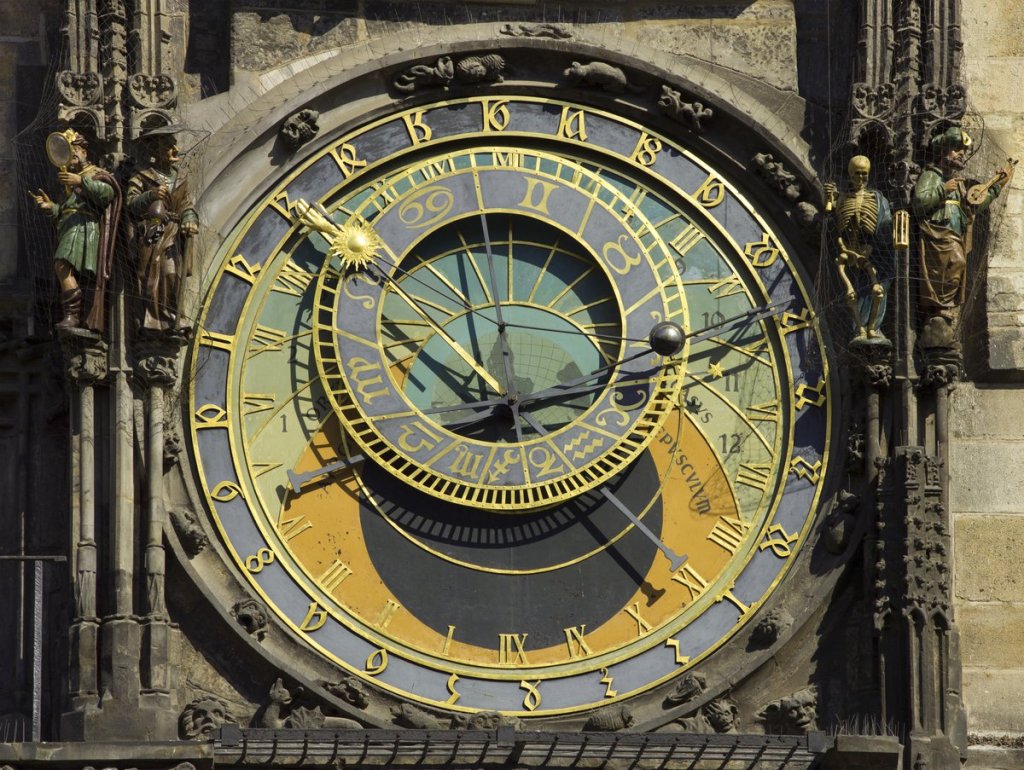
People have been measuring time for at least five thousand years, and for most of that history the instruments were embarrassingly simple. A stick in the ground. A bowl with a hole in it. A shadow creeping across stone. The wristwatch on your arm is the great-great-grandchild of all three, and the whole story of timekeeping is really the story of civilization trying to agree on what time it is.

An Egyptian shadow clock, roughly 3,500 years old. Photo: Wikimedia Commons, CC0.
Reading the sky
The first clocks were the heavens themselves. Farmers needed to know when to plant, priests needed to know when to pray, and kings needed everyone else to know who was in charge of the calendar. The Egyptians were casting shadows with obelisks as early as 3500 BCE, and by around 1500 BCE they had portable shadow clocks, little L-shaped bars that told the hour by the length of a shadow. Simple. Free. Useless at night or on a cloudy day.
The night problem bugged everybody, and the first answer was to stop watching the sky and start dripping water instead. That is the second great family of clocks, and you can read its whole story in Water Clocks. The shadow chapter in full is in Sundials.
Stealing time with water
The Greek word for water clock is clepsydra, which literally means “water thief,” and that is a perfect name, because a water clock steals time one drip at a time. The Egyptians were at it by the 14th century BCE. A famous stone clepsydra from Karnak, made for a scribe named Amenemhat during the reign of Amenhotep III, measured the hours by letting water drain out of a vessel marked with scales.
Water clocks spread everywhere water was. Ctesibius of Alexandria, around 270 BCE, rebuilt the clepsydra with a rising indicator column so you could actually read it like a gauge. In Athens, the Tower of the Winds combined sundials on the outside with a water clock inside. And in China, the engineer Su Song built a forty-foot astronomical clock tower at Kaifeng in the 1090s, documented in his 1092 treatise, with a waterwheel driving an armillary sphere and striking figures. The historian Joseph Needham identified its “celestial balance” mechanism as the world’s first known mechanical escapement, centuries before anything similar in Europe, though scholars still argue about exactly how it worked. The whole dripping saga is in Water Clocks.

Su Song’s clock tower, from his 1092 treatise. Photo: Wikimedia Commons, public domain.
Gears take over
Then, in the late 1200s, somewhere in Europe, somebody figured out how to make a machine count time with gears. Nobody knows who. The likeliest story is that monasteries needed a way to ring the bells for prayer through the night, when no sundial and no sleepy monk could be trusted, and necessity did the inventing. The first mechanism was the verge and foliot escapement, a gloriously crude arrangement of a toothed wheel and a rocking bar that let the gears advance one tooth at a time, losing maybe an hour a day and not caring.
The clock at Salisbury Cathedral, dated to around 1386, is claimed by the cathedral to be the oldest surviving working mechanical clock in the world. It has no dial and never did. It strikes the hours on a bell, driven by falling weights and regulated by a verge and foliot, and after a 1950s restoration it is still running. That machine is the ancestor of every movement ever put in a watch case. The full gear-and-iron story is in Mechanical Clocks.
The pendulum makes it precise
The famous story is that Galileo, bored in church as a young man, timed a swinging lamp with his pulse and noticed that a pendulum always takes the same time to swing, whatever the arc. Historians mostly treat the lamp part as legend, but Galileo really did study pendulums, and in 1656 Christiaan Huygens turned the insight into the first working pendulum clock. Accuracy jumped from minutes per day to seconds per day, the single biggest leap in the history of timekeeping.
After that, the improvements came fast. The anchor escapement, around 1670, let pendulums swing in a short arc and made the tall long-case clock possible. George Graham’s deadbeat escapement, around 1715, removed the recoil and became the standard for observatory regulators. And the hardest problem of all, finding longitude at sea, fell to John Harrison’s marine timekeepers: after Parliament offered a fortune in the Longitude Act of 1714, his H4 lost only about three minutes and 36 seconds over 81 days at sea in 1761, which corrected to roughly five seconds once its established daily rate was allowed for. A clock had solved a problem that had sunk ships for centuries.
Crystals and atoms
The railways forced the next change. When trains started colliding because every town kept its own local noon, the world finally agreed on standard time, formalized at the 1884 International Meridian Conference. Then the vibrating quartz crystal, first put to work by Warren Marrison at Bell Labs in 1927, made cheap accuracy possible. Seiko’s Astron of 1969 put a quartz movement on the wrist and nearly killed the Swiss mechanical watch industry in the process.
And then physics took over. The first atomic clock was built in 1949, a cesium version followed in 1955, and in 1967 the second itself was redefined as 9,192,631,770 vibrations of a cesium-133 atom. Time is no longer measured against the sky at all. It is counted in the shivering of atoms, and your phone checks in with those atoms, via GPS satellites, every time you glance at it.
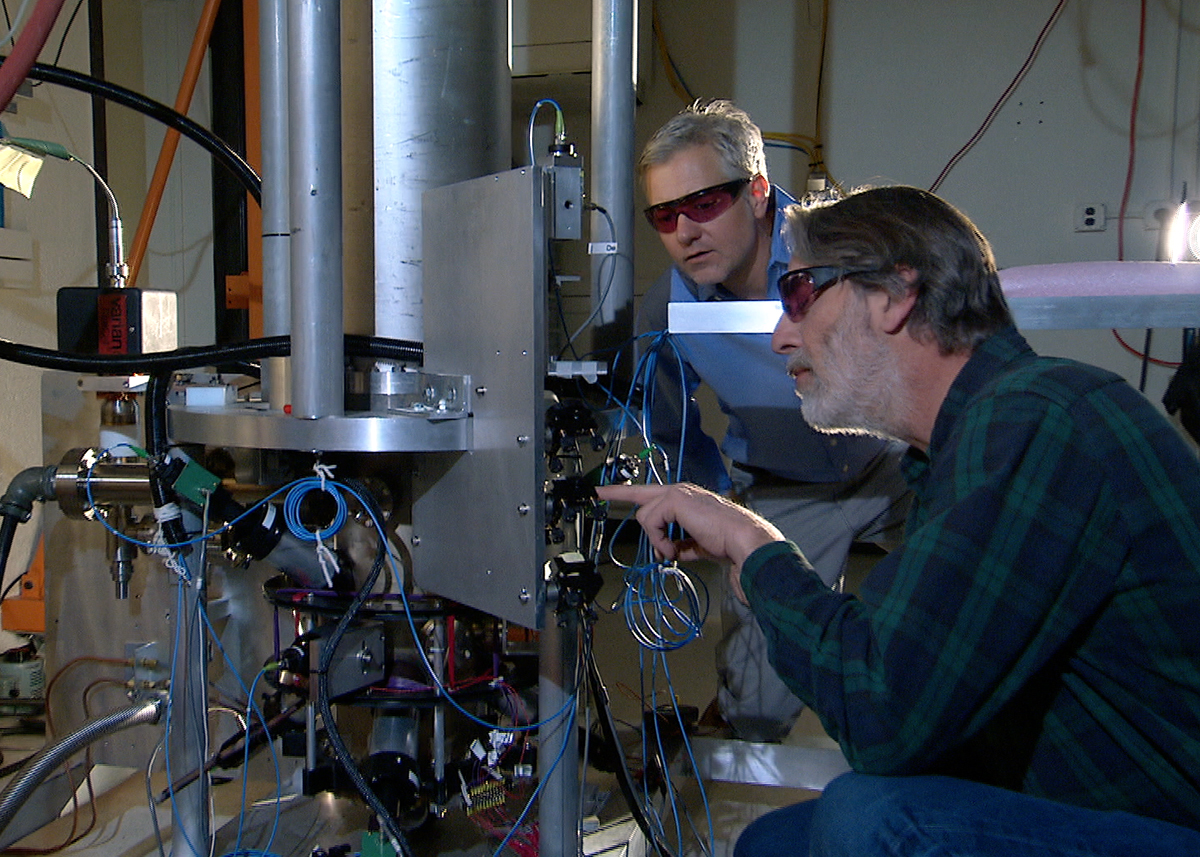
The NIST-F2 cesium fountain atomic clock, one of the devices that defines the second. Photo: Wikimedia Commons, public domain.
Why it matters
Every leap in this story was driven by somebody needing to know the time badly enough to build a machine for it. Prayer hours gave us the tower clock. Navigation gave us the marine chronometer. Railways gave us standard time. The watch on your wrist sits at the end of a five-thousand-year chain of people staring at shadows, dripping water, swinging weights, and vibrating atoms, all trying to answer the same question you asked this morning. What time is it.
Thanks for reading this.

