
Sometime in the late 1200s, somewhere in Europe, somebody figured out how to make gears count time, and nobody knows who. No patent, no treatise, no proud inscription. The mechanical clock just appears in the historical record in the early 1300s, fully formed. The likeliest parents are monasteries, which needed bells rung for prayers through the night, when sundials were blind and monks were asleep. Necessity did the inventing, and then forgot to sign the work.
The verge and foliot: gloriously crude
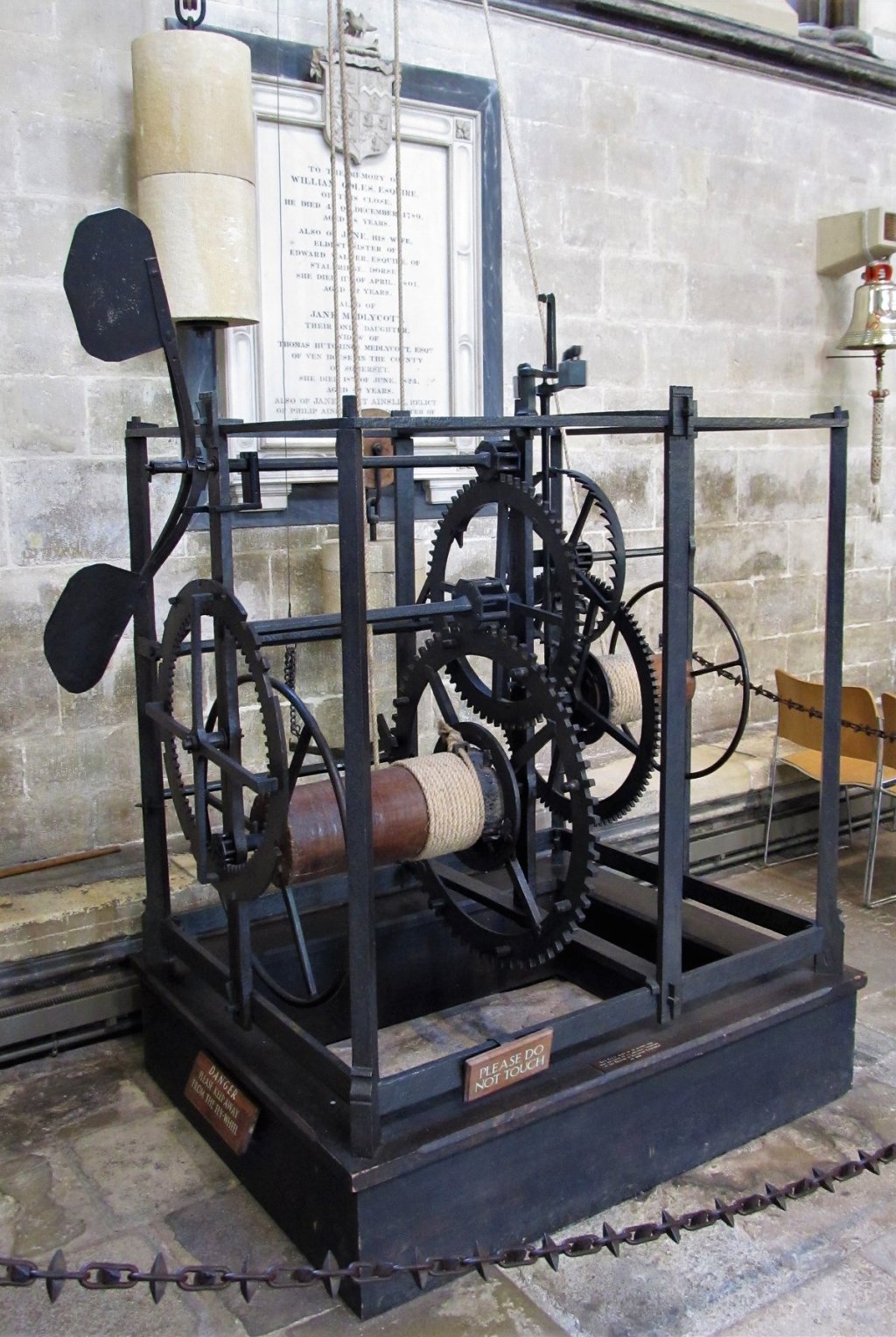
The first escapement, the device that lets a clock’s gears advance one controlled step at a time, was the verge and foliot. Picture a toothed wheel like a crown, the crown wheel, with a vertical rod, the verge, sticking through it. The rod has two little pallets that catch the teeth alternately, and across the top sits the foliot, a horizontal bar with adjustable weights on each end. Push the foliot, it swings, the pallets rock, one tooth escapes, the gears lurch forward, and the whole thing rocks back the other way. Tick. Tock. Repeat for six hundred years.
It was crude. A good verge and foliot clock might lose an hour a day, which sounds useless until you compare it to a monk guessing. But it had one enormous virtue: it worked in the dark, in winter, indoors. For the first time, time was fully manufactured, and these clocks did not even have dials. They just struck a bell on the hour.

The clock at Salisbury Cathedral, dated to around 1386. Photo: Wikimedia Commons, CC BY-SA 2.0.
Tower clocks: time goes public
The 1300s were the century of the tower clock. Milan got a public clock in 1335. Giovanni de’ Dondi spent sixteen years, from 1348 to 1364, building his Astrarium in Padua, a seven-faced astronomical masterpiece that showed the planets as well as the hours. Richard of Wallingford, abbot of St Albans, designed an astronomical clock around 1327 whose written description survives, one of the earliest technical documents in horology.
And then there is Salisbury. The great clock in Salisbury Cathedral is dated to around 1386, and the cathedral claims it as the oldest surviving working mechanical clock in the world. No dial, just a bell struck by falling weights and a verge and foliot, restored to working order in the 1950s and still running. Wells Cathedral has the second-oldest, from around 1392, complete with knights who joust above the dial every hour, because medieval clockmakers understood showmanship.
Galileo’s lamp and Huygens’s pendulum
The famous story is that a young Galileo, bored during a service at Pisa Cathedral, timed a swinging lamp with his pulse and realized a pendulum’s swing always takes the same time. Historians mostly treat the lamp part as legend. What Galileo did, in letters from 1602 and in his Discorsi of 1638, was work out the pendulum’s mathematics, and he sketched a pendulum clock late in life that was never built while he lived.
The man who built it was Christiaan Huygens. In 1656 he put a pendulum on a verge escapement and produced the first working pendulum clock, and accuracy jumped from minutes per day to seconds per day, the single biggest leap in the history of timekeeping. He added cycloidal cheeks to keep the pendulum isochronous at wide swings, and in 1673 he published the Horologium Oscillatorium, the founding text of mathematical horology.

Huygens’s first pendulum clock design, 1656. Photo: Wikimedia Commons, public domain.
The anchor and the deadbeat: error gets squeezed
A pendulum on a verge still had to swing in a wide arc, which wasted energy and kept accuracy limited. Around 1670 came the anchor escapement, usually credited to Robert Hooke, with the first working versions built by the clockmaker William Clement around 1671. The anchor’s arms rocked over the escape wheel like a ship’s anchor, hence the name, and the pendulum only needed to swing a few degrees. That one change made the long pendulum practical, which made the tall long-case clock practical, which is why your grandparents called it a grandfather clock.
Then, around 1715, George Graham invented the deadbeat escapement, and the name tells you what it fixed. Earlier escapements recoiled, the seconds hand visibly shuddering backward with every beat. Graham’s eliminated the recoil, so the wheel advanced and stopped dead. Deadbeat escapements became the standard for observatory regulator clocks, the reference timekeepers against which everything else was checked. Each escapement in this chain did the same job: waste less energy, disturb the pendulum less, and shave the error down. From an hour a day to seconds a week in four hundred years.

The anchor escapement at work. Photo: Wikimedia Commons, CC0.
From towers to wrists
The same century that perfected the escapement also shrank the clock. Spring-driven domestic clocks appeared in the 1400s, and the famous story credits Peter Henlein of Nuremberg with the first small spring-driven timepieces around 1510, the so-called Nuremberg eggs, though historians think the story overstates one man’s role. Clocks got smaller, got springs instead of weights, got dials and hands, and eventually got small enough to carry. The hardest prize, keeping time at sea well enough to find longitude, fell to John Harrison’s marine timekeepers in the 1700s, and from there the line runs straight through the movements in modern watches.
The earlier chapters are in Sundials and Water Clocks, and the whole story from shadow to atom is in the History of Timekeeping overview.
Why it matters
Every mechanical watch movement is a descendant of that anonymous verge and foliot. The gear train, the escapement metering out energy one beat at a time, the oscillator keeping the beat, the whole architecture was worked out in church towers between 1300 and 1715, and watchmakers have been refining it ever since rather than replacing it. When you hear a mechanical watch tick, you are hearing the same conversation between wheel and pallet that started in a medieval bell tower. Six hundred years of engineering, and the basic idea never changed. Let the energy out slowly, and count as it goes.
Thanks for reading this.

