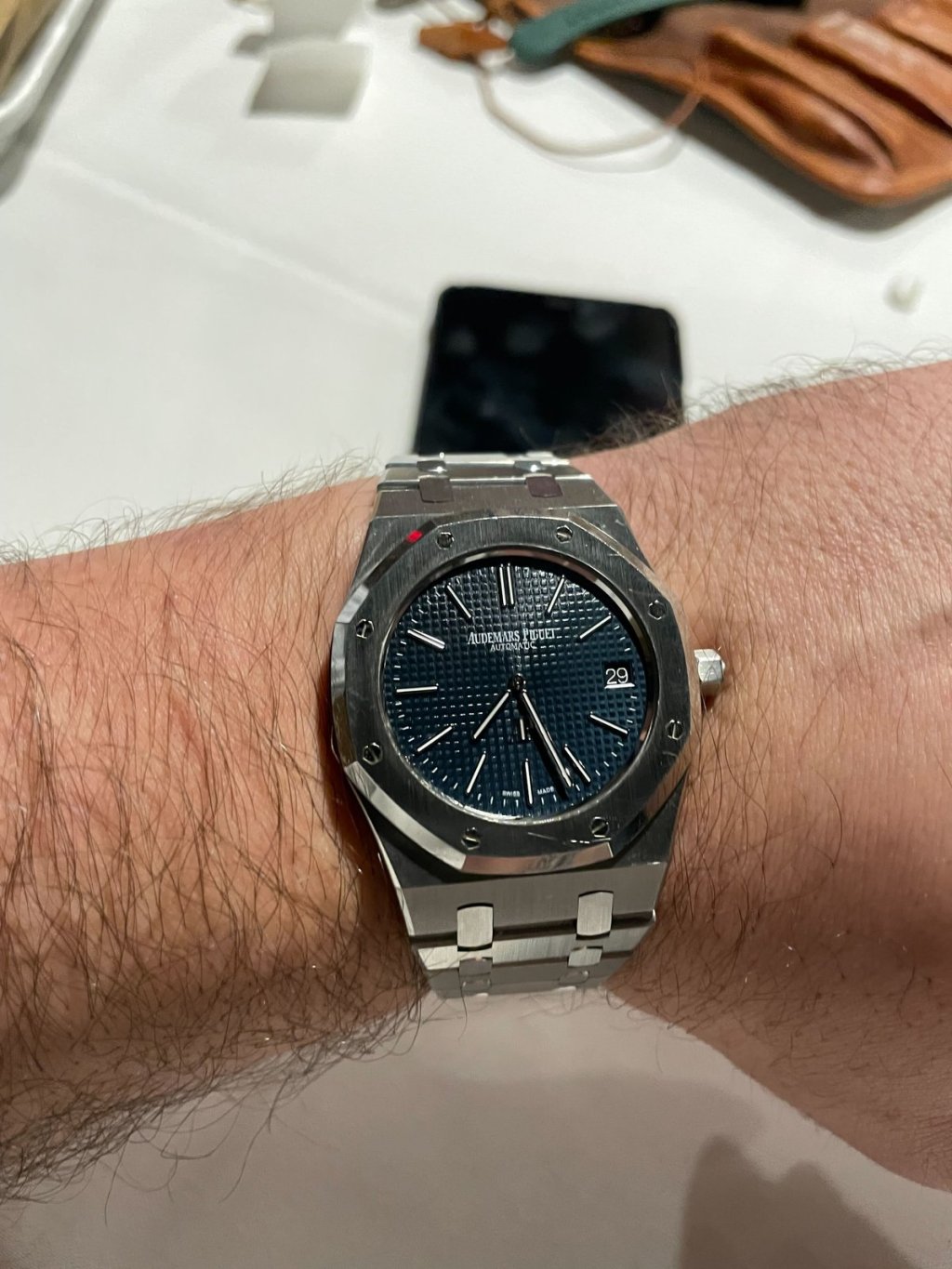
Tapisserie is the small-square hobnail texture on the dial of the Audemars Piguet Royal Oak, and it has been there since the beginning. When Gérald Genta designed the Royal Oak, unveiled at the Basel fair in April 1972, the dial was one of the design’s signature elements: a field of tiny raised squares, each one a small truncated pyramid, set in a precise grid across the dial. The French word tapisserie means tapestry, and the name fits. Up close it reads as woven texture; at a distance it reads as depth. Tilt the watch and the little pyramids catch the light one row at a time, so the dial seems to move as your wrist moves. It is the single most imitated dial texture in watchmaking, and the imitation is the sincerest form of flattery the industry offers.
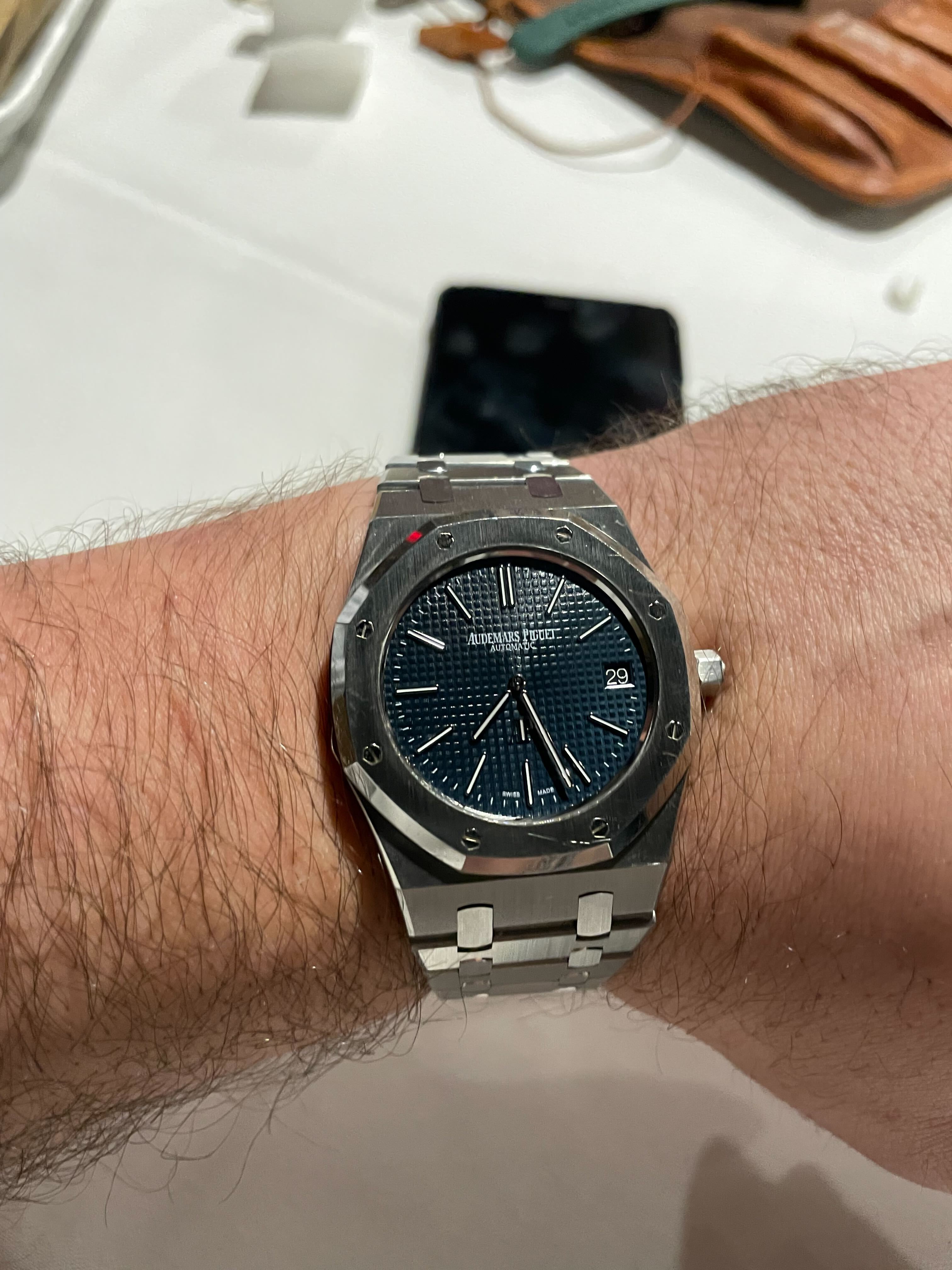
A Royal Oak ref. 15202 Jumbo with a blue Petite Tapisserie dial. The small squares are the pattern Genta specified in 1972. Photo: Wikimedia Commons, CC BY-SA 4.0.
What it looks like, exactly
Each unit of the pattern is a small square pyramid with its top cut off, what geometers call a truncated pyramid, sitting in a grid with narrow channels between the units. The pyramids are raised above the dial surface; the channels between them sit lower and darker. Light hits the sloped sides of the pyramids and the flat tops differently, so every tiny square carries its own highlight and shadow. Multiply that by the hundreds of pyramids on a dial and you get the shimmering, almost liquid quality that photographs never quite capture. One description that gets it right calls the squares “set among diamond-shaped holes,” which is another way of seeing the same geometry: pyramids up, channels down, light doing the rest.
Audemars Piguet produces the pattern in three sizes, and the names are part of the lore. Petite Tapisserie is the small, fine version, the one on the original 1972 reference 5402 and on the Jumbo models that followed it. Grande Tapisserie is larger and bolder, used on many of the modern 41mm Royal Oaks. Méga Tapisserie is the largest, chunkier still, associated with the Royal Oak Offshore line. The names are marketing, but the sizes are real, and collectors can usually call the size at a glance.
How it is made
Tapisserie is not hand-cut on a rose engine the way true guilloché is. It is stamped: the pattern is pressed into the dial blank with an engraved die, forming all the little pyramids in a single operation. The original 1972 dials were made by Stern Frères, the great Geneva dial maker, working to Genta’s design. Stamping was the practical choice for a pattern this regular and this dense; cutting hundreds of identical pyramids by hand on an engine would have been ruinous, and the uniformity is part of the look. Over the decades AP has refined the process, and the modern dials are crisp to a degree the 1972 originals were not, but the principle is the same: a die, pressure, and a brass blank.
This is worth stating plainly because the language around tapisserie sometimes borrows the prestige of hand guilloché. AP’s own heritage materials have described the dial as guilloché, which is true in the loose sense that it is an engraved repeating pattern, and misleading in the strict sense that no craftsman cut it line by line. It is machine-made decoration, executed to a very high standard. There is no shame in that. The shame would be in pretending otherwise, and to AP’s credit the brand does not hide the method from anyone who asks.

A Royal Oak Offshore, which wears the larger Méga Tapisserie. Same geometry as the original, scaled up for a bigger, brasher watch. Photo: Wikimedia Commons, CC BY 3.0.
Why it became a signature
Tapisserie worked because it solved a design problem. The Royal Oak was the first luxury sports watch in steel, and it needed a dial with enough presence to hold its own against the octagonal bezel, the exposed screws, and the integrated bracelet. A flat lacquered dial would have disappeared. The tapisserie gave the dial its own architecture, something for the eye to land on, and it tied the whole watch together: the bezel is geometry, the bracelet is geometry, the dial is geometry. Take the tapisserie away and the Royal Oak still looks like a Royal Oak, but it looks quieter, less sure of itself. AP has occasionally done exactly that, with smooth or smoked dials on special editions, and the reaction from collectors is always the same: interesting, but bring back the squares.
The pattern’s success made it a target. Within a few years of 1972, small-square hobnail textures were appearing on other brands’ sport watches, and they have never stopped. Some of the imitations are respectful nods; some are close enough to cause arguments at watch meetups. None of them can use the name tapisserie, which AP guards, but the geometry itself is not protectable, so the market is full of waffle dials, hobnail dials, and clous de Paris dials that owe everything to Genta’s 1972 drawing. That is how design influence works. The original keeps its value anyway.
Keep digging
Tapisserie is the most famous stamped dial pattern. See Guilloché for the hand-cut craft it is often confused with, Stamped dial patterns for the broader family, and Sunburst dials for another texture that plays with light.
Why it matters
Tapisserie matters because it proves that a dial pattern can be as much of a signature as a case shape. People recognize a Royal Oak from across a room, and half of that recognition is the little squares. It is also a useful case study in honest manufacturing: a stamped pattern, done well, refined over fifty years, carrying one of the most valuable designs in watchmaking. Hand-cut would not be better. It would just be different, and probably worse.
Thanks for reading this.

