
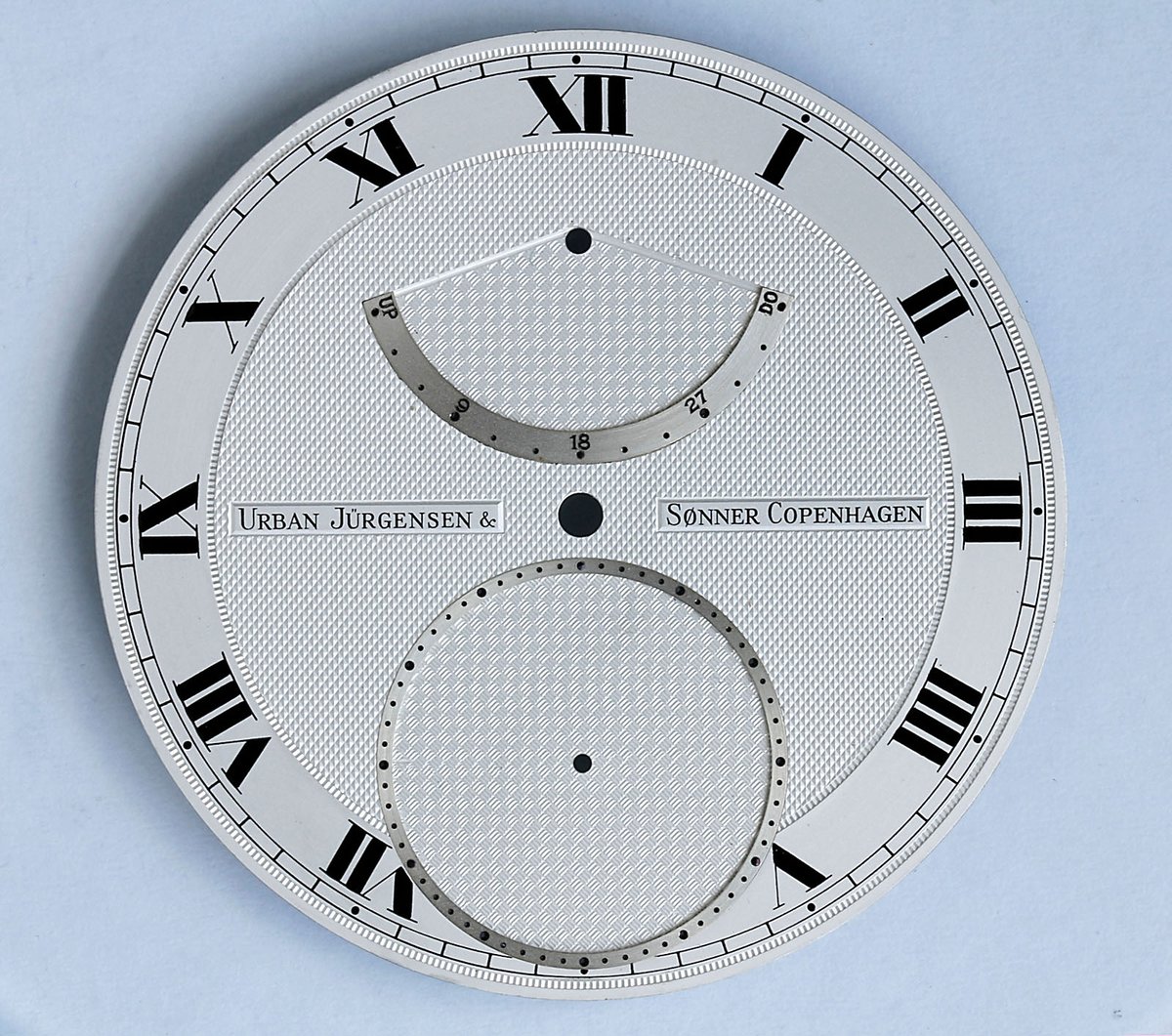
Guilloché is a pattern cut into metal by a hand-operated machine. On a watch dial, a craftsman turns a crank with one hand and guides a cutting tool with the other, and the machine’s cams steer the cut into repeating lines. Because every groove is cut, the surface catches light differently as the wrist moves. That is also the difference between a real guilloché dial and the stamped versions that imitate it.
How it works
The pattern is the combination of two motions. The blank turns on a spindle while the cutting tool is displaced across it. In a rose engine a rubbing block rides on a cam called a rosette, an edge cut in a wavy outline. As the spindle turns, the rosette pushes the work in and out relative to the tool by an amount that follows the wave, so each turn of the spindle cuts a closed wavy circle. A rosette with N lobes cuts a circle with N waves, and the depth of the waves is set by how far the rubbing block is allowed to follow the cam. After each circle the tool is moved by a small step, so that successive circles interleave into a woven pattern. Where the waves of neighboring circles cross, the lines meet in lozenges and rosettes.
A straight-line engine does the same in a plane: a carriage moves the blank in a straight line while a cam moves it sideways, cutting parallel, wavy or crossing lines. The cut is a groove with a V-shaped section, with a pitch of tens of micrometers. The facets of the groove catch light at different angles as the dial moves, which is why the surface shimmers, and fine grooves scatter light enough to give a glare-proof matte. The tool is steel or diamond, and the depth is set by pressure, so the depth, speed and tool shape together set the look. A cut cannot be undone.
From wood and ivory to the watch dial
The technique is more than five centuries old. It appeared first on soft materials such as wood and ivory, then on metal in goldsmith and silversmith work. In watchmaking, freehand engraving on cases does not appear before about 1770 and remains rare before 1790. Abraham-Louis Breguet used guilloché in 1786 and was almost certainly the first to apply it to metal dials, and many other makers followed. Use of the technique then declined for decades. It revived in the 1980s, and major brands have reintroduced it since the 2000s. The origin of the word is uncertain. One account credits a worker named Guillot, and another credits an inventor called Guilloche. A third links it to an Italian word for drop or bead, and a fourth to a French word for a stick, after the shape of the ornament.
Two machines and a cut
The rose engine, also called the guilloché lathe, is operated by hand and produces concentric, circular or radial patterns. The straight-line engine, which emerged in the eighteenth century, uses cams, levers and carriages to cut linear, repetitive patterns. Rose engines have not been made since the 1960s, and the oldest working one dates to 1770. Breguet bought several engine-turning machines built before their makers disappeared in the mid-twentieth century, keeps a workshop to repair them, and has also built some machines of its own.
The process starts with a flat blank, usually brass or silver, though Breguet starts from a solid gold plate. The maker chooses a rosette, or cam, and a graver, tests them on offcuts to check depth and cadence, then cuts the pattern groove by groove. Positioning, rotation speed and tool pressure all affect how even the result is. A complex dial may need over a full day and more than 1,000 cuts, and a dial that combines several patterns can take days. Burrs are removed afterward and the dial is silvered and lacquered with a transparent varnish called zapon, or covered with translucent enamel. A mistake means starting again. Fewer than 100 craftsmen in Switzerland do this work. There are no formal schools. Training takes about five years in one account, and Breguet trains its engine-turners in-house over three.
The patterns
Classic patterns have French names. Clous de Paris is the hobnail pattern, and pavé de Paris is related. Grain d’orge is the barleycorn pattern used on modern Breguet dials. Flinqué is the wave pattern, often covered in translucent enamel. Other standards include sunburst, basketweave and checkerboard, and the lists run to dozens more, such as nid d’abeille, grain de riz and paon. Each needs a different cam and a different sequence of movements.
Hand-cut, copied and imitated
Not all engine-turned work is done by hand. Audemars Piguet’s Petite Tapisserie is made on guilloché copying machines, of which the company has about 30. A pattern plate is enlarged, and a pantograph transfers it at a smaller scale to the dial through a cutting tool. Industrial methods go further. CNC machines are precise and repeatable and can produce complex or three-dimensional patterns, and they are often used on accessibly priced luxury watches. Stamped dials press the brass base to deform it. They are inexpensive, but the texture tends to be shallower and less sharp. Laser engraving lacks the luster of hand work. Hand-cut dials are said to show a distinctive luster and slight irregularities. A dial that looks too regular may be CNC-made, and stamped dials look flatter, with less depth, under magnification. Makers named as doing hand guilloché include Décors Guillochés SA, Metalem, Kari Voutilainen (through Comblémine SA), Breguet, Patek Philippe, Jaeger-LeCoultre, Louis Vuitton and Chronoswiss.
Sources
- “The Art of Hand Guillochage at Breguet,” Monochrome
- “Technical Perspective: The Art of Guilloché Dials,” Monochrome
- “Guilloché,” Horopedia
- “The Manufacturing Secrets of a Guilloché Dial,” Montres Passion
Thanks for reading this.