
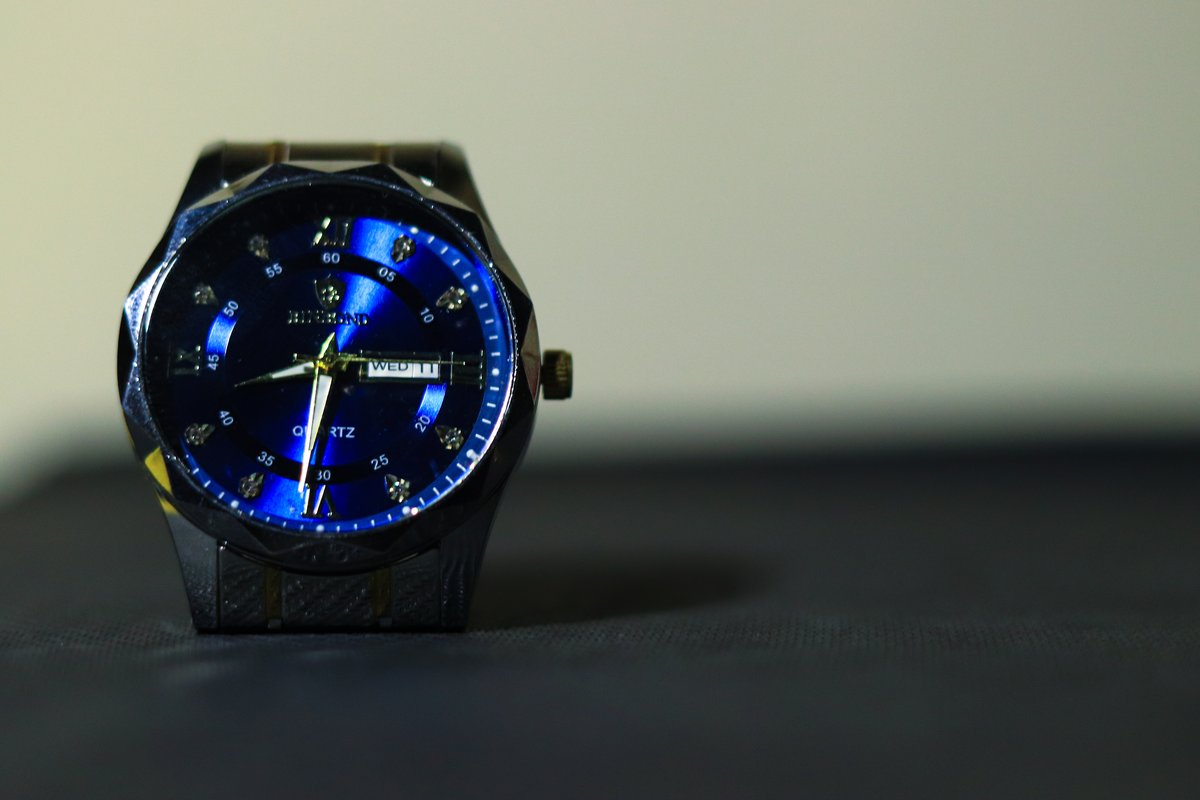
A sunburst dial is a watch dial finished with fine lines radiating from the center outward, like rays from a sun. The French term is satiné soleil, sun-satin. It is one of the most common decorative finishes in watchmaking, found at every price level. The effect is easiest to see in motion: as the wrist turns, the dial catches the light, brightening in one area while the rest stays dark, and the bright zone sweeps across the face. That shimmer is not produced by paint. It is produced by brushing, a texture worked into the surface of the dial blank before any color is applied.

How it works
The dial blank, usually brass, is mounted on a lathe and spun while an abrasive is worked across its surface from the center outward. The abrasive leaves behind fine radiating lines, thousands of microscopic grooves running from the middle of the dial to its edge. Rolex describes its own method as brushing the dial with a slightly abrasive solution, which leaves behind imperceptibly fine radiating lines. The sequence matters: the brushing comes first, and the color comes after. Once the sunburst texture is in place, the dial is colored by lacquering, electroplating, or PVD, physical vapor deposition, and then sealed with a transparent varnish. Because the color is a coating laid over the texture rather than a replacement for it, the light play of the grooves survives underneath the finished color.
The visual effect follows directly from the geometry of those grooves. Each microscopic groove reflects light at a slightly different angle, depending on where it sits around the dial and how it is oriented to the light source. When the watch is held still, the eye averages all of those reflections into a single color. When the wrist moves, the angles change, the zone of strongest reflection moves across the dial, and the shade appears to change with it. Watch people sometimes call this the dial playing with light. The underlying fact is simpler: the surface is not uniform, so it cannot reflect uniformly.
The process is industrial and quick. A dial maker can run hundreds of sunburst blanks in a shift, which is why the finish appears at every price, on department-store fashion watches and on five-figure references alike. The presence of a sunburst finish on a dial indicates nothing about the price of the watch. It indicates that the maker wanted the dial to look alive under changing light instead of flat.
Sunburst is often paired with fumé, or gradient, lacquer, in which the color darkens toward the edges of the dial. The pairing is a natural one: the brushing gives the light something to reflect from, and the gradient gives the color depth across the dial’s radius. Glashütte Original uses this pairing extensively. Its Sixties line uses galvanic, or electroplated, color over a subtle sunburst finish, and its Serenade models describe the same recipe of sunray brushing under galvanic color.
History
The sunburst story is mostly a story of two different techniques sharing one name, and the history of the finish is the history of the gap between them. The brushed sunburst described above is a surface finish applied with abrasive, developed as an industrial process: fast, repeatable, and cheap enough to apply to dials in volume. Its spread across the industry follows from that economics. A vintage Sicura with a silver sunburst dial shows how long the finish has been standard equipment across price tiers, and its presence today on everything from fashion watches to a Rolex Datejust 36 is the same fact at a later date.
Alongside it sits a true engine-turned sunburst, cut line by line on a rose-engine lathe, which is a form of hand guilloché. The problem this version solves is different: not how to finish dials quickly, but how far a cut ray pattern can be pushed as hand work. Laurent Ferrier has made platinum watches with hand-cut alternating broad and thin rays on a white gold dial, work done by a person guiding a machine, with the small irregularities that hand guidance leaves behind. Hand-cut rays have a sharpness and depth that brushing does not reproduce.
Most watches described as sunburst use the brushed kind. Some brands blur the line between the two in their marketing copy, and the distinction is worth holding onto when reading a specification sheet. The practical checks are the price of the watch and a close look at the lines themselves: regular, uniform rays at a modest price are brushed, while the depth and slight irregularity of hand-cut work appear on pieces priced for the hours they took.
Where it stands now
Sunburst remains one of the standard dial finishes across the industry, applied by brushing and colored by lacquer, electroplating, or PVD, exactly as described above. It is paired frequently with gradient lacquer, as on Glashütte Original’s Sixties and Serenade models, and it continues to appear across all price tiers without signaling cost in either direction. The engine-turned version persists as a separate, much smaller practice within hand guilloché. Sunburst sits in a family of dial finishes covered elsewhere in this section: Guilloché for the hand-cut relative, Stamped patterns for pressed textures, and Lacquered dials for how color is applied to a dial.
Sources
- FZine, The Beauty and Craft of Rolex Watch Dials
- Tatler Asia, Every Rolex Dial Is a Fusion of Craftsmanship and Innovation
- Oracle of Time, Guilloché Dial Styles
- Glashütte Original, Sixties
Thanks for reading this.