
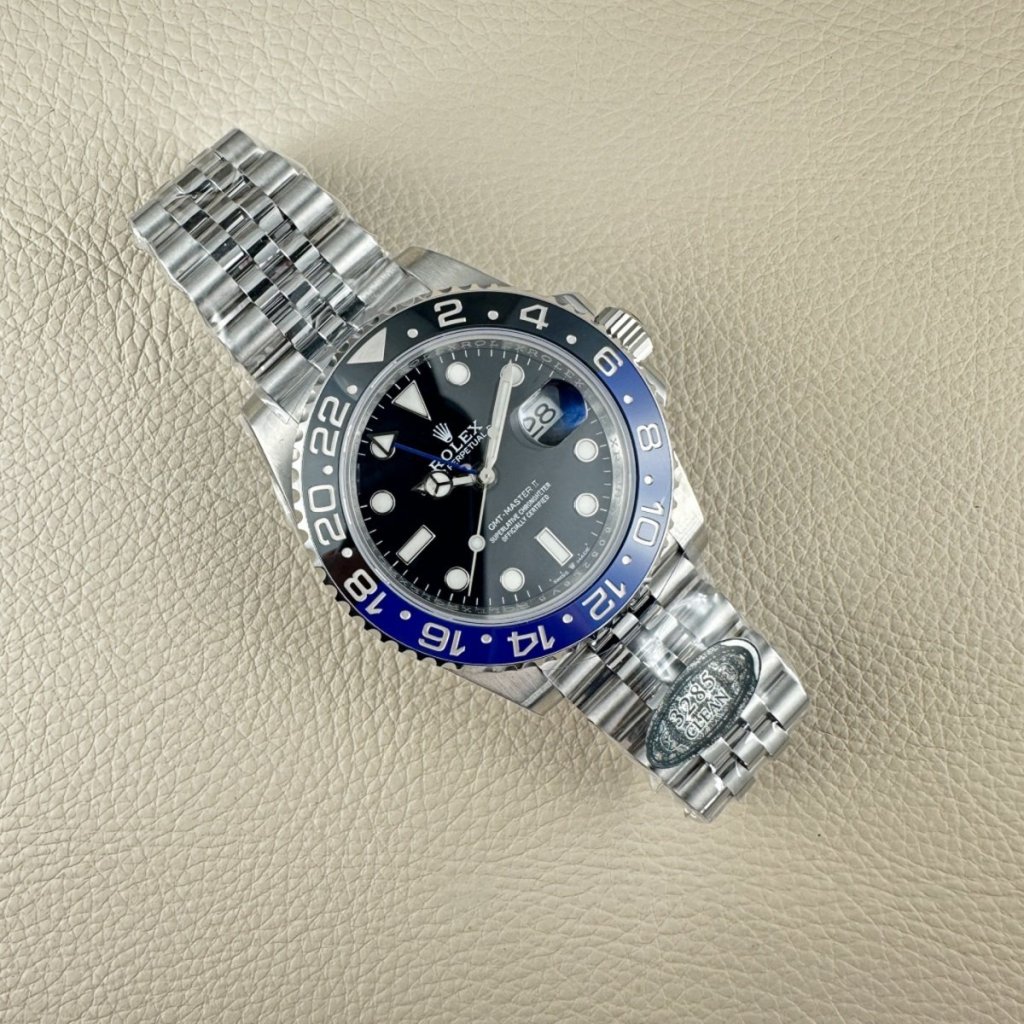
GMT stands for Greenwich Mean Time, the old name for the world’s reference time, and a GMT watch is one that tracks two time zones at once: a normal 12-hour display for local time, plus a fourth hand that circles the dial once every 24 hours, read against a rotating 24-hour bezel. The name of the complication comes from a single watch, the Rolex GMT-Master, launched in 1955 and forever associated with the Pan Am pilots who wore it. Seventy years later, every brand makes one, and most people who buy them have never flown a plane. The pilot connection is the romance. The two time zones are the point.

A Glycine Airman, the 1953 original that beat the GMT-Master to market by two years. Photo: Wikimedia Commons, CC BY-SA 3.0.
Before Rolex: the Glycine Airman
Here is the part Rolex would rather you skim over: the GMT-Master was not the first pilot’s GMT. That was the Glycine Airman, and it came from an actual pilot. In the summer of 1953, Glycine’s sales manager Samuel Glur was flying from Bangkok to Calcutta and got talking to the Thai Airways captain, Chat Brown, who told him exactly what pilots needed: a 24-hour dial with a 24-hour hand and a rotating 24-hour bezel, so they could track local time and GMT on one watch and always know whether it was day or night. Glycine built it, patented the 24-hour watch with a locking 24-hour bezel in December 1953 (patent no. 314,050), and beat Rolex to market by two years. The Airman went on to become a genuine military favorite, worn by American servicemen through the Vietnam era, and NASA astronaut Pete Conrad wore one on the Gemini 5 and 11 missions. It is still the cult favorite among people who know this story, which is the smallest and most self-satisfied club in watches, and I say that as a member.
Pan Am and the GMT-Master
In the mid-1950s, Rolex built a watch for the new problem of intercontinental pilots dealing with jet lag as flights got faster. Rolex delivered in 1955: the first GMT-Master, reference 6542. It had an additional 24-hour hand, a rotating bezel graduated for 24 hours, and a Bakelite bezel insert, chosen because the plastic would not reflect light and distract pilots. The Bakelite turned out to be extremely fragile, which is why surviving examples with intact bezels now sell for collector prices, but the watch itself became the watch Pan Am crews wore and the template for every GMT since. The red-and-blue “Pepsi” bezel, with red for daytime hours and blue for nighttime, arrived along the way and became one of the most recognizable designs in all of watchmaking. The 6542 ran on the chronometer-certified automatic caliber 1030, beating at 18,000 vibrations per hour, in a 38mm case with no crown guards. It looks, from the front, almost exactly like the GMTs Rolex sells today, which tells you how completely Rolex got it right the first time.
How a GMT works
The mechanics are beautifully simple. The fourth hand is geared to make one full revolution every 24 hours instead of every 12, so it points at a 24-hour scale rather than a 12-hour one. Set it to your home time zone, set the regular hands to local time, and the rotating bezel gives you a third option: turn it and the 24-hour hand can read a third zone off the bezel. There are two schools of how the hands are adjusted. On the original style, sometimes called a “caller” GMT, the 24-hour hand is the one you set independently, and the regular hands set local time together. On the “flyer” or true GMT, introduced by Rolex with the GMT-Master II in 1982 and its caliber 3085, the 12-hour local hand jumps forward or backward in one-hour steps without stopping the watch, while the 24-hour hand stays put on home time. The flyer version is the traveler’s choice: you land, you click the hour hand forward a few jumps, the minutes and seconds keep running undisturbed, and you are done. It is one of those small mechanical pleasures that makes people irrationally fond of a watch.

A Rolex GMT-Master reference 1675 with the red-and-blue “Pepsi” bezel, red for day, blue for night. Photo: Wikimedia Commons, CC BY-SA 4.0.
The lineage
After the 6542 came the reference 1675 in 1959, which replaced the Bakelite bezel with metal and stayed in production for over two decades, becoming the GMT most people picture. The GMT-Master II arrived in 1982 with the independently adjustable local hour hand. Since then the line has cycled through every bezel color combination the market will bear, from the black-and-blue “Batman” to the brown-and-black “Root Beer,” but the architecture has barely changed. That is the thing about the GMT: it was designed correctly in 1955, and nobody has found a reason to redesign it. If you want all the world’s time zones at once instead of two, that is the world time watch, a different animal. If you want the second zone on a second 12-hour hand instead of a 24-hour one, that is the dual time. The GMT sits between them, the simplest and most popular answer to the traveler’s question.
Why it matters
The GMT matters because it was the first watch complication built for the jet age, and it is still the best answer for the person who actually travels. The jet lag Pan Am was worried about is real, the home-time hand really does keep you from calling your family at 3 a.m., and the bezel really does give you a third zone for free. Most complications are solutions to problems nobody has anymore. This one solves a problem that millions of people have every single day, which is why the GMT-Master is one of the few complicated watches you will regularly see on actual wrists in actual airports. That is the highest compliment a complication can get.
Thanks for reading this.

