
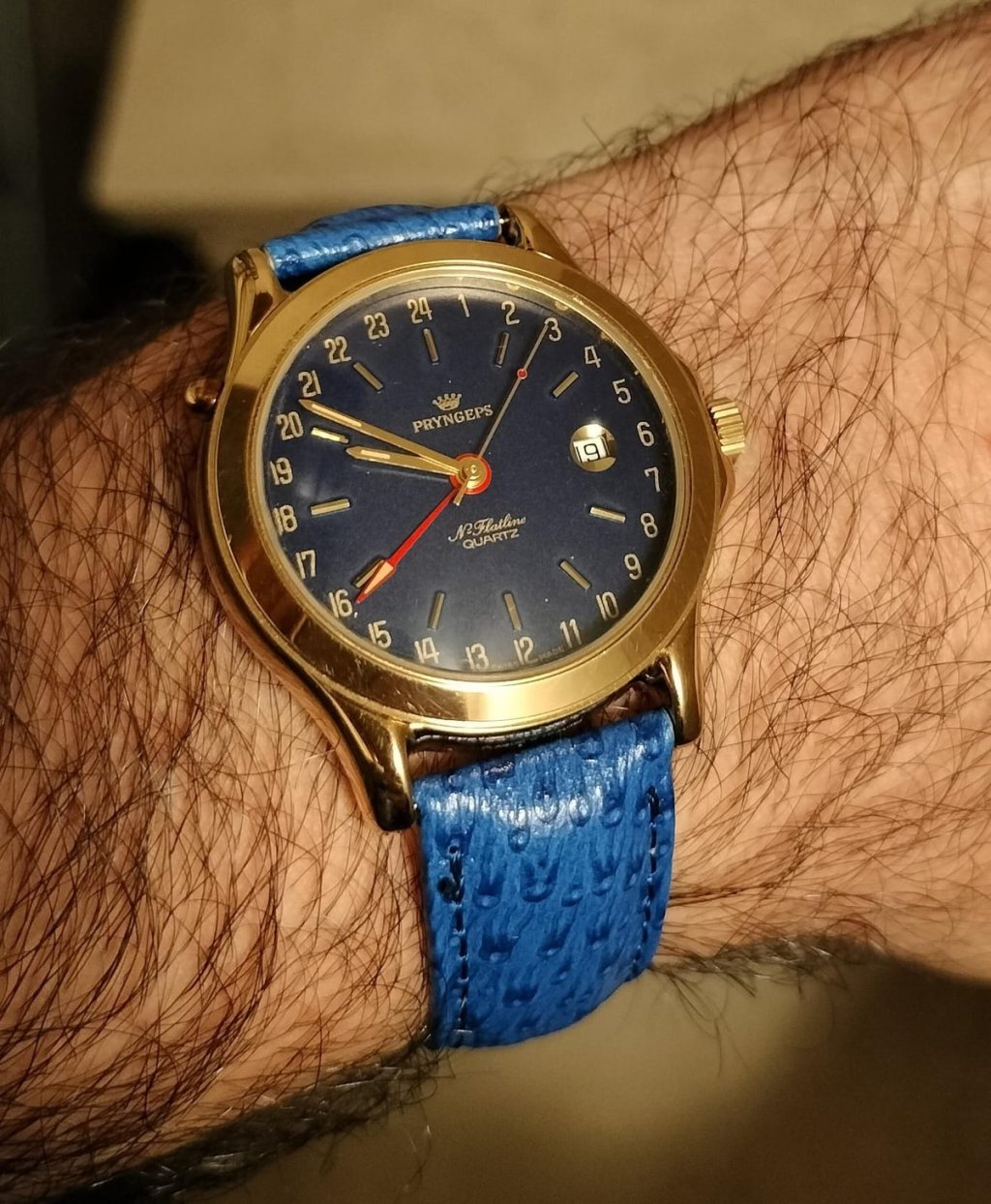
A dual-time watch shows two time zones with two hour hands sharing one dial: one hand for where you are, one for where you live. Where a GMT tracks home time on a 24-hour hand, the dual time gives the second zone its own 12-hour hand, usually skeletonized so you can tell it apart, that you can jump forward or backward in one-hour steps as you travel. It is the travel watch for people who find the GMT’s 24-hour math one calculation too many.
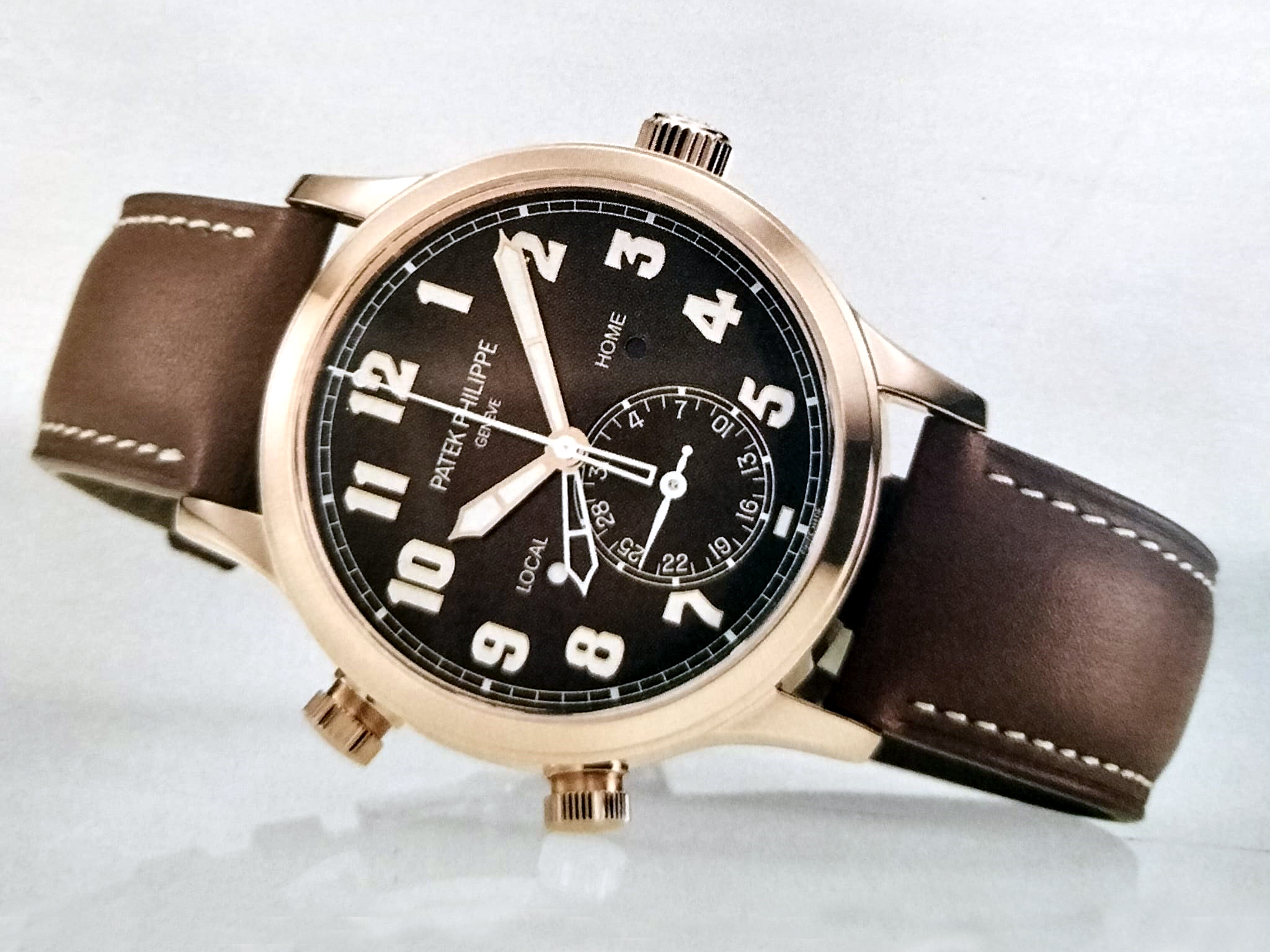
A Patek Philippe Calatrava Travel Time: two hour hands on one dial, local and home. Photo: Wikimedia Commons, CC BY-SA 4.0.
Cottier does it again
Once again, the trail leads back to Louis Cottier, the Geneva independent who invented the world-time watch. Patek Philippe, which had spent the 1930s and 40s building its reputation on Cottier’s world timers, wanted something simpler for travelers: not every time zone, just two. The answer was the reference 2597, introduced in 1958 under the name “Cross Country.” The first series had a single hour hand that could be jump-set in one-hour steps via a pusher, which was useful but half the idea. By the early 1960s, the second series added the second hand: a blued-steel auxiliary hour hand that could be adjusted with tiny pushers on the case side, all without stopping the watch and without taking it off your wrist. When you were not traveling, the auxiliary hand could be parked directly underneath the local hour hand and forgotten. The movement was Patek’s hand-wound 12”’400 HS, and the concept was protected by a 1959 Swiss patent for a “time zone watch.” The 2597 is the genesis of every twin-hand travel watch Patek has made since, and it is also a reminder that the best complications are the ones you can set with the watch still on your wrist.
How it works
The layout is the same across almost every dual-time watch. The solid hour hand shows local time, the time where you are standing. The skeletonized or differently colored auxiliary hand shows home time, or whatever second zone you care about. When you land somewhere new, you press the pushers (usually at 8 and 10 o’clock on modern Pateks) to jump the local hour hand forward or backward in one-hour steps. The minutes and seconds keep running undisturbed, which means the watch never loses its accuracy while you are fiddling with it, and the home-time hand stays exactly where it was. Most dual-time watches add day/night indicators for both zones, little apertures or subdials, because the one thing a 12-hour hand cannot tell you is whether it is 2 a.m. or 2 p.m. back home, and that is precisely the information that matters when you are deciding whether to call. Modern Patek Travel Time calibers, like the 324 S C FUS in the Aquanaut Travel Time, do all of this automatically and elegantly. In 2022, Patek combined the system with an annual calendar in the Ref. 5326G, a movement with eight patents, because apparently the regular Travel Time was not complicated enough for Geneva.
Other takes on two zones
Jaeger-LeCoultre’s Master Geographic takes a different approach: local time on the main dial, and a subdial ringed with city names showing the second zone, which keeps the dial cleaner than two stacked hands. A. Lange & Söhne’s Lange 1 Time Zone, introduced in 2005, is arguably the most thought-through dual-time watch ever made: the main off-center dial shows home time, a smaller subdial at the bottom right shows the second zone with its own day/night indicator, and a rotating city ring around the subdial lets you select the zone with a pusher, each press advancing the city and the hour together. The second generation, from 2020, even added a daylight-saving indication. Patek also puts the Travel Time system into the Nautilus, the reference 5990 Travel Time Chronograph, which is a dual-time flyback chronograph with an annual calendar’s worth of functions crammed into a sports watch. At some point the travel watch stops being a tool and becomes a demonstration, but it is a very good demonstration.

The Patek Philippe Nautilus Travel Time Chronograph ref. 5990 (2014): dual time plus flyback chronograph in a sports watch. Photo: Wikimedia Commons, CC BY-SA 4.0.
Why it matters
The dual time matters because it is the most human of the travel complications. The GMT gives you a 24-hour hand that requires a moment of mental arithmetic. The world timer gives you every zone and expects you to find yours. The dual time just shows two ordinary hour hands, one for here and one for home, and lets you move one of them when you land. It is the complication that best understands what a traveler actually needs: not more information, but the right information, readable at a glance, adjustable without stopping the watch. Cottier figured that out in 1958, and nobody has improved on the idea since.
Thanks for reading this.

