
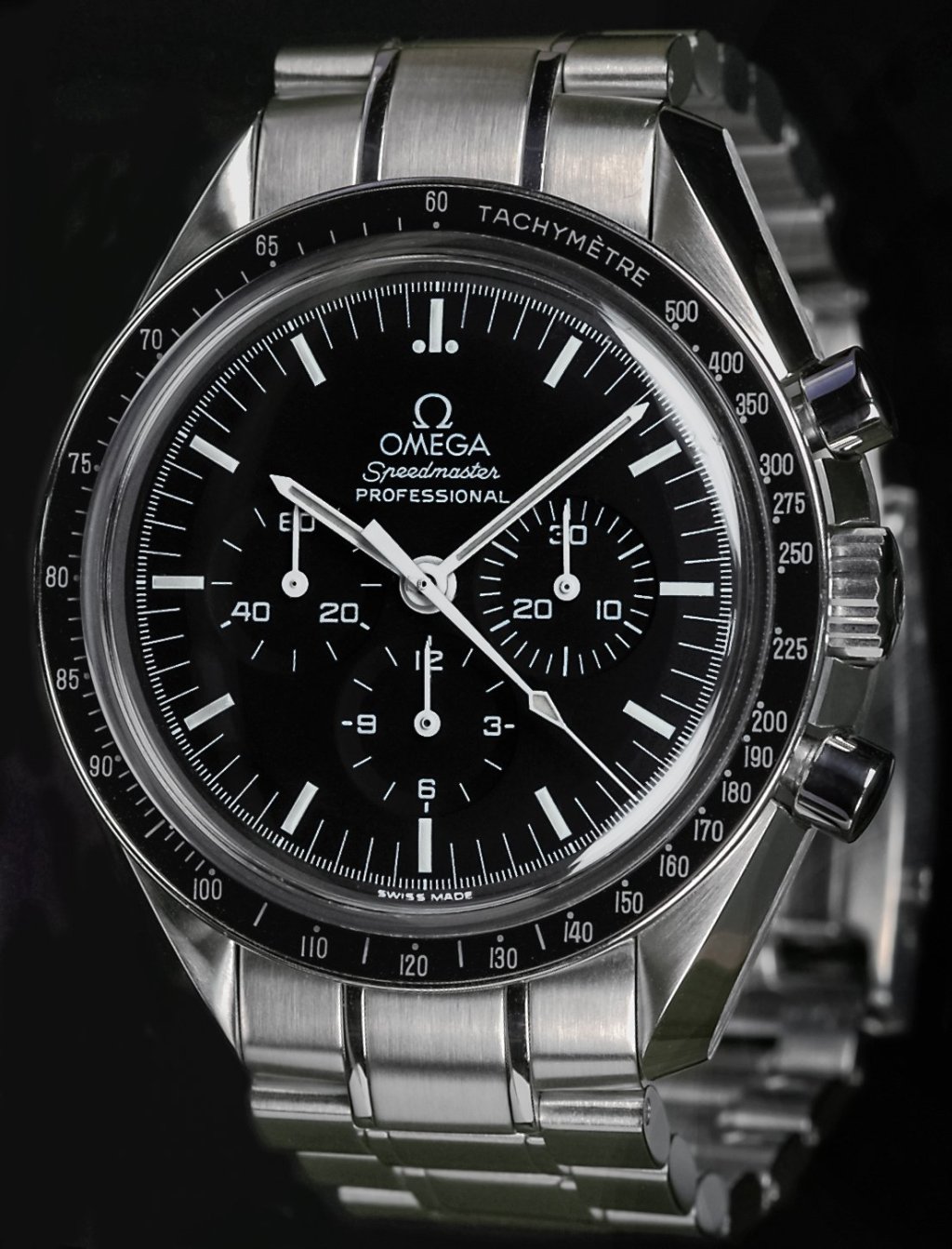
A chronograph is a watch with a built-in stopwatch. Push a button and a second hand starts sweeping; push again and it stops; push a third and it snaps back to zero. The subdials count the minutes and hours of whatever you are timing. The word comes from the Greek chronos (time) and graphein (to write), and the original chronograph really did write: it marked the time in ink on a rotating dial. Two hundred years later, it is still the most popular complication in watchmaking, and the one most people will never use for its intended purpose. That egg timer on your phone is not going anywhere.

Nicolas Rieussec’s original 1821 chronograph, the ink-dropping “time writer” that gave the complication its name. Photo: Wikimedia Commons, CC BY-SA 3.0.
Rieussec, and the 2013 plot twist
For nearly two centuries, the story was simple: the chronograph was invented by Nicolas Mathieu Rieussec, watchmaker to the French royal court, who unveiled it in 1821 at a horse race on the Champ de Mars in Paris. His device was a wooden case containing a watch movement that drove two enamel discs, one for seconds and one for 30 minutes. Above the discs sat a hand tipped with ink-filled nibs. When a horse crossed the finish line, the timekeeper pressed a button, the nibs dropped onto the spinning discs, and each horse’s running time was literally written in ink. The racing directors loved it and made it their official time-measuring device; the French patent office granted Rieussec his patent in the spring of 1822. He named it the chronograph, the time writer, and the name stuck to every stopwatch made since, even though almost none of them write anything. Then, in 2013, the story got a wrinkle. A pocket instrument by the French watchmaker Louis Moinet, made in 1816 for timing astronomical observations, turned out to measure time to 1/60th of a second with a central seconds hand and subdials, five years before Rieussec. So Moinet built the first chronograph-like device, and Rieussec coined the name and got the patent. History credits both, which is more than most watchmakers get.
How a chronograph works
Inside, a chronograph is two machines sharing one case. The base movement keeps time as usual. The chronograph mechanism sits on top of it, connected by a clutch that engages when you press start and disengages when you stop. There are two classic ways to build the switching. The older one is the column wheel, a little rotating castle whose notches sequence the start, stop, and reset levers. It is precise, it gives the pushers a crisp feel, and it is beautiful to look at, which is why the high end still uses it. The newer one, dominant since the 1970s, is cam or lever switching, cheaper to make and easier to assemble, and the backbone of mass-produced chronographs like the Valjoux 7750 of 1973, the most produced chronograph movement ever made. The clutch comes in two flavors too. A horizontal clutch slides the chronograph gears into mesh with the drive train, and you can sometimes see the seconds hand jump slightly when it engages. A vertical clutch stacks the gears on one axis so they engage smoothly, with no jump, and it lets the chronograph run continuously without extra wear, which is why modern designs favor it. Resetting works by swinging hammers onto heart-shaped cams on the chronograph wheels, forcing every hand back to zero in one snap. It is a small mechanical miracle, and it happens every time you press the bottom pusher.
The 1969 race
The great drama of the chronograph is the race for the first automatic, and it is still argued about. By the late 1960s, automatic winding was standard for ordinary watches but nobody had managed to apply it to a chronograph. Three contenders went at it in 1969. Zenith announced first, unveiling the El Primero on January 10: a fully integrated automatic chronograph beating at 36,000 vibrations per hour, fast enough to measure tenths of a second, with a column wheel and a date. The Chronomatic consortium of Heuer, Breitling, Hamilton-Buren, and Dubois Dépraz launched the Caliber 11 in March. And Seiko, working alone in Japan, quietly put the automatic column-wheel Caliber 6139 on sale in May. So who was first? Zenith announced first, Seiko sold first, and the consortium reached the global market first, depending on how you count. The honest answer is that all three won something, and the pedantry about it has kept forums busy for decades. The El Primero’s own story has the best ending: when the quartz crisis hit and Zenith’s new owners ordered the tooling destroyed, a watchmaker named Charles Vermot hid the presses and plans in an attic, and the movement came back to live again. Rolex used the El Primero in the Daytona from 1988 to 2000, detuned to 28,800 beats per hour with the date removed, which is about as strong an endorsement as a movement can get.

The Zenith El Primero, the 1969 high-frequency automatic chronograph, seen from the back. Photo: Wikimedia Commons, CC BY-SA 2.0.
The landmarks
A few chronographs stand above the rest. The Omega Speedmaster, introduced in 1957, went to the moon in 1969 and became the Moonwatch, the most famous chronograph on Earth and, briefly, off it. The Heuer Carrera of 1963, designed by Jack Heuer for race drivers, is the clean-dialed ideal of the racing chronograph. The Rolex Daytona, also 1963, started as a slow seller and became the most hyped watch in the world, which is a whole separate article. The Breitling Navitimer of 1952 wrapped a slide-rule bezel around a chronograph for pilots doing fuel and distance math in the cockpit. Two harder variants get their own articles: the split-seconds chronograph, which times two events at once, and the flyback chronograph, which resets and restarts in a single push. And the dial layouts developed their own language: the tachymeter scale for measuring speed over a known distance, the pulsometer for doctors counting heartbeats, the telemeter for judging how far away a storm is by the gap between lightning and thunder. Most of these scales are decorative now, since nobody does cockpit math with a bezel anymore, but they look fantastic, which has always been at least half the point.

The Omega Caliber 321, the column-wheel chronograph movement that went to the moon. Photo: Wikimedia Commons, CC BY-SA 2.0.
Why it matters
The chronograph matters because it is the complication that turned the watch from a passive instrument into an active one. A time-only watch tells you what time it is. A chronograph lets you measure something, time a lap, a steak, a parking meter, and that interactivity is why it outsells every other complication combined. It is also the complication that best shows what mechanical watchmaking is for: nobody needs a mechanical stopwatch in the age of the smartphone, and yet the column wheel still clicks, the hammers still fall, and the hands still snap to zero with a satisfaction no touchscreen has ever matched. Rieussec’s ink dots are long dry. The idea is not.
Thanks for reading this.

