
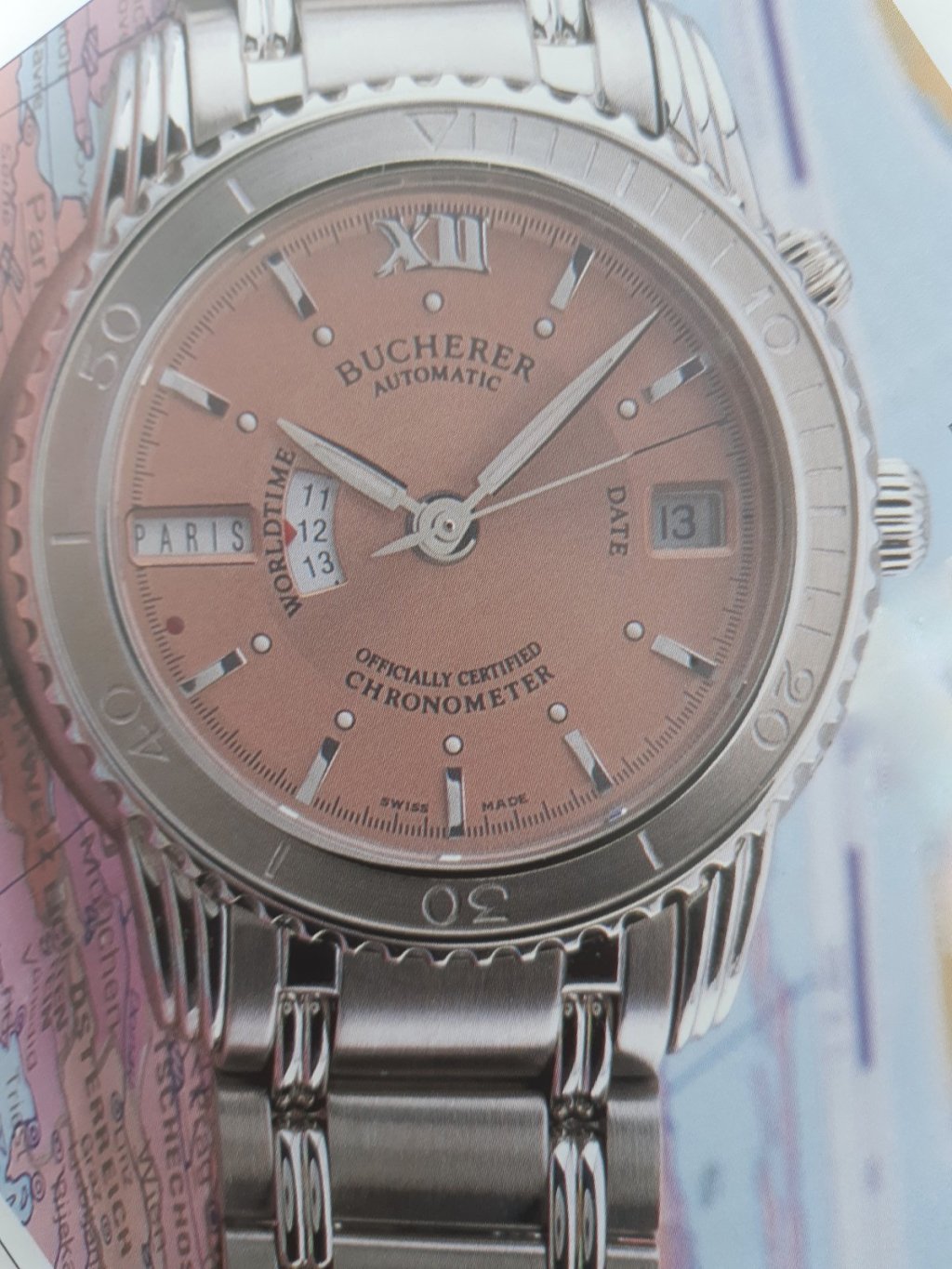
A world-time watch shows the time everywhere at once. The central hands tell local time, like any watch. Around them sits a ring marked with the names of the world’s great cities, London, New York, Tokyo, Sydney, and a 24-hour ring rotating beneath it, so that at a glance you can read the correct hour in every time zone on the planet. If the GMT answers the traveler’s question of “what time is it back home,” the world timer answers the harder one: “what time is it everywhere.”

A Patek Philippe World Time ref. 1415 with a cloisonné enamel map dial, late 1940s: the city ring around a painted world. Photo: Wikimedia Commons, CC BY-SA 4.0.
Louis Cottier’s invention
The world time wristwatch was invented by one man working in a room behind his wife’s bookshop. Louis Cottier (1894-1966) was a Geneva watchmaker who, in 1931, solved a problem that had been bothering watchmakers for a century: how do you show every time zone on a dial small enough to wear? Earlier attempts were cramped and illegible, cities crammed around a 24-hour dial that nobody could read. Cottier’s answer was the heures universelles, universal time. Local time would be shown at the center with ordinary hands. The hour hand would be linked to a 24-hour ring that rotated counterclockwise, half a turn for every full turn of the hour hand. And around the whole thing would sit a fixed ring with the names of the 24 cities that anchored the world’s time zones. As the hours passed, the 24-hour ring moved in step with the hands, and since the minute hand is the same everywhere on Earth, you could read the correct time in any city at a glance. It is one of those inventions that looks obvious the moment you see it, which is the mark of the genuinely clever ones.
The big houses come calling
Cottier’s first world-time pieces were pocket watches, made for a jeweler, because in 1931 the pocket watch was still where the money was. But the big Swiss houses noticed fast. In 1932, Vacheron Constantin commissioned the first of his mechanisms, a pocket watch. By 1937, Patek Philippe came calling, and the wristwatch versions began: the rectangular Ref. 515 HU and the Ref. 96 HU in a Calatrava case, HU for heures universelles. The 96 HU went on to become one of the most collectible Patek Philippe watches ever made. Cottier would go on to deliver around 380 world-time movements to Patek Philippe between 1937 and 1965, most of them built under his direct supervision, and his mechanism also went into watches for Rolex, Agassiz, and others. Between 1939 and 1964, Patek and Cottier made just 95 examples of the Ref. 605 HU, many with cloisonné enamel dials painted with whole continents, and those are now among the finest horological artifacts money can buy. A platinum world-time Patek from 1946 once held the record for the most expensive wristwatch ever sold at auction. All of it traces back to the room behind the bookshop.
How a world timer works
The bones of Cottier’s 1931 design are still visible in every world timer made today. The central hour and minute hands show local time. They are linked to the 24-hour ring, which turns counterclockwise in step with the hour hand. Around the outside, the city disk carries the names of the reference cities, one per time zone. To read the time anywhere, you line up your local city with 12 o’clock, and every other city on the ring sits opposite its correct hour on the 24-hour scale. The 24-hour ring is usually split into light and dark halves, so you can see at a glance whether it is day or night in that city, which is the detail that makes the display genuinely useful instead of merely impressive. Cottier kept refining the system: in 1953 he added the ability to adjust the city disk via a second crown, and in 1958 Patek patented a system for jumping the hour hand without stopping the movement. Modern world timers from Patek Philippe, Vacheron Constantin, and Breguet’s Hora Mundi all run on Cottier’s logic, with refinements like push-button city selection and day/night indicators. The cities have been updated over the decades as time zones shifted and names changed, which means a world-time dial is quietly a little history book of geopolitics.
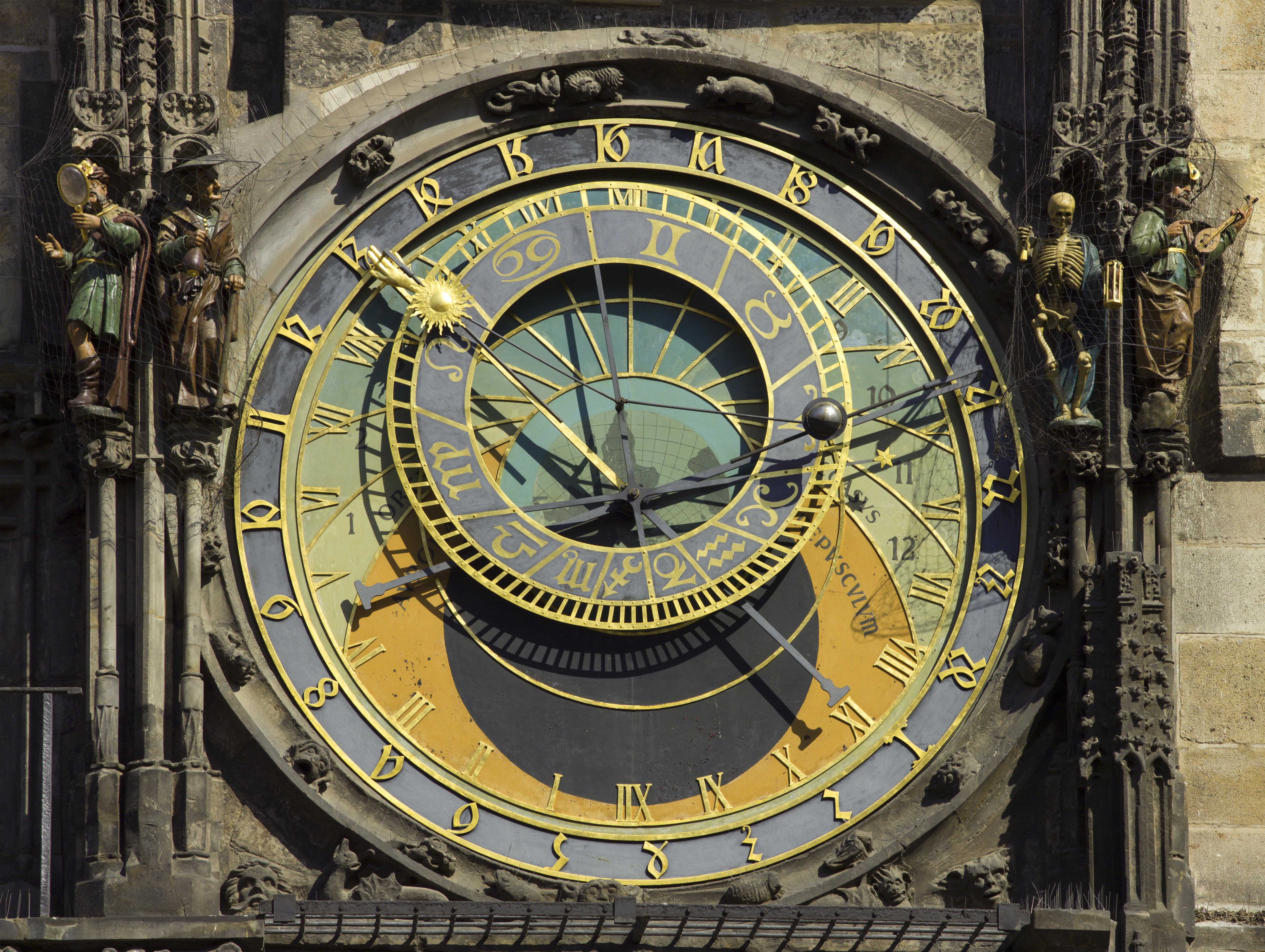
The Prague astronomical clock: the medieval ancestor of the idea that one dial can hold the whole sky’s worth of time. Photo: Wikimedia Commons, CC BY-SA 4.0.
Why it matters
The world timer matters because it is the most complete answer watchmaking ever gave to the question of what time it is. A GMT tells you two zones. A world timer tells you all of them, on a dial you can read in two seconds, using a mechanism invented before commercial air travel existed. It was designed for a world where crossing time zones took weeks by ship, and it turned out to be perfect for a world where it takes hours by plane. Cottier invented it in a back room and the great houses of Geneva spent the next century polishing his idea. Some inventions get replaced. This one just got enamel dials.
Thanks for reading this.

