
The date window is the most common complication in the world and also the most argued about. A little number at 3 o’clock, often under a magnifying bubble, that flips over at midnight. It seems like the simplest thing a watch can do beyond telling time. But before 1945, no self-winding wristwatch did it automatically, and the watch that changed that became the template for nearly everything since.

A Rolex Datejust: the date window at 3 under the Cyclops magnifier, a layout that has barely changed since 1945. Photo: Wikimedia Commons, public domain.
The Datejust, 1945
Rolex introduced the Datejust in 1945 to mark the company’s 40th anniversary, launching it as the reference 4467 in solid gold on the new five-link Jubilee bracelet. Its claim, repeated in every history since, is that it was the first self-winding wristwatch with a date that changed automatically at midnight. The “Datejust” name did not actually appear on the dial until the 1950s references, but the formula was set from day one: date window at 3, instant change at midnight, waterproof Oyster case. The Cyclops magnifier over the date arrived in 1953 and became just as iconic as the window itself. Love it or hate it, the Datejust made the date window the default expectation for a wristwatch, and most of the industry has been copying the homework ever since.
How the date actually works
Under the dial sits a date wheel with 31 teeth, one for each day of the month, driven off the hour wheel through reduction gearing so it creeps forward all day. A jumper spring holds it in place until midnight, when the mechanism snaps it to the next number. Early date mechanisms dragged the wheel slowly through the change, so the date would sit crooked for an hour or two around midnight. Modern ones snap it over in minutes or instantly. One piece of practical advice that has survived every generation of date watches: avoid setting the date while the mechanism is engaged, roughly between 9 in the evening and 3 in the morning, because forcing the wheel while the gears are mid-change can damage them.

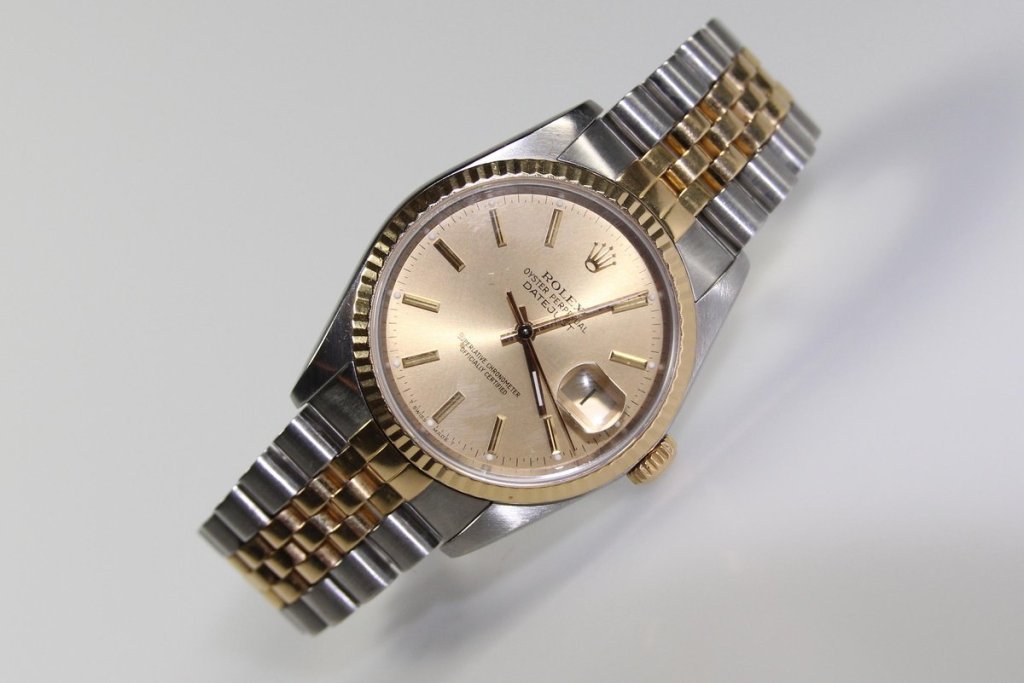
A two-tone Datejust 16013 from the 1980s: the quickset date, which arrived in the late 1970s, made setting the date a matter of seconds. Photo: Wikimedia Commons, CC0.
Quickset and the alternatives
The great quality-of-life upgrade was the quickset date, which lets the crown spin the date wheel independently of the time. Rolex introduced it on the caliber 3035 in 1977, and within a few years it was industry standard. Before that, setting the date on the 1st of the month meant winding the hands through up to 31 days, a monthly ritual owners of vintage watches still remember with mixed feelings. The date also comes in other flavors. The pointer date uses a hand that points to numerals printed around the dial edge, a format Oris has kept alive since the Big Crown Pointer Date of 1938. And when one small window is not enough, there is the big date, which doubles the digit size with two discs. Purists will also note the calendar’s blind spot: a simple date has no idea that some months are shorter, which is where the annual calendar and perpetual calendar pick up the slack.
Why it matters
The date matters because it is the complication most people actually use. Nobody needs a moonphase to catch a train, but plenty of people glance at their wrist to check the date before writing it on a form. It is also the great divider in watch design: date versus no-date is one of the first decisions a buyer makes, and collectors will argue about a window ruining dial symmetry until closing time. All of that passion over a little number that flips at midnight. The Datejust earned it.
Thanks for reading this.

