
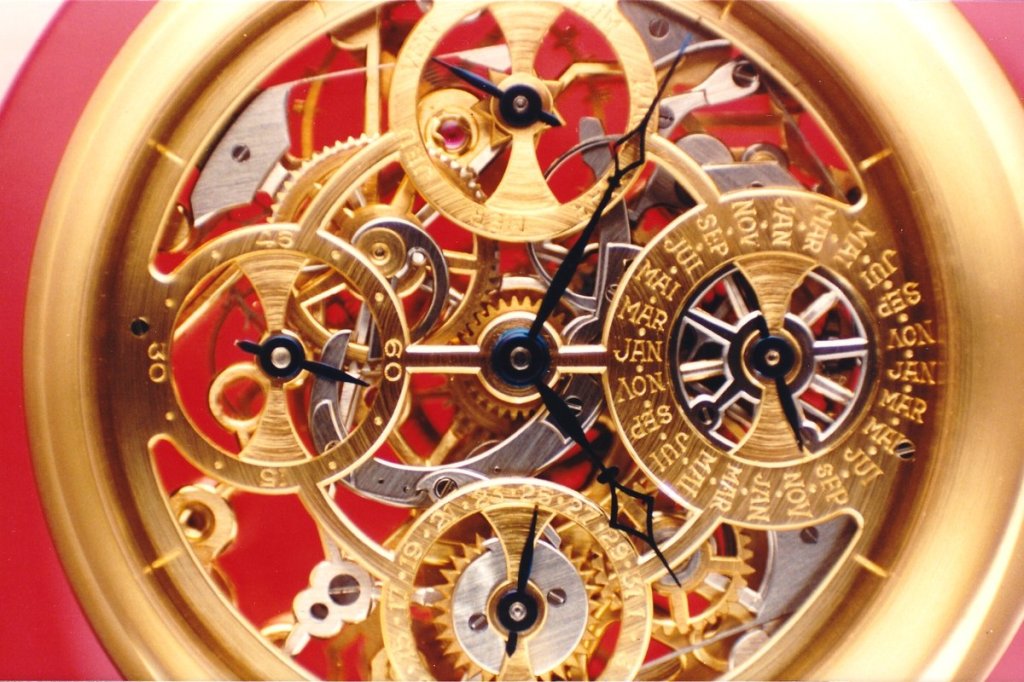
A perpetual calendar is a mechanical watch that always shows the correct date, day, and month without being adjusted for months of different lengths, and that remembers the leap day every four years. If you keep it wound and running, you only need to correct it in years like 2100, when the Gregorian calendar skips a leap year. It is one of the grand complications of watchmaking, and it is also a solution to a problem that a quartz watch solved for about thirty dollars back in the seventies. That has not stopped anyone from wanting one.

A Patek Philippe Nautilus Perpetual Calendar ref. 5740 in white gold, the thinnest Nautilus ever made. Photo: Wikimedia Commons, CC BY-SA 4.0.
Thomas Mudge and the first calendars
The perpetual calendar was not invented by a Swiss brand, whatever the marketing would have you believe. It was invented in 18th-century England by Thomas Mudge, the same watchmaker who gave us the lever escapement. An example of his perpetual calendar pocket watch from 1762 survives, and it may be the oldest one ever made. The Swiss took a while to catch up: one of the earliest Patek Philippe perpetual calendars is a pocket watch from 1864, now in the company museum, and Patek patented its own perpetual calendar mechanism in 1889. So the complication is old. What is newer is the idea of putting it on a wrist, which turned out to be much harder, because a wristwatch movement is roughly the size of a coin and a perpetual calendar mechanism is essentially a mechanical computer.
Patek’s wristwatch firsts
Patek Philippe claims the first perpetual calendar wristwatch, and the story behind it is almost embarrassingly casual. The company made the movement in 1898 for a women’s pendant watch, which then sat unsold because nobody wanted it. In 1925, someone at Patek had the bright idea of putting that orphaned movement into a wristwatch case, and the Ref. 97975 was born: a 34.4mm yellow gold watch that was the world’s first perpetual calendar wristwatch. It sold in 1927 to an American collector named Thomas Emery. That was a one-off, though. Serial production started with the hand-wound Ref. 1526 in 1941, a perpetual calendar with moonphase, and the same year Patek launched the Ref. 1518, the first serially produced perpetual calendar chronograph. In 1962 came the Ref. 3448, the first automatic perpetual calendar wristwatch. The steel Ref. 1518, by the way, became for a time the most expensive wristwatch ever sold at auction, about CHF 11 million at Phillips in November 2016, a record Paul Newman’s Rolex Daytona broke the following year, which tells you something about what this complication does to collectors.
How the mechanism works
At the heart of most perpetual calendars is a wheel with 48 notches, one for each month of a four-year cycle: three regular years plus a leap year. It rotates once every four years, and a lever samples the notches one by one. The rule is simple: the deeper the notch, the sooner the mechanism moves on to the first of the next month. The deepest notches are the four Februaries, and one of those four is cut very slightly shallower than the others, marking the leap-year February that gets a 29th. This is the mechanical memory of the watch, a little program etched in steel that knows how many days every month has for an entire century. What it cannot know is the Gregorian exception: years like 2100, 2200, and 2300 are not leap years, despite being divisible by four, so a conventional perpetual calendar needs a manual correction on those dates. Some modern makers sidestep the problem entirely. The IWC Da Vinci of 1985, designed by Kurt Klaus, is programmed for a 400-year cycle and needs no correction until the year 2499. And A. Lange & Söhne built a variant for the Lange 1 Perpetual Calendar that replaces the notched wheel with a rotating month ring sampled by a lever, doing the same job in a completely different way.

An Audemars Piguet perpetual calendar dial: day, date, month, moonphase, and the leap-year cycle, all on one face. Photo: Wikimedia Commons, CC0.
What nobody tells you
There are two things nobody tells you when they are selling you a perpetual calendar. The first is that it only works if the watch keeps running. Let it stop for a month and you get to reset everything with tiny corrector pushers around the case, usually with a wooden toothpick, while taking care not to adjust it during the hours when the date is changing or you risk damaging the mechanism. It is like owning a very expensive tamagotchi. The second is that the watch will outlive the need for its own party trick: the 2100 correction is real, and most of us will not be around to see whether the person who inherits the watch knows how to do it. None of this has dented the complication’s appeal. If anything, the fussiness is part of it.
Why it matters
The perpetual calendar matters because it is the most ambitious version of the calendar itself, the thing every watch does and most do badly. It takes a problem that is genuinely irregular, the uneven lengths of months, the leap-year exception to the four-year rule, the century exception to that, and encodes all of it in cams and levers small enough to hide under a dial. It will keep being right about February long after everyone who bought it is gone, which is either beautiful or a monumentally expensive way to avoid tapping a date button four times a year. Probably both. The best complications are.
Thanks for reading this.

