
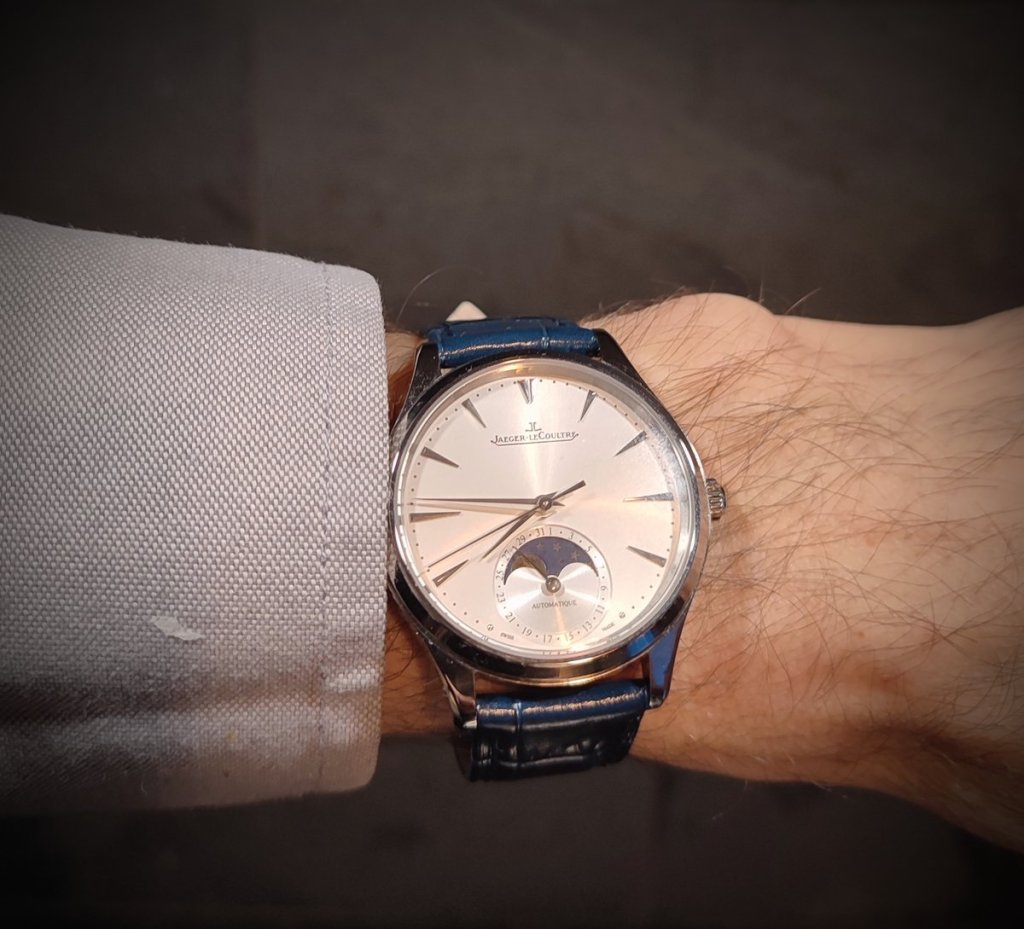
A moonphase display shows the current phase of the moon on the dial, usually as a little golden moon gliding past an aperture. It is the most openly decorative complication in watchmaking: nobody is checking a wristwatch to find out whether the moon is waxing, because you can just look up. The display exists because the moon is beautiful and because watchmakers have been putting it on timepieces for about seven hundred years, and that is a better reason than most.
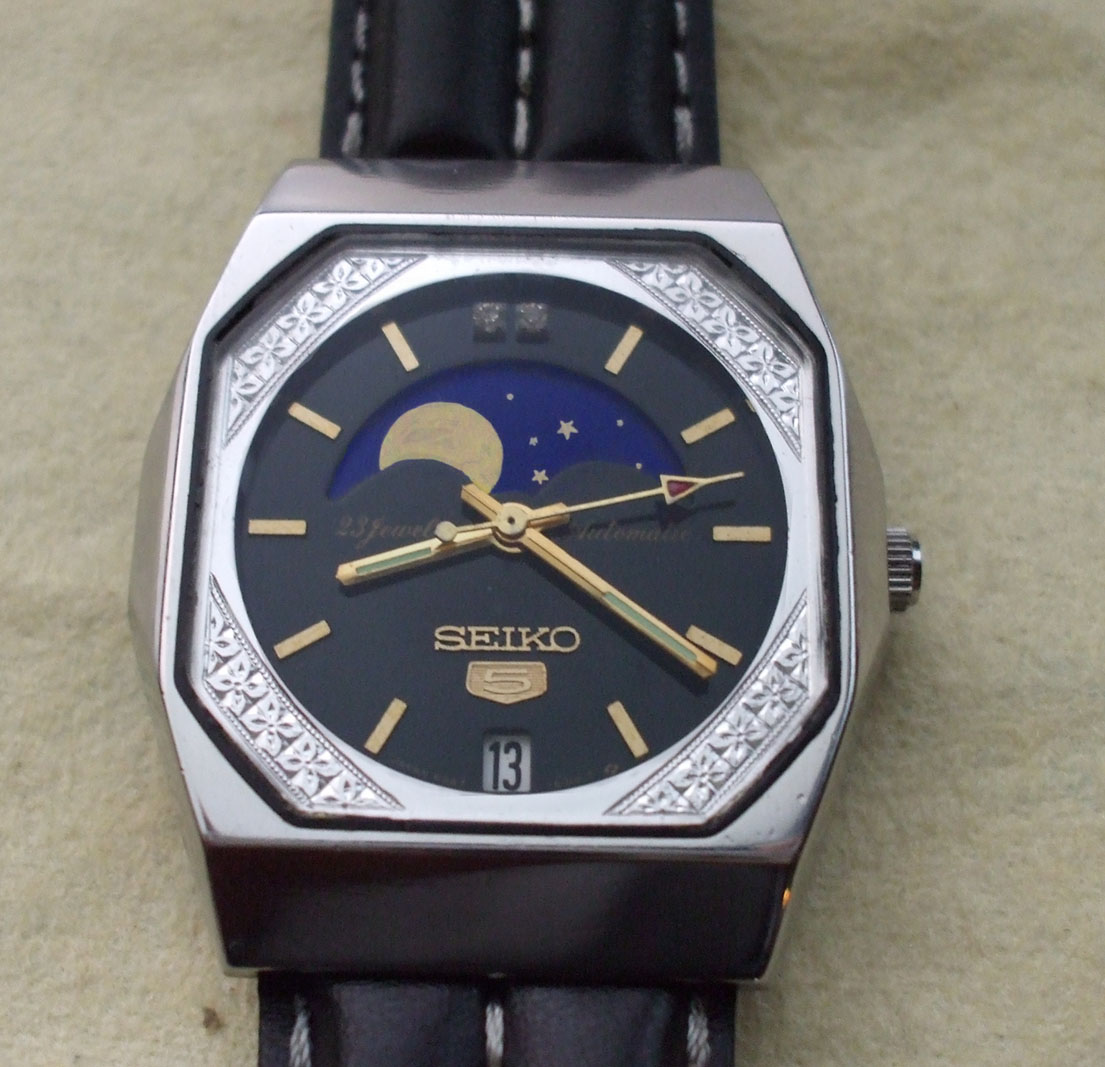
A moonphase display on a wristwatch dial: the golden moon in its aperture, doing its slow monthly crawl. Photo: Wikimedia Commons, CC BY-SA 4.0.
Seven centuries of the moon on the dial
The moonphase started long before wristwatches, long before pocket watches, long before pretty much anything you would recognize as a clock. In 1327, Richard of Wallingford, the Abbot of St. Albans, began work on an astronomical clock for his abbey that showed the positions of the stars, the sun, and the moon complete with its phases. The display migrated down through the centuries: from monumental clocks to weight-driven wall clocks, to spring-driven table clocks, and by the Renaissance to pocket watches. In the late 17th century, pocket watches showing the hours, the date, and the phases of the moon were in high favor with devotees of astronomy and astrology. By the 20th century, the complication had become what it remains today: essentially romantic. The first moonphase wristwatches appeared in the 1920s, usually paired with a complete calendar, and it became a specialty of Patek Philippe, which made some of the great mid-century examples like the Ref. 1526, alongside smaller houses like Record Watch and Angelus. Then, in 1985, Kurt Klaus, the head watchmaker at IWC Schaffhausen, debuted his perpetual calendar in the Da Vinci ref. 3750, and its astronomical moonphase, accurate to one day in 577.5 years, reset expectations for what a moonphase could do. The version showing the moon’s phase as seen from both the northern and southern hemispheres came later, on the 2003 Portugieser Perpetual Calendar.
How the mechanism works
Under the dial sits a disc printed with two moons, half of it hidden behind the dial, with an aperture that reveals one moon at a time. The disc is geared to the hour wheel and advances slowly, completing one full rotation per lunar month. The trick is what you count as a lunar month. The basic version uses a 59-tooth wheel, two teeth per day, which approximates the month at an even 29.5 days. The real synodic month is 29 days, 12 hours, 44 minutes, and 3 seconds, so the cheap version drifts a full day off in about two years and eight months. Fancier versions gear it closer. The A. Lange & Söhne Lange 1 Moon Phase uses a more elaborate wheel train that tracks the true lunar cycle so closely it only needs correcting once every 122.6 years. Rolex did something similar with the Cellini Moonphase in 2017, quoting 122 years. That is a lot of engineering to get the moon right, and it is worth saying plainly: it makes no functional difference to anyone. The moon is up there whether the disc is accurate or not. But accuracy is the game watchmaking plays, and the moonphase is one of its prettiest scoreboards.

An animated diagram of how a moonphase disc advances through its monthly cycle. Photo: Wikimedia Commons, CC BY-SA 4.0.
Landmark examples
Patek Philippe owns the moonphase’s modern history. The Ref. 1526 of 1941, a perpetual calendar with moonphase, is one of the most collected watches in existence. Rolex’s moonphase story is stranger: the brand made triple-calendar moonphase watches in the 1950s, the references 6062 and 8171, then abandoned the complication for more than sixty years before bringing it back in 2017 with the Cellini Moonphase, reference 50535. That watch had a blue enamel disc and a full moon made of an actual piece of meteorite, which is exactly the kind of thing Rolex does when it decides to be romantic. The Cellini line was discontinued in the early 2020s when the 1908 collection replaced it, making the Cellini Moonphase the only modern Rolex moonphase. A. Lange & Söhne’s version is the engineer’s answer: the Lange 1 Moon Phase, introduced in 2002 and redesigned in 2017 with a celestial disc that doubles as a day/night indicator, the moon riding across a sky that changes color from bright blue by day to starry dark blue by night. Omega, not to be left out, put a 122-year moonphase with a photorealistic moon into the Speedmaster Moonphase, because the one watch most associated with the actual moon could hardly skip the complication named after it.
Why it matters
The moonphase matters because it is watchmaking’s least defensible and most beloved complication, and the gap between those two things is the point. It does not help you catch a train. It does not make the watch more accurate. It just tracks the moon, beautifully, for no reason at all, and it has been doing it since the 14th century. Every so often you glance at your wrist and catch the little gold moon in its aperture, and for a second you are connected to the same sky that Richard of Wallingford was tracking in 1327. That is worth more than most functions.
Thanks for reading this.

