
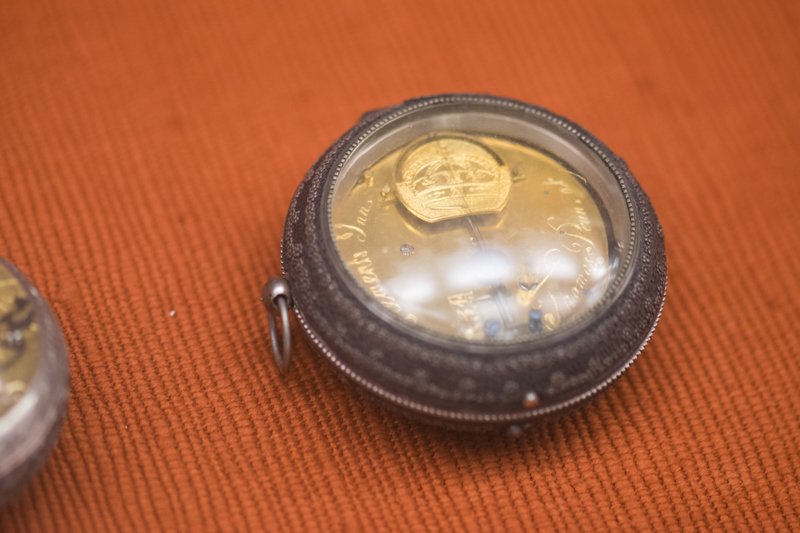
In November 1462, an Italian clockmaker named Bartholomew Manfredi wrote to the Marchese di Mantova with a sales pitch: he could make him a “pocket clock” better than the one owned by the Duke of Modena. It is the earliest known reference to a portable timepiece, and it sums up the next 400 years of watch history in one sentence. Rich men wanted the time on their person, and craftsmen competed to sell it to them.
By the end of the 1400s, spring-driven clocks had appeared in Italy and Germany, and the first things we would recognize as watches started coming out of Nuremberg. Picture a heavy brass drum, several inches across, hanging from a chain around your neck: a single hour hand, no glass, just a hinged brass cover, often pierced so you could peek at the time. Movements were iron or steel, pinned together, since screws did not come into use until after 1550, and many had alarms or striking mechanisms. Later in the century, makers got playful with the shapes: books, animals, fruit, skulls, the famous “death’s head” watches.
The Nuremberg egg
The famous story goes like this: around 1500, a Nuremberg locksmith named Peter Henlein invented the portable watch, the “Nuremberg egg,” and portable timekeeping begins with him. Henlein was a real man, a master locksmith in Nuremberg who died in 1542, and a 1511 text mentions him making small portable timepieces. The Germanisches Nationalmuseum holds a watch dated 1510 bearing his name. All of that is documented.
What is not documented is the clean “he invented it” story. Spring-driven portable clocks were emerging in several places at once, the 1510 watch’s attribution has been questioned, and the cute “Nuremberg egg” nickname, possibly a pun on his name, shows up much later than Henlein did. Henlein was probably an early and important maker in a craft evolving fast, and history compressed a whole scene into one man’s name because one name is easier to remember.
The rounded “egg” shape came slightly later, as the drum form evolved. For a long time these stayed jewelry for the rich, worn as pendants. Men started putting watches in pockets instead, which the traditional story dates to 1675, when Charles II of England introduced the waistcoat. “The story goes” is doing some heavy lifting there, but everybody repeats it. Watches flattened into the familiar rounded shape, glass covered the dial from around 1610, and you wound and set them with a key.

A hunter-case Elgin pocket watch, circa 1909. The spring-hinged lid protected the crystal; the name comes from English fox hunters. Photo: Wikimedia Commons, CC BY-SA 4.0.
The escapement ladder
Up to the 1720s, nearly every watch used the verge escapement, a 14th-century technology borrowed from tower clocks. It was crude: lots of friction, no jewels, and accuracy to match. The first real improvement was the cylinder escapement, developed by the Abbe de Hautefeuille early in the 1700s and put to work by George Graham. Then, in 1755, Thomas Mudge invented the lever escapement. A handful of makers put it into limited production, and suddenly a domestic watch could hold within a minute a day. Lever escapements took over after about 1820, and your mechanical watch almost certainly still uses a descendant of Mudge’s design.

A pocket watch movement, the full going train on display. Photo: Wikimedia Commons, CC BY-SA 4.0.
Breguet’s toolbox
Breguet deserves his own paragraph because half the vocabulary of watchmaking is his. From his Paris workshop, Abraham-Louis Breguet patented the tourbillon in 1801, invented pare-chute shock protection in 1790, developed the overcoil hairspring, and created the visual language, hands, numerals, engine-turned dials, that still reads as “luxury watch” two centuries later. (More on Breguet here.)
America industrializes it
In 1857 the American Watch Company in Waltham, Massachusetts, introduced the Model 57, the first watch with fully interchangeable parts, and the price of a reliable watch fell off a cliff. By 1865 Waltham was turning out more than 50,000 watches a year. The Swiss, driven out of the cheap end of the market, moved upmarket into precision, which is the short version of why Switzerland means luxury watches today.
The railroad
On April 18, 1891, two trains collided head-on near Kipton, Ohio, because one engineer’s watch had stopped for four minutes. The railroad hired Cleveland jeweler Webb C. Ball as Chief Time Inspector. In 1893 the General Railroad Timepiece Standards were adopted by nearly every American railroad: open-faced, size 16 or 18, at least 17 jewels, adjusted to five positions, accurate to within 30 seconds a week, lever setting, the stem at 12 o’clock, and bold black Arabic numerals on a white dial. Ball built nothing himself; he set the standard and inspected the results. For half a century, a railroad inspector with a loupe was the toughest accuracy test a watch could face in America.
Peak and decline
The pocket watch peaked around 1900, chained to waistcoats across the industrial world. Then came the First World War, and soldiers found that fishing a watch out of a pocket under fire was a bad system. (The war years are their own story.) The wristwatch came home from France on officers’ wrists and never left. Pocket watches retreated to railroad men, formal dress, and the collectors who still buy, sell, and argue about them every day in the hobby.
Why it matters
Four hundred years of the pocket watch is mechanical timekeeping in miniature: jewelry for nobles, tools for workers, instruments for railroads, then obsolescence, then affection. Every technology in your modern watch was worked out to make the pocket watch better. The pocket watch lost the wrist, but it won the argument about what a watch is supposed to do.
Thanks for reading this.

