
In October 1707, four British warships ran onto the rocks of the Isles of Scilly and sank, drowning an estimated 1,400 to 2,000 sailors. The fleet’s navigators knew their latitude. They always knew their latitude. What they could not pin down was their longitude, how far east or west of home they were, and the error put them dozens of miles off course, straight into the rocks.
Longitude is a time problem. The earth turns 15 degrees every hour, so if you know the exact time at your home port and the exact local time where you are, the difference tells you how far around the planet you have traveled. The catch is carrying home-port time with you, on a rolling wooden ship, for months, without the clock drifting more than a few seconds a day. In 1707, nobody could build that clock. Isaac Newton himself doubted anyone ever would.
The prize
Parliament decided to buy the solution. The Longitude Act of 1714 offered up to 20,000 pounds, a fortune, to anyone who could determine longitude at sea to within half a degree, about 30 nautical miles. Astronomers mostly chased the moon, tabulating lunar distances against the stars. One Yorkshire carpenter decided to build a better clock instead.
A carpenter from Yorkshire
John Harrison was born in 1693 in Foulby, Yorkshire, and trained as a joiner. He built his first longcase clocks out of wood, oak and lignum vitae, and they worked so well that three of them still survive. Along the way he invented the gridiron pendulum, which cancels out temperature expansion, and the grasshopper escapement, which runs almost without friction. In 1730 he took his sea-clock idea to London, where Edmond Halley sent him to the clockmaker George Graham, who lent him money to build it.
It took Harrison five years to finish H1, his first sea clock. In 1736 he sailed with it to Lisbon aboard HMS Centurion and came home on HMS Orford. The Orford’s sailing master reported something striking: his own dead reckoning had put the ship sixty miles east of its true position, while Harrison’s clock had the landfall right. The Board of Longitude granted Harrison 500 pounds for further work. They would spend the next four decades being impressed and not quite paying him.
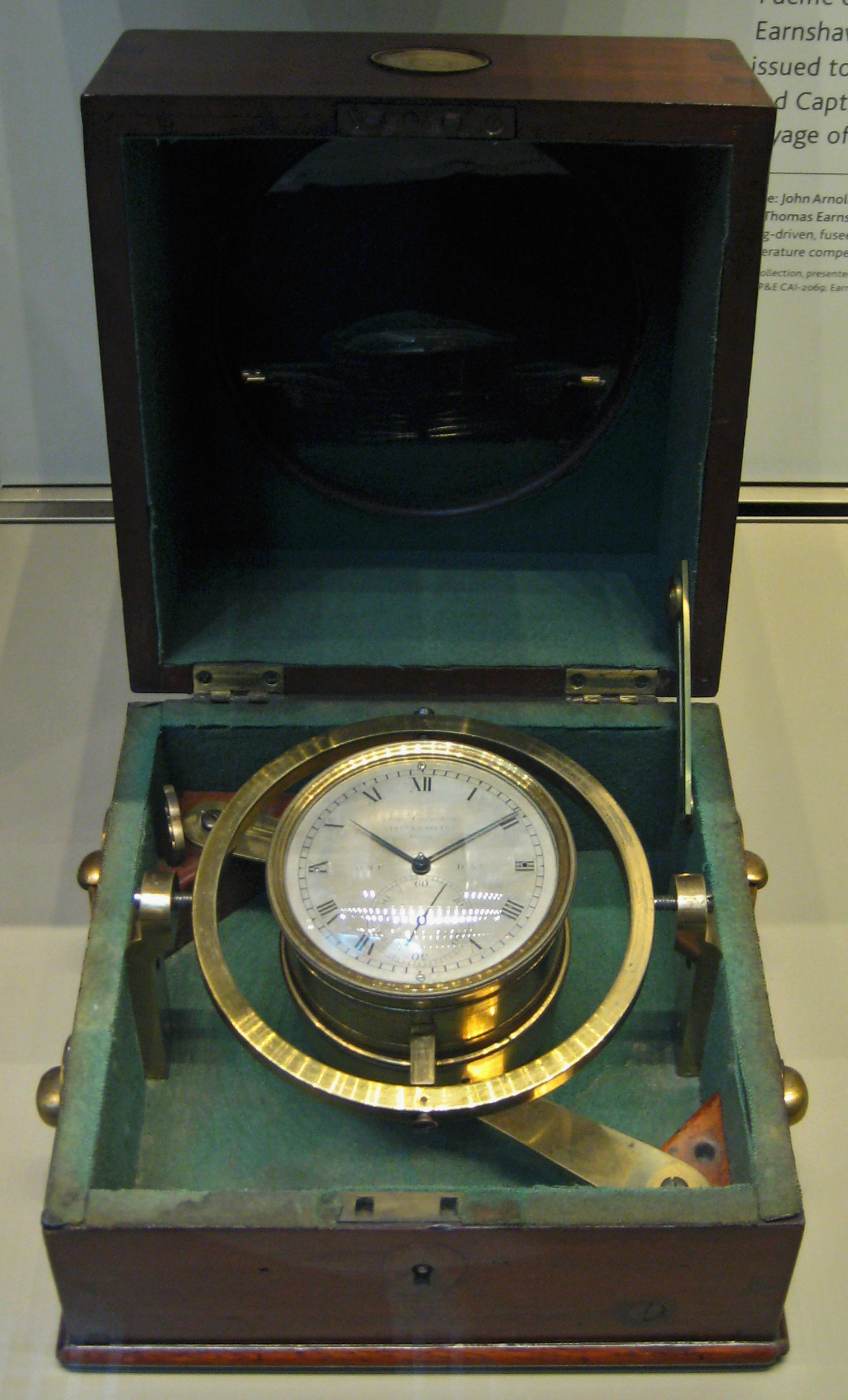
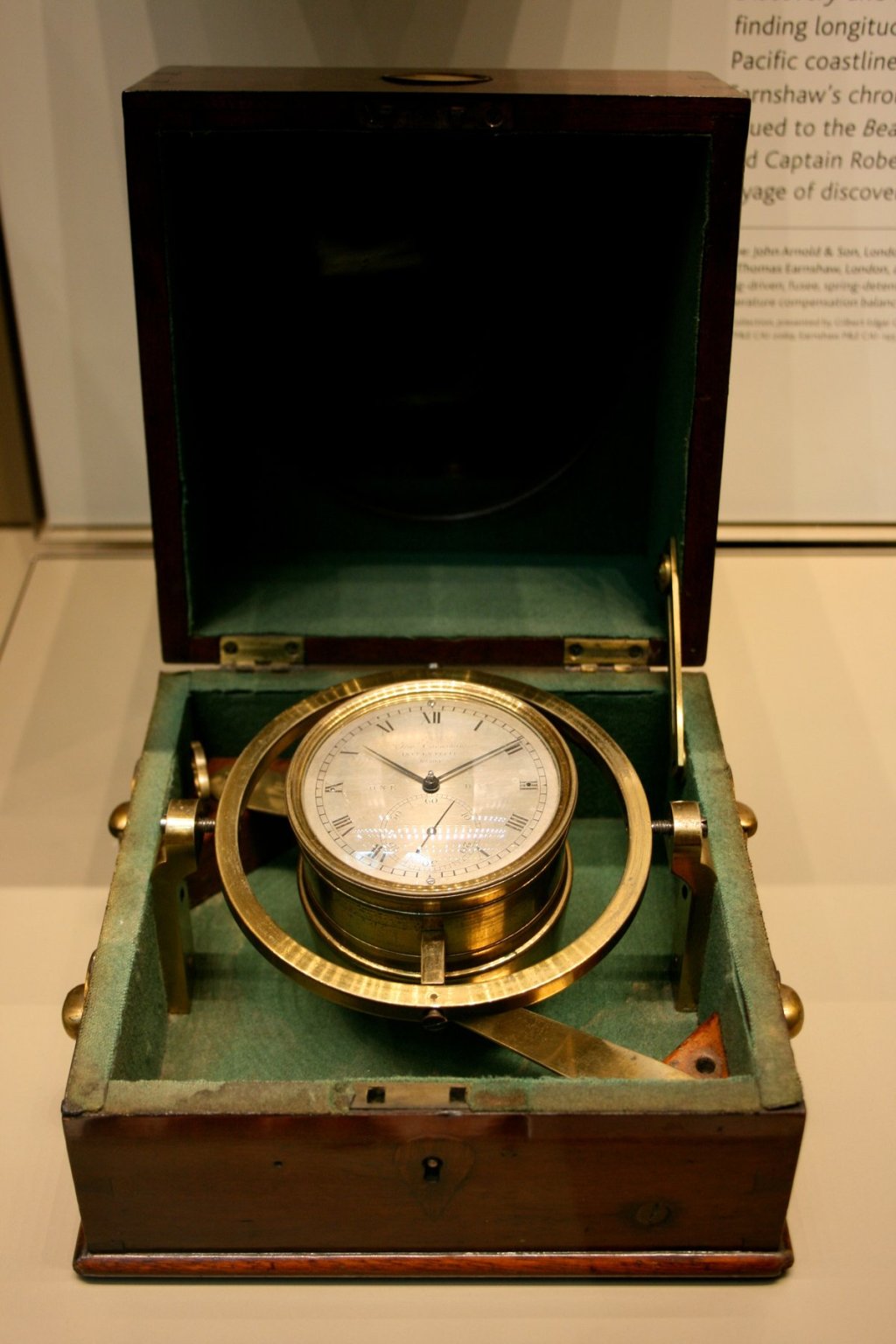
A marine chronometer of the type that descended from Harrison’s work, on display at the British Museum. Photo: Wikimedia Commons, CC BY-SA 4.0.
Smaller, smaller, smaller
Harrison spent the next twenty years shrinking his machines. H2, finished in 1741, was abandoned when Harrison found a fatal flaw himself: the bar balances changed period when the ship yawed while tacking. H3 consumed seventeen years and never quite satisfied him, since nobody yet understood spring physics well enough, but it left the world two permanent gifts: the bimetallic strip and the caged roller bearing.
Then came the surprise. Precision watches made by Thomas Mudge, Graham’s successor, were keeping time as well as Harrison’s giant sea clocks. The answer was not a bigger clock but a better watch. Harrison redesigned the watch from first principles and built H4: a “sea watch” finished in 1759, five inches across and three pounds, looking like an oversized pocket watch of the period, made with the care of a jewel.
Jamaica, and the long wait
In 1761 Harrison’s son William carried H4 to Jamaica aboard HMS Deptford. After 81 days at sea the watch had accumulated about three minutes and 36 seconds of loss, which corrected to roughly five seconds slow once its established rate was allowed for. The prize demanded half a degree of longitude. H4 had beaten it by a mile, literally. The Board demanded another trial. In 1764 H4 sailed to Barbados and came home about 39 seconds off over the whole voyage, still far inside the requirement. The Board offered half the money, with strings attached, while the Astronomer Royal, Nevil Maskelyne, championed the rival lunar-distance method and kept finding reasons to delay.
In 1772 the Board admitted both methods worked but declared neither “practical.” Harrison took his case to King George III, who tested one of the watches himself, and in 1773 Parliament voted Harrison 8,750 pounds. He died in 1776, recognized but never handed the full 20,000 as a clean prize. A provincial carpenter solved the greatest scientific problem of the age, and the establishment spent years acting as though the paperwork mattered more than the clock.

A 19th-century marine chronometer by the Spanish maker J. R. Losada, in its gimballed box. Photo: Wikimedia Commons, CC BY-SA 4.0.
Cook proves it at sea
The vindication that mattered came from a working sailor. Larcum Kendall built K1, a copy of H4, in 1769, and Captain James Cook carried it on his second Pacific voyage from 1772 to 1775. K1 performed superbly, and Cook’s charts of New Zealand, Australia, and the Pacific were drawn with Kendall’s copy of Harrison’s watch keeping Greenwich time below decks. Cook took K1 again on his third voyage, and Kendall’s K2 later sailed with William Bligh. The method worked at sea, in hands other than the inventor’s, which is the only test that counts.
In the 19th century the chronometer became an industry. Makers like John Arnold and Thomas Earnshaw simplified the design around the spring detent escapement, and soon every serious ship carried chronometers in gimballed boxes, checked against time signals in port. Accurate longitude made ocean schedules reliable and quietly underwrote a century of global trade and naval power.
Why it matters
Every time your phone’s map figures out where you are, it is solving Harrison’s problem with satellites instead of springs. The marine chronometer was the first time humanity could know its position on an empty ocean with confidence, and it came from a carpenter who taught himself clockmaking and refused to stop for forty years. The Longitude Act also invented something we still use: the big public prize for a hard technical problem. Harrison’s story is the template. An outsider solves the impossible thing, the experts spend decades explaining why it does not count, and the sailors use it anyway.
Thanks for reading this.

