
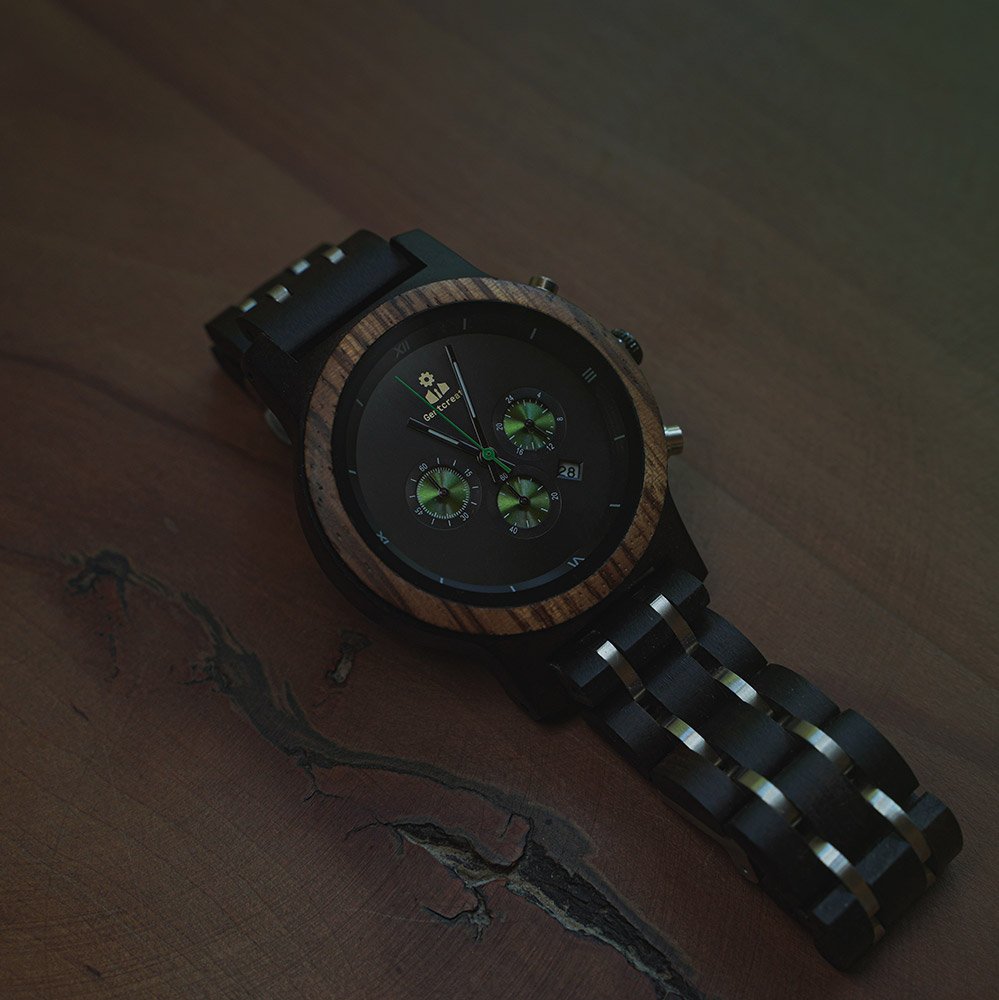
A wood dial is a watch dial made from, or faced with, real wood. The usual construction is a thin slice of veneer, stabilized and sealed, mounted on a conventional dial blank the way any applied material would be. Each piece carries the grain of the tree it came from, so no two dials match. That is the entire pitch, and it is an honest one: you are looking at a cross-section of a plant that grew for decades, cut thin enough to fit under a crystal, finished so it does not immediately fall apart.

A wooden wristwatch with matching wood dial and bracelet. Wood construction like this is a modern novelty, not a traditional craft. Photo: Wikimedia Commons, CC BY-SA 4.0.
A short and scattered history
Wood has no real tradition as a dial material the way enamel or lacquer does. It shows up in waves, usually when the industry is feeling playful or desperate. In the 1960s and 1970s, several brands experimented with it: Universal Genève and others made pieces with wood dials, Bulova put inlaid wood on an Accutron bezel in 1973, Hamilton built Sherwood automatics with wood elements, and Rolex offered burled mahogany dials on Day-Date and Cellini models. Around 1975, Cartier issued the Tank La Nature, a Tank with a wood case and dial, gold-plated rather than solid gold, made in small numbers and discontinued by about 1976. These were quartz-crisis-era experiments, curiosities more than statements, and most of them are obscure enough now that collectors call them sleepers.
The modern wave came with marquetry, the art of inlaying small cut pieces of veneer to form a picture. Cartier showed a Rotonde with a marquetry bear dial at SIHH 2011, made by the marqueter Jérôme Boutteçon from dozens of tiny hand-cut veneer pieces. Patek Philippe introduced a wood marquetry Royal Tiger in 2010. More recently, Vacheron Constantin’s Métiers d’Art Wooden Wings (2026) took it further, with artist Anna Le Corno building a falcon from twelve wood species in three-dimensional marquetry. These are art pieces that happen to tell time, and they are priced accordingly. Below them sits a whole ecosystem of small brands selling plain wooden watches, walnut and maple and bamboo, usually with quartz movements, usually aimed at gift buyers.
The practical problems
Wood is a difficult dial material and everyone in the business knows it. It moves with humidity, it fades with sunlight, and it is softer than anything else you would put on a watch. Dial makers stabilize the veneer, seal it against moisture, and finish it with lacquer or oils, and inside a modern sealed case a wood dial will generally behave. But “generally” is doing work in that sentence. A wood dial left in a sunny window will change color. A wood dial in a case with poor seals will not enjoy the damp. Compared to brass, enamel, or stone, wood is the high-maintenance option, and it asks for care in exchange for nothing but looks.

Samples of different wood species. The grain is the whole point of a wood dial, and it is different on every slice. Photo: Wikimedia Commons, CC BY-SA 3.0.
What wood dials are actually for
It helps to be clear-eyed about what this material is. Wood dials are not a traditional craft being preserved, the way hand guilloché or enameling is. There is no centuries-old lineage of wooden watch dials, no guild of dial woodworkers handing down techniques. Wood dials are a novelty, sometimes an artful one, sometimes a gimmick. The marquetry pieces from Cartier, Patek Philippe, and Vacheron Constantin are genuinely impressive craft, tiny inlaid pictures cut by hand, and they deserve respect as art. The plain walnut-dial quartz watch from a Kickstarter is a different product with a different audience, and there is nothing wrong with that either, as long as nobody confuses one for the other.
The other thing wood dials are for is warmth. Metal dials are cold and precise; enamel is glassy and perfect. Wood is the only dial material that looks like it grew, because it did. On the wrist it reads less like an instrument and more like an object, which is either exactly what you want or exactly what you do not want. There is no wrong answer, but know which one you are before you buy.
Keep digging
Wood is one of the natural dial materials. See Stone dials for the mineral equivalent, Meteorite dials for the exotic end of the spectrum, and Dial manufacturing for how dials are produced.
Why it matters
Wood dials are worth understanding precisely because they are not traditional. They are a reminder that the dial is a canvas, not a law: brands can put anything flat and stable under a crystal, and sometimes the experiment works. They also teach a useful skepticism. When marketing copy wraps a walnut veneer in heritage language, check the history. The history of wood dials is short, scattered, and mostly from the 1970s. That does not make them bad. It makes them what they are.
Thanks for reading this.

