
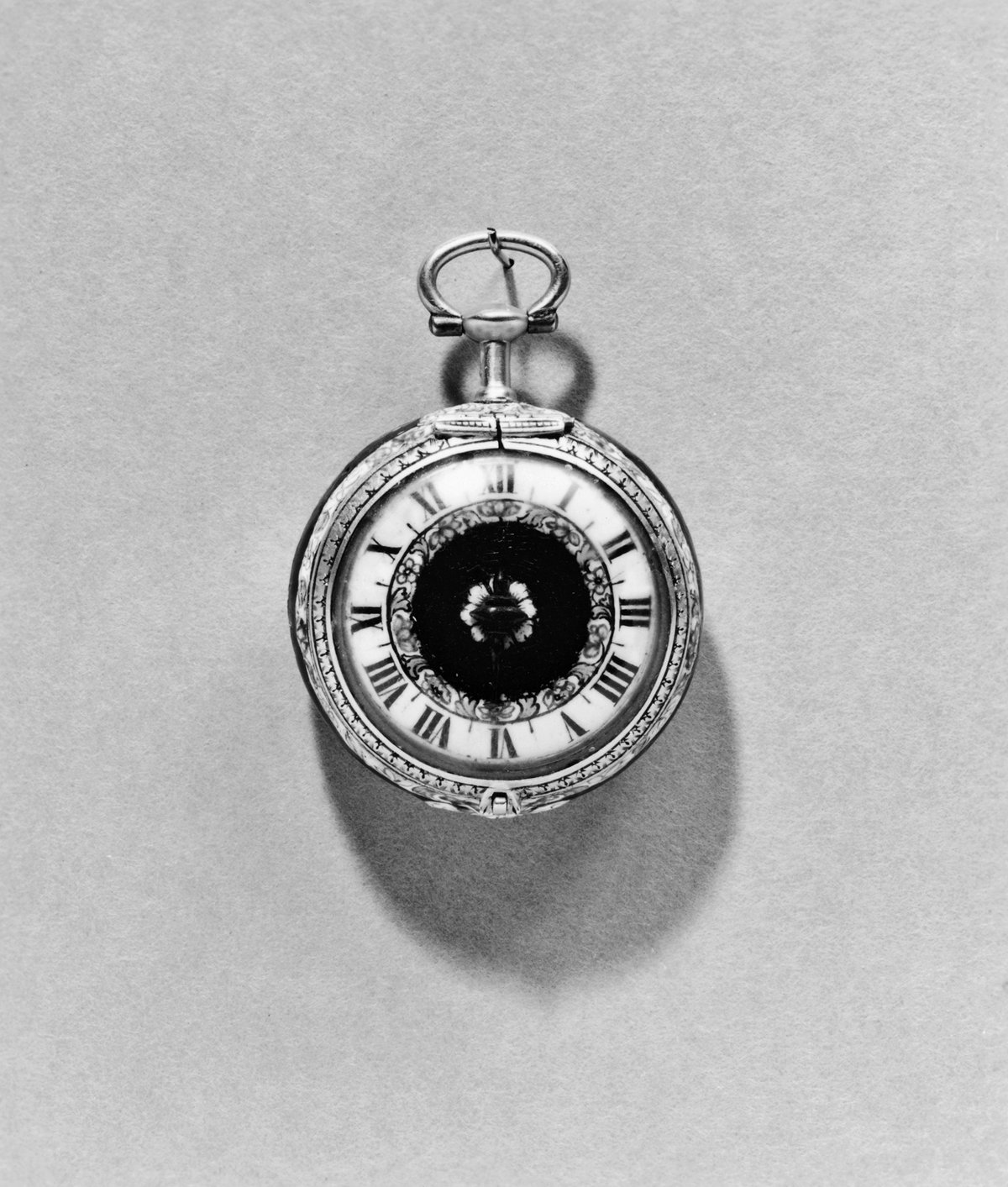
Vitreous enamel is powdered glass fused to a metal base at high heat. The powder melts in the kiln, flows across the surface, and hardens into a smooth coating bonded to the metal. On a watch dial, the result is a layer of colored glass: hard, glossy, and resistant to the fading that affects paint, because the color is part of the glass itself.
Enamel is a family of techniques rather than a single finish. Grand feu, cloisonné, and champlevé all start from the same basic material, but they structure it differently, by firing plain layers, by dividing colors with wire, or by filling cells carved into the plate. The shared material explains the shared strengths and the shared difficulty: glass holds color, and glass can crack.

How it works
Enamel starts as frit, glass melted with metal oxides for color and then ground to powder. The powder is applied to a metal base, usually copper or gold for watch dials, and the piece is fired in a kiln at roughly 750 to 850 degrees Celsius. In the kiln the powder melts and settles, and as it cools it hardens into a vitreous coating fixed to the metal underneath.
Light behaves differently in enamel than on a painted surface. It enters the layer and returns changed, which gives an enamel dial a depth that can make it look wet even when it is dry. Ultraviolet light, which fades paint and textiles, does not fade the color, because there is no surface pigment to break down. The color runs through the glass.
The same firing that creates the finish creates the risk. Dust in the air can become a flaw in the glass. The metal base expands in the kiln at a different rate from the coating, so a dial can warp or the enamel can craze as it cools. A dial can survive several firings and fail in a later one, and a failed piece cannot be repaired. The enameler starts over.
The rejection figures in the source material are attributed rather than general. At Donzé Cadrans, the Swiss enamel specialist now owned by Ulysse Nardin, Louis Erard, a Donzé client, puts the rejection rate at over 50 percent, and for difficult runs it has reportedly topped 90 percent, despite hours of skilled work on each dial.
The main techniques divide the work in different ways. Grand feu is the foundation: plain vitreous enamel fired at high temperature, the technique behind classic white and colored enamel dials. Cloisonné builds cells from thin gold wire fixed to the base, fills each cell with a different color, and fires the whole piece, which suits miniature scenes. Champlevé works in reverse, with the cells carved down into the metal plate and filled with enamel, leaving the metal as the outlines.
Beyond those three, the family includes paillonné, with tiny foil shapes suspended in translucent enamel; grisaille, white enamel painted in shades over a dark ground; flinqué, translucent enamel over guilloché; and plique-à-jour, enamel with no backing, like a miniature stained glass window. One naming caution from the source material: cold enamel is tinted resin cured at low temperature, and it is not vitreous enamel.
History
Enameling is one of the oldest decorative technologies in the source material, with roots in Mesopotamia and Egypt, and the basic physics have not changed in thousands of years. The first problem was permanence: how to fix color to metal so that it would last. Fusing glass to the surface answered it, because the color became part of a glass layer rather than a coating sitting on top.
The medieval period shows the techniques already dividing into families. A French medallion dated to circa 1100, worked in cloisonné and champlevé enamel on gilded copper, uses the same two approaches that later appear on watch dials: wire forming the cells in one, and the plate itself carved to form them in the other. The problem at that stage was structure, giving each color a boundary that would hold it in place through firing.
Watches took up the material later. An 18th-century watch with enamel decoration, dated to circa 1750, shows enamel on watch cases and dials, and a white enamel dial from 1800 still shows the quality the technique is known for: color that looks essentially as it did when it cooled. The problem enamel solved for watchmakers was the same one it had solved earlier, keeping color stable over long periods, now applied to an object whose dial is read every day.
The surviving evidence carries its own selection effect. Enamel dials from the pocket watch era are valued in the source material when they survive uncracked, and a cracked dial shows the other side of the material: glass is glass, and its permanence lasts only as long as the layer stays intact.
Where it stands now
Enamel dials are still made by the same route: frit applied to a metal base, fired at high temperature, and accepted or rejected on what comes out of the kiln. Donzé Cadrans remains a named specialist in the source material, owned by Ulysse Nardin and supplying clients such as Louis Erard, whose attributed rejection figures describe how much of the work is lost in production.
The family of techniques also remains intact. Grand feu covers the plain fired dials, cloisonné covers the wire-cell work, and champlevé, paillonné, grisaille, flinqué, and plique-à-jour cover the carved, foiled, painted, and unbacked variants. Each is treated in its own article where the source material supports one.
The position of enamel in current watchmaking follows from its properties. It cannot be hurried through firing, a failed dial cannot be repaired, and the colors hold because they are glass. Those facts, rather than any change in the basic process, explain why enamel dials continue to be produced in limited settings by specialists, and why the finished dials represent only the portion of the work that survived the fire.
Sources
- Wikipedia, Vitreous enamel
- Monochrome, Buying guide to enamel watches and techniques including cloisonné, champlevé, flinqué and plique-à-jour
- Haute Time, What is a grand feu enamel dial
Thanks for reading this.
In this section
Thanks for reading this.