
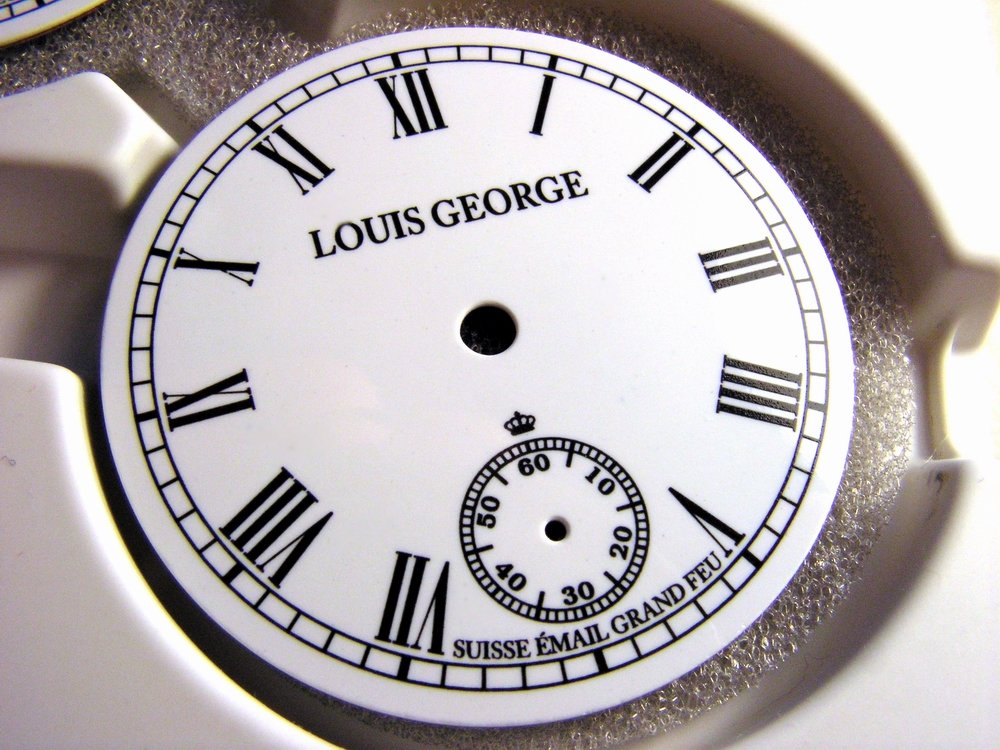
Grand feu enamel is vitreous enamel fired at high temperature, around 800 degrees Celsius, in repeated firings that build the coating up layer by layer on a metal blank. The name means great fire in French, and it refers to the heat the process requires. It is the plain form of enamel work, without wire cells or carved compartments, and it produces the deep, glossy surface associated with classic white and colored enamel dials.
Within the enamel family, grand feu is the foundation technique. Other methods add structure to the surface or paint pictures on it. Grand feu depends on the quality of the fired layers themselves, on their depth, evenness, and freedom from flaws, which is why the firing process and its failure rate are central to understanding it.

How it works
The process starts with a metal blank, usually copper. The source material explains the choice: the zinc content of brass causes trouble in the kiln, and copper is pure enough to behave. Gold is also used, at the high end. The enameler sifts powdered glass over the blank, often through a fine sieve, and fires it. Then the process repeats, layer by layer.
Jaeger-LeCoultre’s Master Ultra Thin Tourbillon Enamel dial gives a documented example. It is fired five times at 800 degrees, cooling carefully between each round, to build the color to full depth over a hand-guilloché pattern. Each layer has to melt and settle without disturbing the layer beneath it, and every firing is a separate chance for the dial to fail.
The reverse of the dial is enameled as well. This counter-enamel is not decoration. Glass and metal expand at different rates, and a dial coated on one side only can bow or crack its own face as it cools. Coating the back balances the stresses between the two sides, so the counter-enamel is a structural part of the process.
The failure modes are present at every firing: bubbles, cracks, warping, and color shifts. Enamel is brittle, and molten glass collects dust. A dial that survives four firings can fail in the fifth. The rejection rate at Donzé Cadrans is put at over 50 percent by Louis Erard, a Donzé client, and for difficult runs it has reportedly topped 90 percent, with dials destroyed after hours of skilled work.
The risk continues after the last firing. The holes for the hands are drilled after firing, and drilling a completed enamel dial can shatter it. There is no repair for a failed piece at any of these stages. The only course is to start over.
What the process produces, when it succeeds, is a surface with depth: light sinks into the enamel rather than sitting on it. The classic result is an opaque white or ivory dial, though colored grand feu exists, with blue described in the source material as difficult to fire evenly. The high temperature limits the palette, because many pigments cannot survive 800 degrees, and the colors that can be used tend toward a restrained set.
History
The early problem grand feu addresses is the same one enamel had always addressed: how to give a dial a colored surface that would not fade or peel. Firing glass onto metal at high temperature fixed the color into the surface itself. The dials that survive from around 1800 show what the method offered watch and clock makers: a French clock from circa 1800 carries a white enamel dial with the milky depth the technique produces.
The next problem was mechanical rather than visual. A dial coated on one side only is under unbalanced stress as it cools, because its glass and metal layers expand at different rates. Counter-enamel on the reverse was the solution, balancing the dial so that it stayed flat and its face stayed intact. The step looks like waste from the outside, since the back of a dial is not seen in the watch, but it follows directly from the physics of the materials.
A dial face made by Pierre Daniel Destigny between 1798 and 1805 shows fired enamel dials in use through a period when even the system of timekeeping was being experimented with, since that dial belonged to a decimal clock. The dated examples in the source material are sparse, but they place established enamel dial making at the end of the 18th century and the start of the 19th, using the same cycle of coating, firing, and cooling that defines the technique now.
As the technique developed in watchmaking, the problem shifted from whether enamel could be fired onto a dial to how much depth and evenness could be built into it. Repeated firings, each adding a layer over the last, answered that question, at the cost of multiplying the chances of failure. Modern practice, such as a dial fired five times over a hand-guilloché pattern, is that older solution carried to a deliberate extreme.
Where it stands now
Grand feu dials are still produced by repeated firing at around 800 degrees, still on copper or gold blanks, still with counter-enamel on the reverse, and still with a substantial share of the work rejected. Donzé Cadrans supplies grand feu dials to houses including Ulysse Nardin and Louis Erard, and Jaeger-LeCoultre, A. Lange and Söhne, and Van Cleef and Arpels are among the manufactures the source material associates with the technique.
Because a finished dial represents the survivors of a process with a high rejection rate, grand feu dials appear mostly in expensive watches and limited editions in the source material’s account. The cost of a finished dial includes the labor and materials spent on the dials destroyed along the way, since each one consumed skilled work before it failed.
The technique itself has not been replaced by a faster equivalent. Its defining features remain the high firing temperature, the repeated layers, the counter-enamel that keeps the dial flat, and a palette limited by what pigments can withstand the kiln. Those constraints explain both the appearance of the finished dials and the narrow place the technique holds in current production.
Sources
- Haute Time, What is a grand feu enamel dial
- Hypebeast, Louis Erard works with masters on an enamel dial
- Ethos Watches, Jaeger-LeCoultre Master Ultra Thin Tourbillon Enamel
- Tatler Asia, Why enamel dials are highly sought after
Thanks for reading this.