
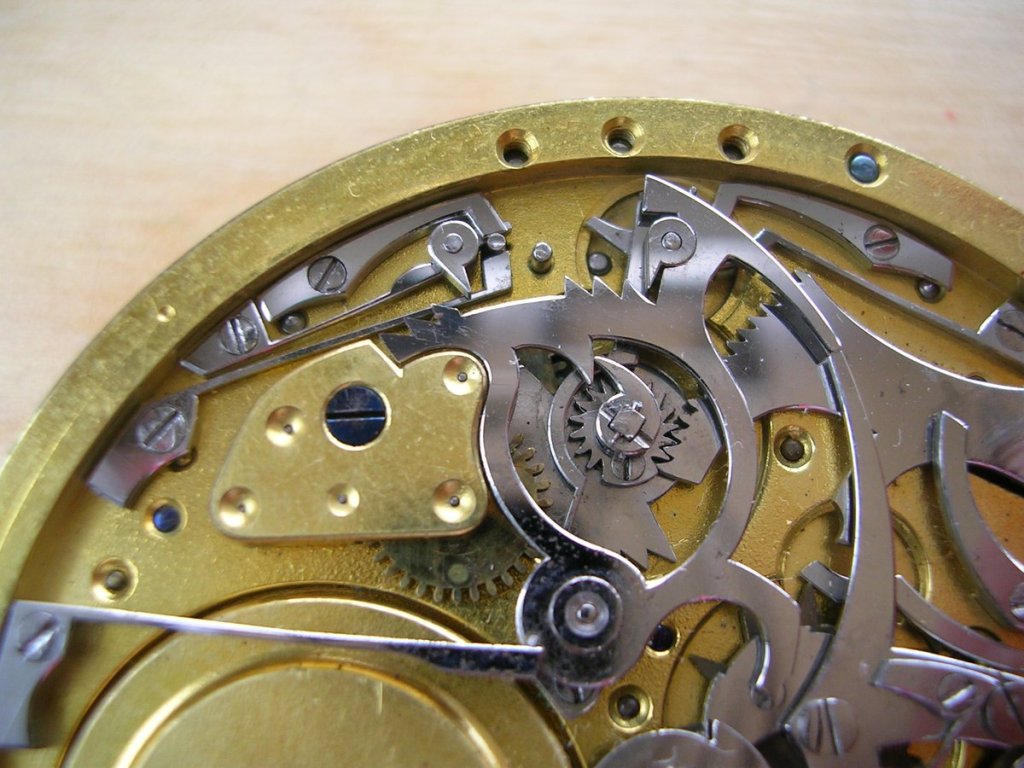
A sonnerie is a striking watch that chimes on its own, without being asked. Where a minute repeater stays silent until you push its slide, a sonnerie strikes the hours and quarters automatically, all day and all night, like a tiny cathedral tower strapped to your wrist. There are two flavors: the grande sonnerie strikes the hours and the quarters every quarter, repeating the hour count at each quarter; the petite sonnerie strikes the hours every hour but only marks the quarters with a simple strike, without repeating the hour. Most sonnerie watches have a mode selector so you can choose grande, petite, or silence. Silence is there for a reason.

Diagram of a sonnerie striking mechanism. Photo: Wikimedia Commons, CC BY-SA 4.0.
From clock towers to wrists
Striking clocks are ancient: the earliest mechanical clocks, from the 14th century, had no dials at all and simply announced the time with chimes. The grande sonnerie in watch form goes back to the pocket watch era; Audemars Piguet’s archives show grande sonnerie watches in production by the early 1880s, and between 1882 and 1892, twenty-eight AP watches featured the complication. But miniaturizing an automatic striking mechanism into a wristwatch defeated everyone for a century. The revival of mechanical watchmaking after the quartz crisis finally made it possible, and the credit goes largely to Philippe Dufour. Audemars Piguet commissioned the young independent watchmaker to build five grande sonnerie pocket watches between 1982 and 1988, and in 1992 Dufour presented the first grande sonnerie wristwatch ever made, a movement that also included a minute repeater. Gérald Genta followed in 1995 with his own grande sonnerie wristwatch, built with Pierre-Michel Golay, and Audemars Piguet began serial production the same year with references 25750BA and 25847BA.
Why it is so difficult
A minute repeater is already one of the hardest things a watchmaker can build. A sonnerie is that, plus a second autonomous machine that strikes on a schedule whether you are listening or not. The watch needs a separate striking train with its own mainspring barrel, because the energy to chime the hours and quarters every fifteen minutes, around the clock, is enormous compared to a repeater’s on-demand use. It needs a mode selector that switches between grande, petite, and silent. And because the striking train drains its own barrel constantly, sonnerie watches usually carry a power-reserve indicator for the striking train, so you know when the chimes are about to run out. The engineering problem is not just complexity, it is energy management: the watch has to keep perfect time while spending most of its power making noise. Getting that balance right, in a case that fits on a wrist, is why so few brands have ever attempted it.
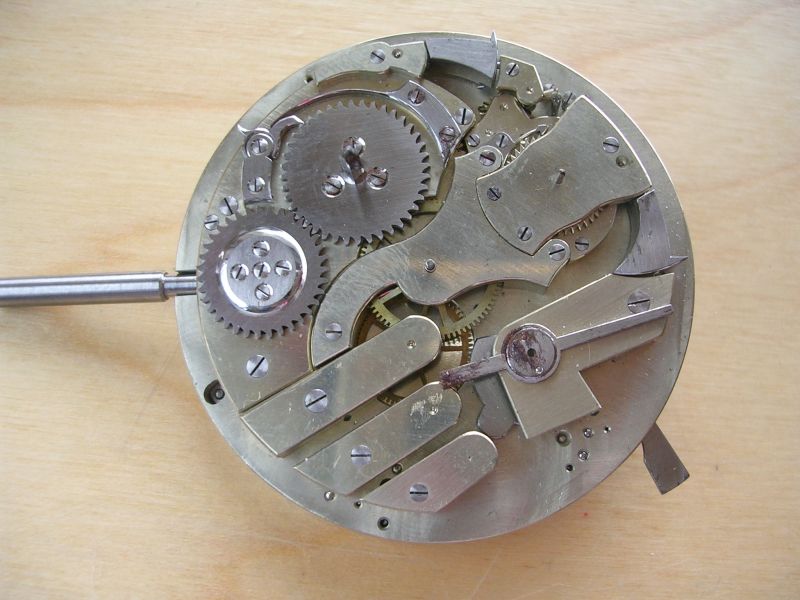
The hammers and coiled gongs of a striking movement; a sonnerie uses the same striking elements, fired automatically. Photo: Wikimedia Commons, CC BY-SA 3.0.
The modern standard
Today the grande sonnerie is one of Audemars Piguet’s signature complications, which is remarkable given how few companies attempt it at all. The brand’s current reference is the CODE 11.59 Grande Sonnerie Carillon Supersonnerie, launched in 2020 with calibre 2956, a thorough reworking of AP’s 1990s grande sonnerie movement. It combines grande and petite sonnerie with a minute repeater and a carillon, and it uses AP’s Supersonnerie acoustic technology, developed with the École Polytechnique Fédérale de Lausanne, including a double caseback with a perforated outer back that acts as a soundboard. The dials on the launch models were paillonné enamel by Anita Porchet. It is, by any measure, one of the most complicated wristwatches in current production. Whether you actually want your watch to chime the quarters at 4 a.m. is a separate question, and the mode selector has a very popular third position.
Why it matters
The sonnerie matters because it is the most ambitious thing you can ask a mechanical watch to do. A minute repeater chimes when you tell it to; a sonnerie keeps its own schedule, spending energy all day to make sure you hear the time whether you asked or not. It is wildly impractical and completely wonderful, and the fact that a handful of watchmakers kept the knowledge alive through the quartz crisis so they could put a cathedral bell on your wrist is one of watchmaking’s better stories.
Thanks for reading this.

