
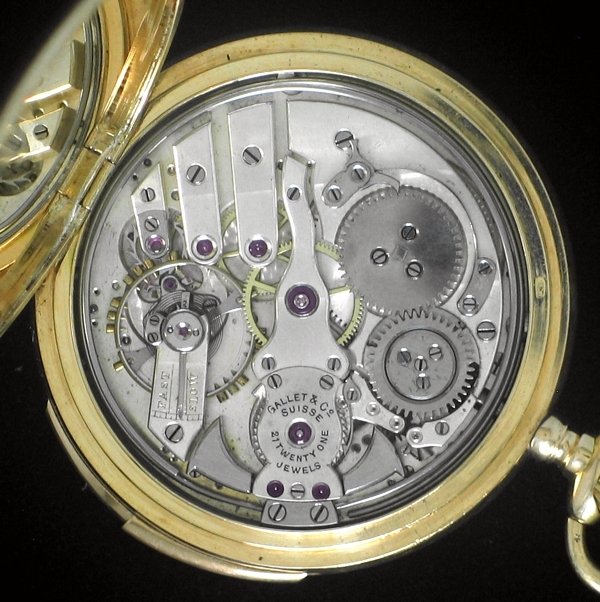
A minute repeater is a watch that chimes the exact time out loud, to the minute, when you ask it to. Push the slide on the case side and it strikes the hours in a low tone, the quarters in paired high-low tones, and the minutes in a high tone. At 6:55, you would hear six low strikes, three pairs of ding-dong, and ten high strikes. It was invented to tell the time in the dark, back when lighting a candle at 3 a.m. was a production, and it was also used by the visually impaired. Nobody needs one now. They still make them because hearing a watch count out the time never stops being remarkable.

A minute repeater movement with its hammers and coiled wire gongs visible. Photo: Wikimedia Commons, CC BY-SA 3.0.
From bells to wristwatches
The minute repeater was created in 1750 by London watchmaker John Ellicott, who refined earlier repeaters that could only chime in five-minute segments into one that could chime individual minutes. Abraham-Louis Breguet took the mechanism further: he was the first to replace the bulky bell mounted in the caseback with two round wire gongs wrapped around the movement, which saved space and sounded better, and around 1820 he invented the all-or-nothing mechanism, which stopped the slide from being released half-cocked and chiming a garbled partial time. By the end of the 19th century the design was considered essentially perfect, and the basic construction has changed remarkably little since. The first minute repeater wristwatch came in 1892, made by Louis Brandt (the brand that would become Omega) with the movement supplied by Audemars Piguet: a 29.3 mm movement, just 13 lignes across, miniaturizing the whole striking apparatus into wristwatch form.
How it works
The mechanism is a small mechanical computer that reads the time and converts it into strikes. When you push the slide, you wind a separate mainspring dedicated to the striking train; releasing the slide lets that spring drive the whole sequence. The time is “felt” by racks dropping onto snails: elaborately shaped cams that physically encode the numerals. The hour snail, rotated by the hour wheel, has twelve troughs of different depths, the shallowest for one o’clock and the deepest for twelve. The hour, quarter, and minute racks fall onto their snails, and the distance each rack falls determines how many teeth engage and therefore how many strikes each hammer performs. The sound comes from two tiny hammers striking gongs: a single long steel wire coiled around the inside of the case, supported in the middle, with its two ends tuned to different pitches. Hours get the low end, minutes the high end, and the quarters get the two struck in rapid succession, the familiar ding-dong. The whole sequence is governed so the strikes fall at an even, measured pace.

A vintage Gallet minute repeater wristwatch. Photo: Wikimedia Commons, public domain.
The decline and the revival
By the middle of the 20th century, the minute repeater had nearly died out. According to Patek Philippe’s technical department, the trade in general stopped producing minute repeaters around the 1950s: they were not needed, and they were extremely difficult to make. The revival came in 1989, when Philippe Stern had Patek Philippe build the Calibre 89 for the brand’s 150th anniversary. It was a drum watch with 33 complications, including Westminster chimes on four gongs alongside grande and petite sonnerie, and it was the first Patek Philippe designed with computer-aided design. The Calibre 89 announced that the minute repeater was back as the ultimate statement of a watchmaker’s skill. Since then, it has become the prestige complication par excellence: the A. Lange & Söhne Zeitwerk Minute Repeater chimes in ten-minute intervals to match its digital display, and Audemars Piguet’s Royal Oak Minute Repeater Supersonnerie pairs the striking train with acoustically engineered casework.
Why it matters
The minute repeater matters because it is the most honest form of showing off in watchmaking. It takes weeks for a master watchmaker to assemble and tune the hundreds of parts, and its only function is to tell you something your phone already told you, in a way that takes longer and requires your full attention. That is the whole point. In a hobby full of people who buy complications they will never use, the minute repeater is the one you can actually enjoy using every day: push the slide, close your eyes, and count.
Thanks for reading this.

