
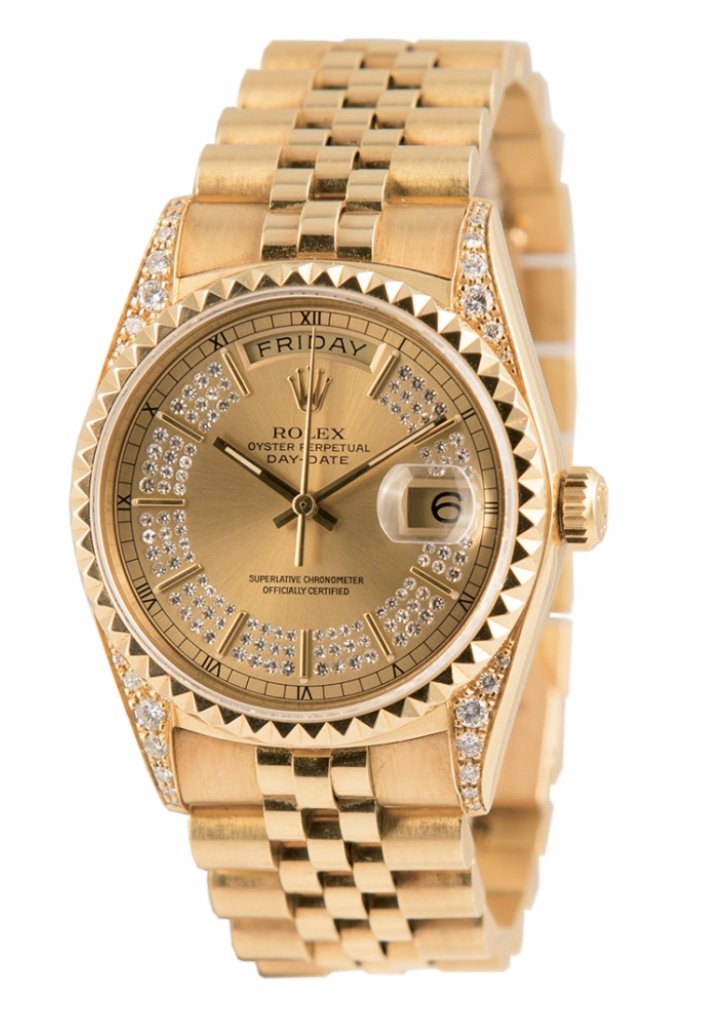
The day display spells out the weekday, usually in full, in a curved window under 12 o’clock. It answers a question the date alone cannot: not just the 14th, but Tuesday the 14th. It is a small piece of information that required a whole second mechanism, and in 1956 Rolex decided it was worth building. Nobody has improved on the layout since.

A Rolex Day-Date ref. 1803 from the late 1970s: day in full under 12, date at 3, the layout Rolex invented in 1956. Photo: Wikimedia Commons, CC BY-SA 4.0.
The Day-Date, 1956
Rolex presented the Day-Date at Basel in 1956, first as the reference 6511 and within months as the improved 6611, running on the caliber 1055, a 25-jewel automatic beating at 18,000 vibrations per hour. It was the first wristwatch to display the day of the week spelled out in full alongside the date. The launch model came only in gold or platinum, on a new three-link bracelet that became known as the President after the American presidents who wore it. The 6611 was also, by most accounts, the first Rolex to carry the “Superlative Chronometer Officially Certified” text on the dial, thanks to an improved Microstella balance. (The earlier 6511 examples used alternative chronometer wording, so the exact inscription belongs to the 6611, not the launch reference.) From the start, the Day-Date sat above the Datejust as the flagship: precious metal only, both calendars, no compromises.
How the day works
Under the dial, a day disc carries the weekday names around its edge, driven by a seven-pointed star wheel that the date mechanism advances one step per day. Around midnight, the day and date change together, which is why the mechanism needs extra energy and why the early Day-Dates ran in a slightly bulkier case than the Datejust. The clever part is the language wheel: the day disc can be printed in dozens of languages, and Rolex currently offers 26, so the same watch can read TUESDAY, MARDI, or DIENSTAG depending on the market. Collectors of vintage pieces hunt specific languages the way others hunt dial colors.
Seventy years of refinement
The Day-Date’s history is a slow polish rather than a series of revolutions. The reference 1803, made from 1959 to 1977 on the calibers 1555 and 1556, is the classic collectors mean when they say “President.” The caliber 3055 of 1978 added the quickset date, so the date could be set without winding through the days. The caliber 3155 of 2000 added the double quickset, letting the day and the date be set independently of each other. A 40mm case joined the traditional 36mm in 2015. Through all of it, the Day-Date has never been made in steel, never lost the day window, and never stopped being the watch Rolex puts at the top of the catalog.

A Day-Date with a lacquered Stella dial: the 1970s originals were bold colors Rolex made for Middle Eastern markets, now among the most collectible dials in vintage Rolex. Photo: Wikimedia Commons, CC0.
Why it matters
The day display matters because it is pure Rolex thinking: take something nobody asked for, engineer it properly, and make it the flagship. The weekday in full is genuinely useful exactly as often as you forget what day it is, which for most of us is more often than we admit. And the Day-Date’s seventy-year run in precious metal only makes it the longest argument in watchmaking that a calendar complication can be a status symbol all by itself.
Thanks for reading this.

