
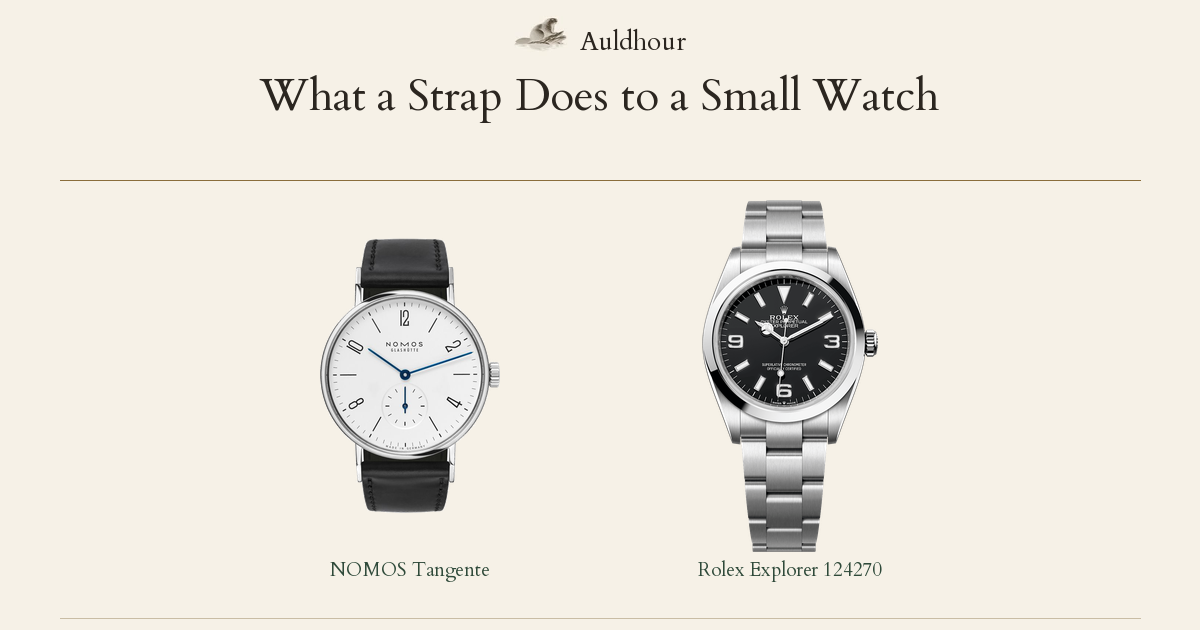
The 35 mm Nomos Tangente has an 18 mm strap. The current 36 mm Rolex Explorer has a bracelet that starts at 19 mm. Follow both toward the buckle, though, and their proportions reverse: the Nomos narrows to 16 mm, while the Explorer’s bracelet comes down to 14 mm.
The larger watch ends up with the narrower attachment. That is a useful place to start when trying to understand why a small watch can have rather more presence than its diameter suggests.
My Tangente can feel bigger on my wrist than my Explorer. The Nomos has plenty helping it along already, with an open dial, a thin bezel and those long, angular lugs. But the leather continues that impression beyond the case. There is enough width beside the watch to give the whole thing some substance.

The Explorer’s pronounced taper produces a different shape. The bracelet gathers inward as it wraps around the wrist, making the attachment progressively lighter. Looking at case diameter alone, you would miss that difference entirely.
We do tend to give that number an extraordinary amount of authority. Thirty-five millimeters sounds small. Thirty-six apparently qualifies as a sensible, historically respectable size for a man who may occasionally encounter a mountain. One millimeter has been asked to do quite a lot of cultural work there.
The Tangente’s proportions make the distinction less convincing. Its strap is half as wide as a 36 mm case, and on the 35 mm watch it gives the spare dial and fine hands something substantial to sit against. To my eye, 18 mm looks right. Make the strap much narrower and the watch takes on a more feminine character. That changes the appeal of the watch, even though the dial, hands and case have stayed exactly where they were.
Taper lets a designer adjust that relationship without changing the width between the lugs. The standard Nomos leather strap does narrow, but only by two millimeters. It retains much of its width around the wrist. The current Explorer loses five, starting a millimeter wider than the Nomos and finishing two millimeters narrower.
Those figures describe the strap and bracelet where they attach to their fastenings. The Explorer’s clasp housing is wider than the final bracelet links, so the bracelet doesn’t remain a uniform 14 mm beneath the wrist. Even so, the narrowing along its length is considerable.

It would be convenient if those measurements explained everything. They don’t. The Tangente’s long lugs carry the leather away from the case differently from the Explorer’s fitted end links, and its broad expanse of dial makes its own contribution. Put the same strap on two different watches and you still have two different watches.
What the comparison does show is how much design continues beyond the case. The width of a strap can reinforce a little watch’s presence. Taper can make the attachment recede, leaving the case more distinct against the wrist. Neither treatment needs a larger diameter to achieve it.
This also makes the usual distinction between the watch and its accessories seem a little artificial. We can discuss a case’s proportions down to fractions of a millimeter, then attach a completely different shape to either end and expect the original judgment to survive. Sometimes it will. Sometimes the strap was doing more of the work than we realized.
I like the substance that an 18 mm strap gives the Tangente. The watch can keep its small case and fine features without looking quite as delicate as those descriptions might suggest. Narrow it much further and I would be looking at a different proposition, however faithfully the specification sheet continued to call it the same 35 mm watch.
Thanks for reading this.
Leave a Reply