
Raketa is a Russian watch brand made at the Petrodvorets Watch Factory in Peterhof, near Saint Petersburg, an enterprise that traces itself to a stone-cutting works founded by Peter the Great in 1721. It spent its first two centuries cutting and polishing stone, became a watch factory after the Second World War, took the name Raketa in 1961 and for decades made millions of watches for Soviet buyers. After a collapse in the 1990s it was taken over by a small group of outside investors who rebuilt a working watchmaking operation.

A Soviet-era Raketa. Photo: Wikimedia Commons, CC BY-SA 4.0.
A lapidary works for the court
In 1721, the year Peter I took the title of Emperor of All Russia, he founded the Peterhof Lapidary Works. By its own account the works cut the diamonds for the Great Imperial Crown in 1762, and by the middle of the 19th century it was a known European maker of luxury goods that also worked on Saint Isaac’s Cathedral. In the 1890s it began collaborating on watches with the Talberg company. In 1935 ruby stars replaced the double-headed Imperial Eagles on the Moscow Kremlin, and the factory took part in producing them.
From stone to watches
Nazi troops destroyed the works in the Second World War, and in 1945 it was rebuilt specifically to make watches. In 1946 the Pobeda brand launched, with production at the newly named Petrodvorets Watch Factory and at two other factories, and more factories followed in the 1950s to meet demand. In 1961 Yuri Gagarin flew into orbit and the factory launched the Raketa brand, named for the Russian word for rocket. By the 1970s the factory employed about 8,000 workers and made more than five million watches a year, exporting to nearly forty countries. Russian polar explorers wore Raketa watches in 1969, and in 1980 the brand made the official watches for the Soviet Olympic Games.
The Copernicus and the zero
The Copernicus launched in the early 1980s with hands that represent planets orbiting a sun. A modern version keeps the large minute hand for the Earth, which orbits the sun in one year, and a small hour hand for Jupiter, which takes twelve. The Big Zero, a white-dial watch with an oversized zero at the top, was made famous by Mikhail Gorbachev, who wore it at a summit in Italy.
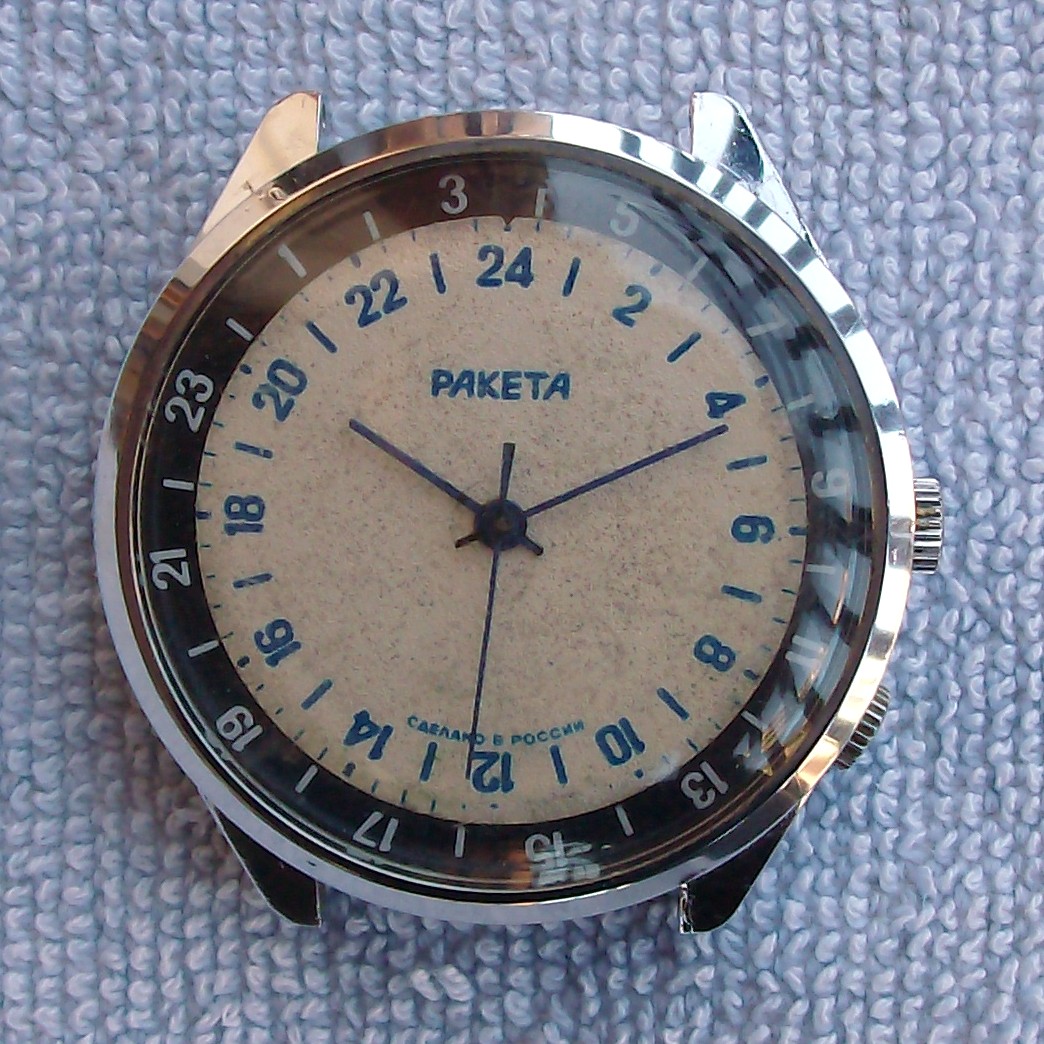
Raketa’s 24-hour dial, the format made for polar expeditions where the sun never sets. Photo: Wikimedia Commons, CC BY 3.0.
A near collapse and a takeover
The company survived the move from communism to capitalism in the 1990s in poor condition. When David Henderson-Stewart visited in 2009, a dozen elderly workers were using old machines to make cheap tourist timepieces. Henderson-Stewart, a lawyer, and Jacques von Polier, a former fund manager with no watch industry experience, bought the factory, according to von Polier in 2009. Von Polier became creative director. In 2012 the factory hired Jean-Claude Quenet, a top engineer from Rolex, and by 2013 it employed more than 100 people including Swiss consultants. It had sold 15,000 watches the previous year and aimed to at least double that.
Von Polier said the partners were betting on Russian pride, with the idea that Russians increasingly wanted local brands that matched their country’s cultural reputation, and he noted that Russia lacked a historic watch brand. The company set up an onsite school where veteran workers train apprentices, and in 2011 the factory was reorganized as a contemporary company.
The movement
The main caliber is an updated version of the Raketa-Avtomat of the 1960s, a robust hour, minute and second movement. Apart from the rubies, the movement is made in house, including a hairspring machined from a Soviet alloy. It can be adapted for a 24-hour display or made to run in reverse. In 2021 the factory marked its 300th anniversary and relaunched the Imperial Peterhof Factory brand.

A Soviet-era Raketa military watch. Photo: Wikimedia Commons, CC BY-SA 4.0.
Sources
- “From emperors to astronauts: the colourful history of Raketa,” Time+Tide
- “Q&A: Frenchman von Polier betting on Russian pride,” The Moscow Times
- “Raketa watches, Russian soul,” Watchonista
- “Raketa Copernicus, a watch inspired by Yuri Gagarin,” Square Mile
- History, Raketa
Thanks for reading this.
From the Dispatch: