
A solar watch turns light into the electricity that runs a quartz movement. Generating a little current from light was possible long before a watch could keep it, so the history of the idea is a history of storage and of hiding the cell: first a cell that could be recharged, then cells efficient enough to work indoors, and finally cells that disappeared under the dial.

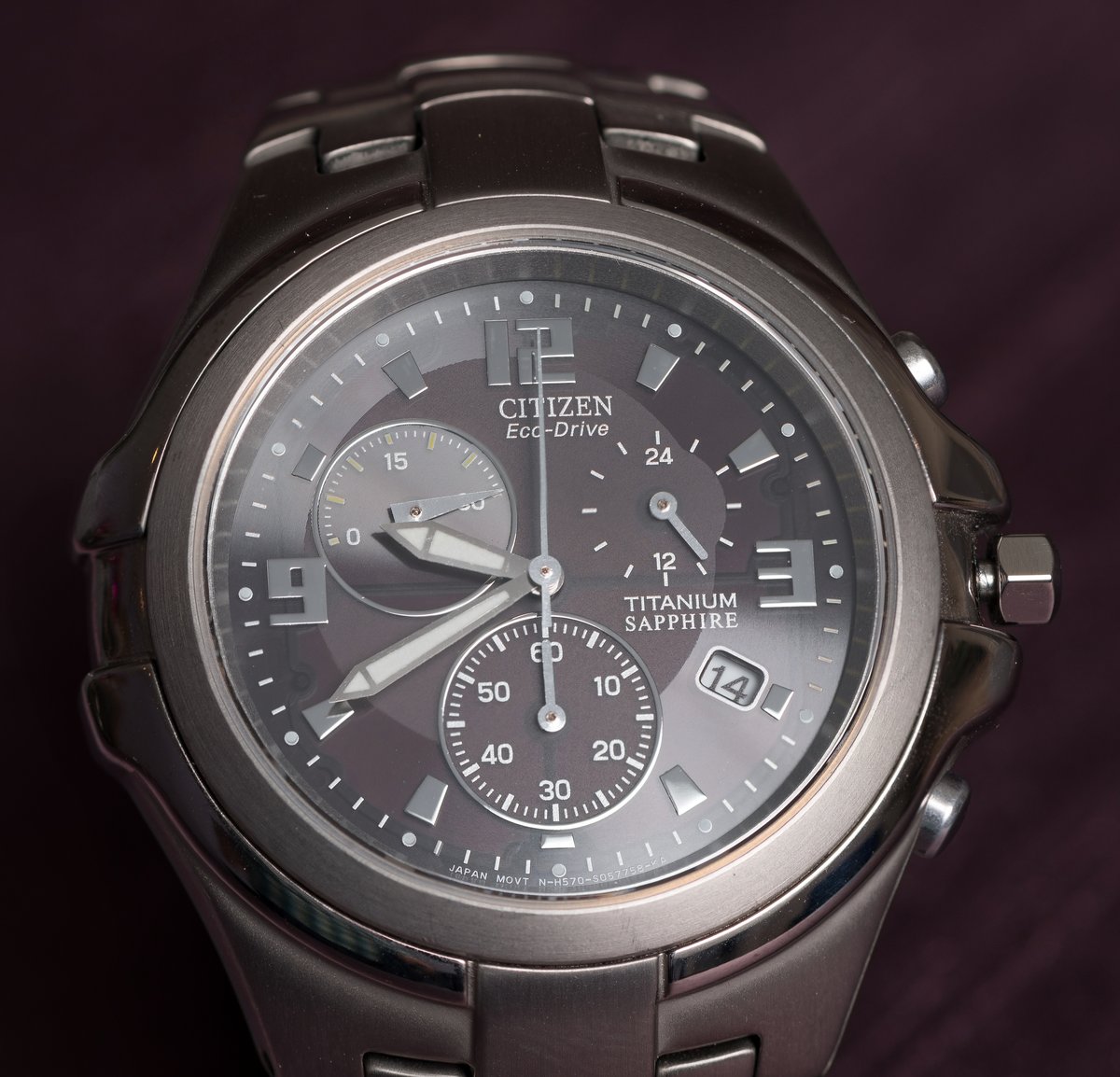
A Citizen Eco-Drive in titanium. The solar cell hides under the dial, so nothing about it looks like a gadget. Photo: Wikimedia Commons, CC BY-SA 3.0.
The energy budget
A photovoltaic cell converts the energy of light into a small direct current. A quartz movement draws very little, on the order of microamperes, so a cell of a few square centimeters under room lighting is enough to run it, provided there is somewhere to store the energy for the dark hours. Storage sets how long the watch runs in darkness, and the size of the cell sets how quickly it recharges. The watch therefore contains three parts: the cell, a storage element, and a circuit that manages the flow of current between the cell, the store and the movement, including a power-saving mode that stops the hands when no light arrives.
Before Citizen
The first solar-powered wristwatch was the Synchronar 2100 of 1972, developed largely alone by the American engineer Roger W. Riehl. It sold for about 500 dollars, had a perpetual calendar programmed on an integrated circuit, and used an LED display with three brightness levels that adjusted to ambient light. It was claimed to be accurate within one minute per year, and production ceased after Riehl’s death in 2005.
The oil embargo and the storage problem
The 1973 oil embargo prompted Citizen’s sustainable-power initiative. In 1974 Citizen completed its first light-driven watch prototype. Its engineers named the central difficulty as the lack of a suitable small secondary battery to store the power generated from light. In 1976 Citizen launched the Crystron Solar Cell as the first analog light-driven watch. It used eight monocrystalline silicon cells, a silver oxide battery and a charging circuit that controlled hydrogen gas. It could run up to five years on a full charge before needing maintenance and was accurate to 15 seconds per month.
Cells that work indoors
In 1986 Citizen introduced amorphous silicon cells, which absorb light better and let the watch run on indoor light as well as sunlight, along with electric double-layer capacitors for storage. The reserve reached about 200 hours, eight days, and charging took about a third of the time of competitors. Improved thin-film cells in the early 1990s made it possible to place the cell behind the dial, with light passing through the crystal and a translucent dial. The first movements used a titanium lithium-ion rechargeable cell, which had become available in the early 1990s. In 1995 the reserve reached six months, nearly 23 times the 1986 figure, and Citizen introduced the Eco-Drive line to Asia, Latin America and Europe, followed by the United States in April 1996. In 1996 Citizen released the first radio-controlled light-powered watch, accurate to 20 seconds a month without a signal. Citizen reports that the cell kept 80 percent of its capacity after 20 years in its tests.
Hiding the cell
A dial that lets light through is a dial that is not opaque, so a cell behind it limits what the dial can look like. Citizen developed a mixing process for polycarbonate resin that controls light permeability for each dye, and current models can work with dark dials that transmit less than 15 percent of light. The VITRO technology of 2002 took the cells out of sight. In 2001 the Eclipse and its caliber F810 introduced Ring Solar, a flexible solar strip around the dial periphery that allowed metal dials, which do not transmit light. A ring-shaped cell around the case appeared in the 2012 RING concept model. Other variants used different sources: the Eco-Drive Thermo of 1999 runs on body heat, and the Promaster Eco-Duo Drive of 1998 combined solar and mechanical power and did not attract consumer interest. Seiko Solar and Casio’s Tough Solar charge from any light.
Fifty years
Accuracy and autonomy kept improving. Caliber A010 reached plus or minus five seconds a year in 2011, and caliber 0100 one second a year. The Eco-Drive One of 2016 used a 1 mm movement in a case of about 3 mm. In 2023 the caliber E365 offered one year of operation on a full charge, and Citizen marked 50 years of Eco-Drive in 2026.

A Citizen Eco-Drive diver, the kind of watch solar power made practical. Photo: Wikimedia Commons, CC BY-SA 3.0.
Sources
- “Citizen Eco-Drive History Explained: 50 Years of Light-Powered Watch Innovation,” Time+Tide
- “Inside the Evolution of the Citizen Eco-Drive and Its 50th Anniversary,” WatchTime
- “As Long as There Is Light: A First-Hand Deep Dive on Citizen’s Eco-Drive Technology,” Worn & Wound
- “The First Solar-Powered Watch Was Far Ahead of Its Time,” Gear Patrol
- “Eco-Drive,” Wikipedia
Thanks for reading this.