

Resonance in a watch means two balance wheels that influence each other until they swing in step, or rather in opposition. The idea comes from a clock observation made in the 1660s, was turned into a precision device around 1780, and returned in two different forms in wristwatches in the twenty-first century. Its through-line is a single question: whether coupling two oscillators gives a steadier rate than isolating one.

One of Christiaan Huygens’s pendulum clocks. In 1665 he noticed two of them, hung on the same beam, falling into step. Photo: Wikimedia Commons, public domain.
Two balances, one rate
When two balance wheels are coupled, each affects the other. A small push from one arrives at the other at a phase that either reinforces or opposes its swing, and over many beats the two settle into a fixed phase relationship. In a wristwatch the coupling is usually a physical link: a spring, a shared bridge, or a common baseplate. The claim is that the average rate becomes steadier than either balance alone, because a disturbance in one is partly cancelled by the other. The effect is real in the laboratory and in clocks, but in a wristwatch it is hard to isolate from other improvements in the movement.
Huygens and the pendulum
Christiaan Huygens noticed the effect in 1665, when two pendulum clocks hung on the same beam fell into step. He called it an odd kind of sympathy. The clocks were not identical, and they did not start together, but the beam transmitted enough motion between them to lock their phases. Bennett and colleagues reconstructed the experiment in 2002 and attributed the synchronization to motion of the beam, not to air flow. Huygens thought the effect might help solve the longitude problem at sea, but the Royal Society doubted it, and the idea lay dormant.
Janvier, Breguet, and the wrist
Antide Janvier developed a double-pendulum construction around 1780. Pendulums beating in natural opposition would, in principle, cancel the effect of a shock on one of them, but the construction was delicate and never became standard. Breguet made a resonance clock in the early nineteenth century, with two movements that influenced each other through a shared frame. The idea returned to the wrist in 2000, when F.P. Journe released the Chronomètre à Résonance. It contains two complete movements, each with its own balance, and a shared baseplate that transmits energy between them. The two balances are set to beat in opposition, so that a shock to one is partly cancelled by the other.
Armin Strom and the resonance clutch
Armin Strom took a different route with the Mirrored Force Resonance, introduced in late autumn 2016 and first shown at Baselworld 2017. Its two balances are linked by a resonance clutch spring, a thin spring that connects the two balance staffs and transmits vibration between them. The clutch is designed to be stiff enough to couple the balances and flexible enough not to disturb their individual rates. Armin Strom claims the coupled balances improve rate stability, and the watch’s two seconds hands, which run in opposite directions, make the synchronization visible.
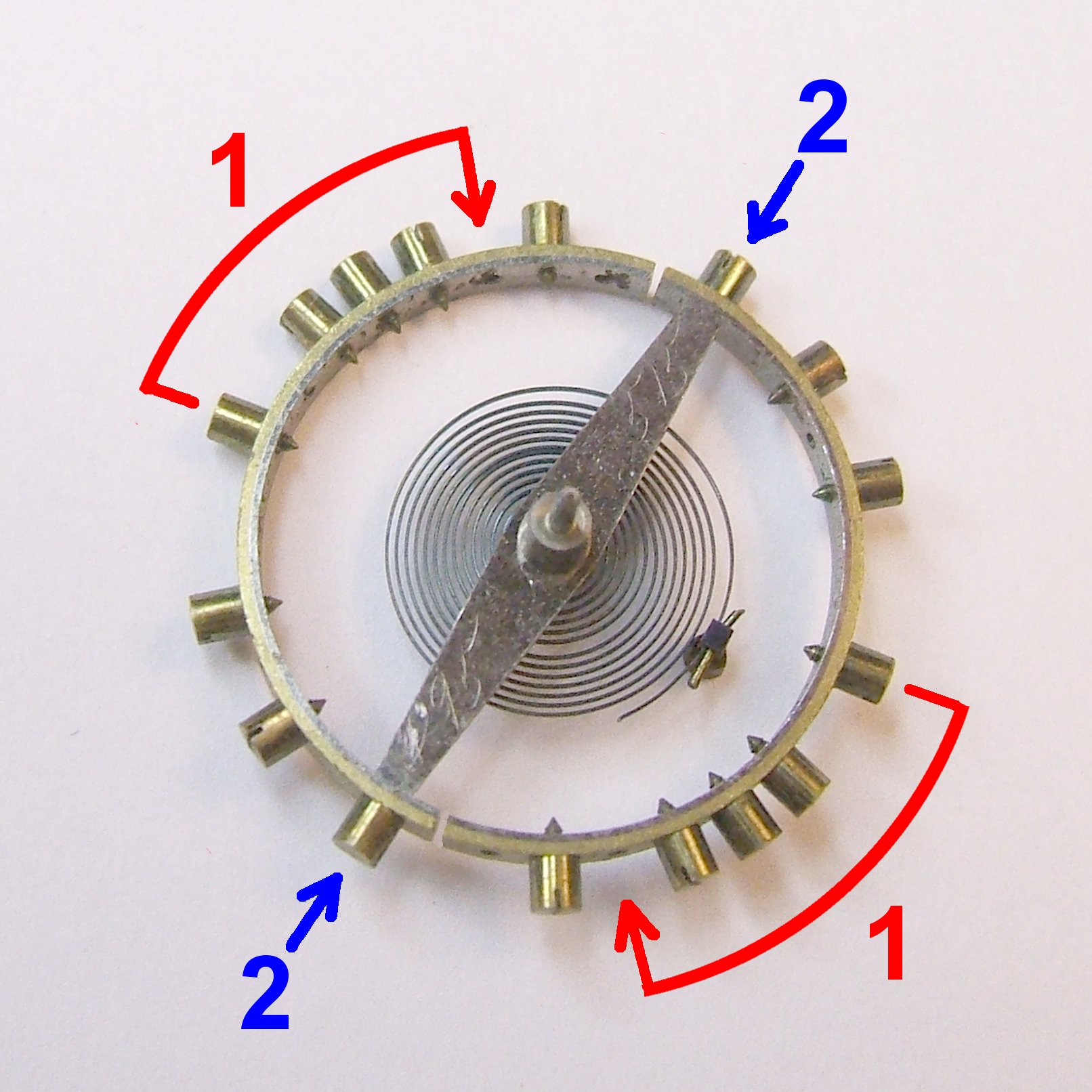
A balance wheel. Put two of these in careful conversation and they keep each other honest. Photo: Wikimedia Commons, CC BY-SA 4.0.
Sources
- “An Odd Kind of Sympathy,” WatchProZine
- “Synchronization of Two Metronomes,” arXiv
- “In-Depth: F.P. Journe’s Chronomètre à Résonance, From 2000 To Today,” Revolution
- “Chronomètre à Résonance,” F.P. Journe
- “Armin Strom Mirrored Force Resonance,” WatchProSite
- “Armin Strom Collaborates with CSEM,” Fondation de la Haute Horlogerie
Thanks for reading this.