
A remontoir, from the French remonter, “to wind,” is a small secondary power source that drives the escapement and is rewound at intervals by the main power. It exists because a mainspring cannot push evenly: its torque falls as it unwinds, the balance’s amplitude falls with it, and a balance that is not perfectly isochronous changes its rate. Clockmakers solved this with weights, watchmakers had to solve it again with springs, and the device reached the wrist only at the end of the 1990s.

A spring remontoire, diagrammed for the 1911 Encyclopaedia Britannica. The principle is centuries old. Photo: Wikimedia Commons, public domain.
The principle
A small secondary spring, or weight, sits between the gear train and the escape wheel. The train rewinds it at set intervals, and between rewinds it alone drives the escapement. Because it is always wound to the same degree, it delivers the same torque each time it unwinds, whatever the state of the mainspring, so the rate depends much less on how wound the mainspring is. The benefit is largest in movements with a long reserve and a single large barrel, where the mainspring’s torque varies most. The interval is the key design parameter. If it is too long, the secondary spring partly relaxes before it is rewound, and the variation in force returns. The cycles range from a vibration-based remontoir that rewinds at every half oscillation of the balance, about eight times a second at 4 Hz, which is the most stable but the hardest to design, make and regulate, to a seconds remontoir that releases and rewinds once a second, which tolerates a larger force variation and often shows as a jump of the seconds hand. In tower clocks, thirty seconds and one minute are the most common intervals.
A weight that is lifted again
The gravity remontoir is usually credited to the Swiss clockmaker Jost Bürgi around 1595, and his Kalenderuhr is generally considered the oldest surviving clock with one. A weight drives the escapement, and the main power periodically lifts it again by equal amounts at equal intervals. Placing a more even power source near the escapement reduces the rate errors caused by uneven friction in the gear train. In tower clocks the remontoir also isolates the escapement from disturbances elsewhere in the movement, such as wind and ice on the hands, and the release of striking or chiming trains. Most tower clocks lacked one because it was costly and needed skilled maintenance, and makers often relied on heavier weights and sturdier trains instead. In domestic clocks a Robin-type gravity remontoir, driven by a mainspring, countered the declining power of the unwinding spring, with a fusee as a cheaper, less accurate alternative. In all these forms the device was known to the seventeenth century and widely used in large precision clocks and observatory regulators.
A spring for the wrist
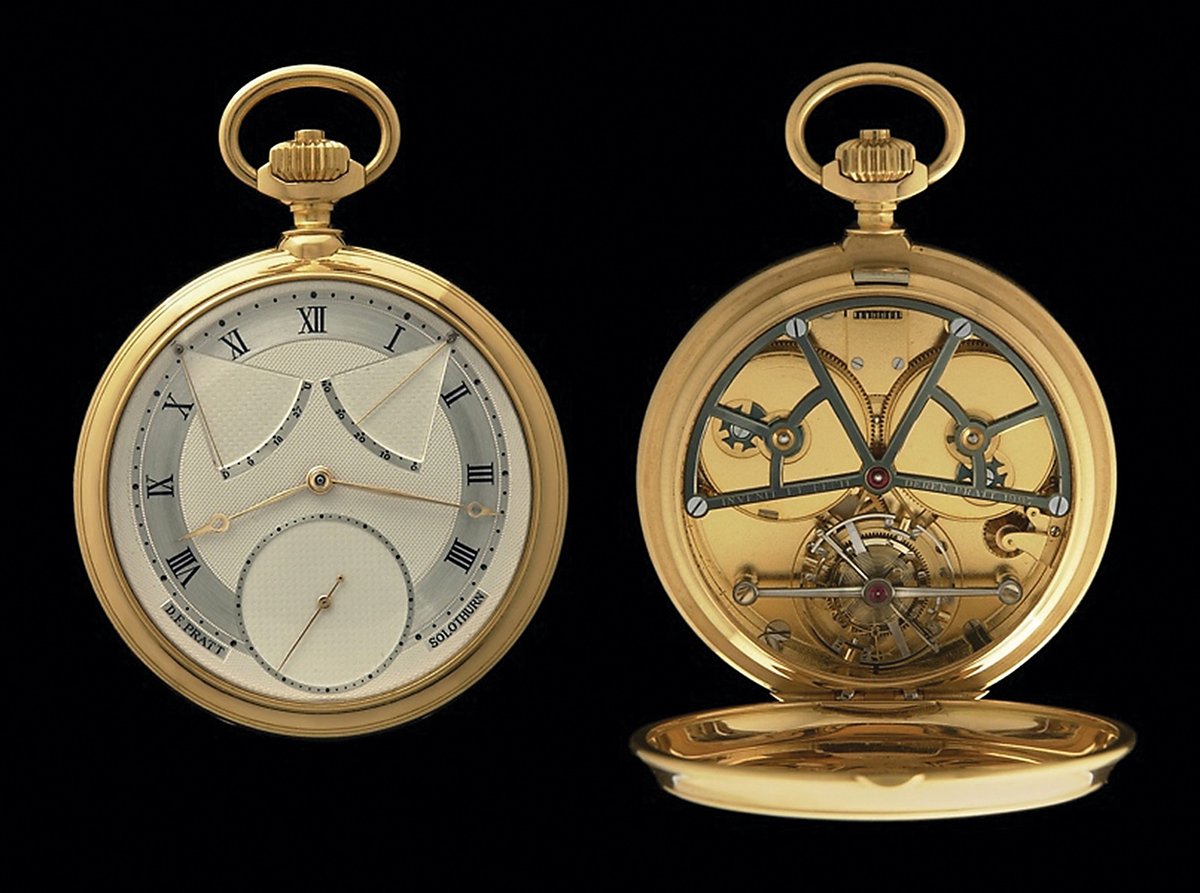
Only a spring remontoir can be used in a watch, because wrist motion would disturb a weight. The smaller the watch, the harder the problem, since the secondary spring and its release have to fit alongside the rest of the movement. From the 1990s several high-end manufactures took it on, and silicon made miniaturization easier by allowing lighter and more consistent springs. It remains rare. The word has an unrelated use. Many French and Swiss pocket watches made after 1860 were stamped “Remontoire,” but that meant only that they were wound by a crown rather than a key, and they usually did not contain a true remontoir.
The remontoir reaches the wrist
F.P. Journe’s Tourbillon Souverain with a remontoir d’égalité, launched in 1999, is cited as the point at which the remontoir entered wristwatches. The device sits at 7 o’clock and is wound in short spurts by the mainspring. The watch also has a deadbeat seconds hand, which jumps one second at a time. Grönefeld’s 1941 Remontoire, shown at Baselworld 2016, rewinds its small spring every eight seconds, against the one-second cycle of most similar devices. Its calibre G-05 is hand-wound, 32.0 mm across and 5.5 mm thick, with 258 parts and 36 jewels. A governor at 9 o’clock regulates the slap when the remontoir releases, and the 36-hour power reserve is delivered with constant force through a stop system. A. Lange & Söhne uses the device on a longer scale. Its constant-force escapement re-tensions the remontoir spring by short, fixed steps, and in the Richard Lange Perpetual Calendar Terraluna, which has a 14-day reserve from twin barrels, the step is 60 degrees every 10 seconds. The Zeitwerk re-tensions every 60 seconds, and each cycle also releases a brief burst of full mainspring torque that drives the jumping numeral discs. The Richard Lange Jumping Seconds re-tensions once a second, and each cycle advances the seconds hand. The effect is negligible in a watch with a 2 to 3 day reserve and becomes significant at 14 or 31 days. The Lange 31, launched in 2007, shows why. Its calibre L034.1 has a 31-day power reserve, described as the first and still the only mechanical timepiece with a reserve lasting an entire month. A constant-force device sits between the two mainspring barrels and the going train and delivers a fixed amount of energy to the escapement every ten seconds, so the balance keeps the same amplitude as the mainsprings wind down. A triangular cam on the fourth-wheel arbor drives a pivoting lever that recharges the remontoir spring. The springs are too strong for the crown, so the watch is wound with a separate key that fits a socket in a recess in the caseback.

A tourbillon up close. Remontoirs often keep it company in high-end constant-force calibers. Photo: Wikimedia Commons, CC BY-SA 2.0.
Sources
- “The Remontoir,” Horopedia
- “Constant-Force Escapement,” A. Lange & Söhne
- “Technical Perspective: The Dilemma of Constant Force in Watchmaking,” Monochrome
- “Remontoire,” My Time Machines
- “Monday Lessons: Explaining the Ups and Downs of Constant Force Mechanisms in Mechanical Movements,” Watches by SJX
- “Tourbillon Souverain,” F.P. Journe
- “Review: Grönefeld 1941 Remontoire,” Deployant
- “Power Packed: A. Lange & Söhne Lange 31 in White Gold,” WatchTime
Thanks for reading this.