
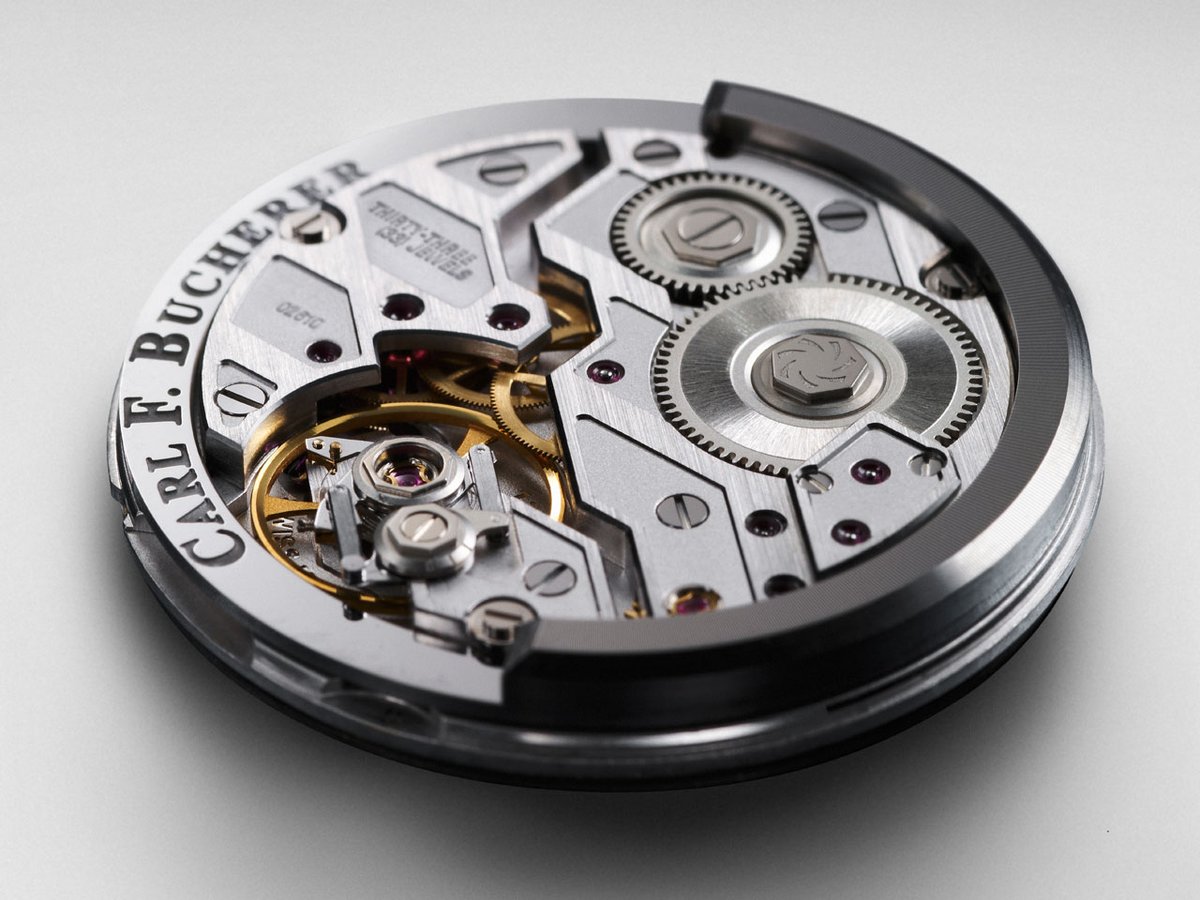
A peripheral rotor is an annular weight that swings around the outside of the movement instead of over it. Nothing sits on top of the wheels, which allows a thinner automatic watch and an unobstructed view of the movement. Its history is the history of a second answer to the thickness of the central rotor, and of the difficulty of fitting a crown to a movement whose edge is occupied.

A Carl F. Bucherer Manero tourbillon. The brand’s peripheral-rotor calibers keep the movement fully visible from the back. Photo: Wikimedia Commons, CC BY-SA 4.0.
The geometry
A rotor’s winding ability depends on its moment of inertia, which rises with both its mass and its distance from the axis. A peripheral rotor puts all of its mass at the outer rim of the movement, which is the largest radius available, so for a given mass it has the highest moment of inertia of any rotor that fits in the case. It is also in the plane of the movement, not above it, so it adds no thickness. These two properties are the whole case for it, and one source calls it much more efficient than a micro-rotor.
First patents, and the crown problem
In June 1955 Paul Gosteli of Geneva filed a Swiss patent (No. 322325) for a winding system with an annular segment around the movement cage. In June 1965 Patek Philippe filed a Swiss patent (No. 548213) for a peripheral winding mass, which led to the calibre 350. Because the rotor ran around the edge of the movement, the crown moved to the case back. The rim is the place where the stem, the crown and the setting mechanism enter the movement. A rotor that occupies the entire rim has to leave room for them. Moving the crown to the case back gave up a convenience, and the type stayed rare for decades.
Bucherer and the return of the crown
In 2009 Carl F. Bucherer introduced the Calibre A1000, the first peripheral-rotor movement produced on a large scale, with a conventional crown and stem at 3 o’clock. Three small rollers coated in DLC, with ceramic ball bearings that need no lubrication, carry the rotor. Two clutch wheels with clamp rollers let it wind in either direction. The A2000 followed in 2016, and the T3000, with a peripheral tourbillon regulator, in 2018.
The thinnest automatics
In 2017 Piaget’s Altiplano Ultimate Automatic, calibre 910P, became the thinnest automatic watch at 4.30 mm. In 2018 Bvlgari’s Octo Finissimo Automatic Tourbillon was described as the thinnest automatic watch and the thinnest tourbillon at 3.95 mm. Bvlgari needed a pusher at 4 o’clock to switch between setting the time and winding, and its movement is the same height as the non-automatic version but larger in diameter. Other examples include the Cartier calibre 9603 MC, which has a shaped weight, and movements by De Witt, Vacheron Constantin, Breguet and Audemars Piguet.
Where it stands
Central rotors have been standard since the 1950s, and peripheral rotors are the newer approach. They cost a larger movement and a more complicated edge, and they buy thinness with the weight placed where its leverage is greatest.
Sources
- “Technical Perspective: Peripheral Rotor Automatic Winding,” Monochrome
- “Peripheral rotor,” Grail Watch Reference
- “History of the Automatic Watch,” Monochrome
- “Peripheral Rotors: Watch Movement Complication,” WatchProSite
Thanks for reading this.