
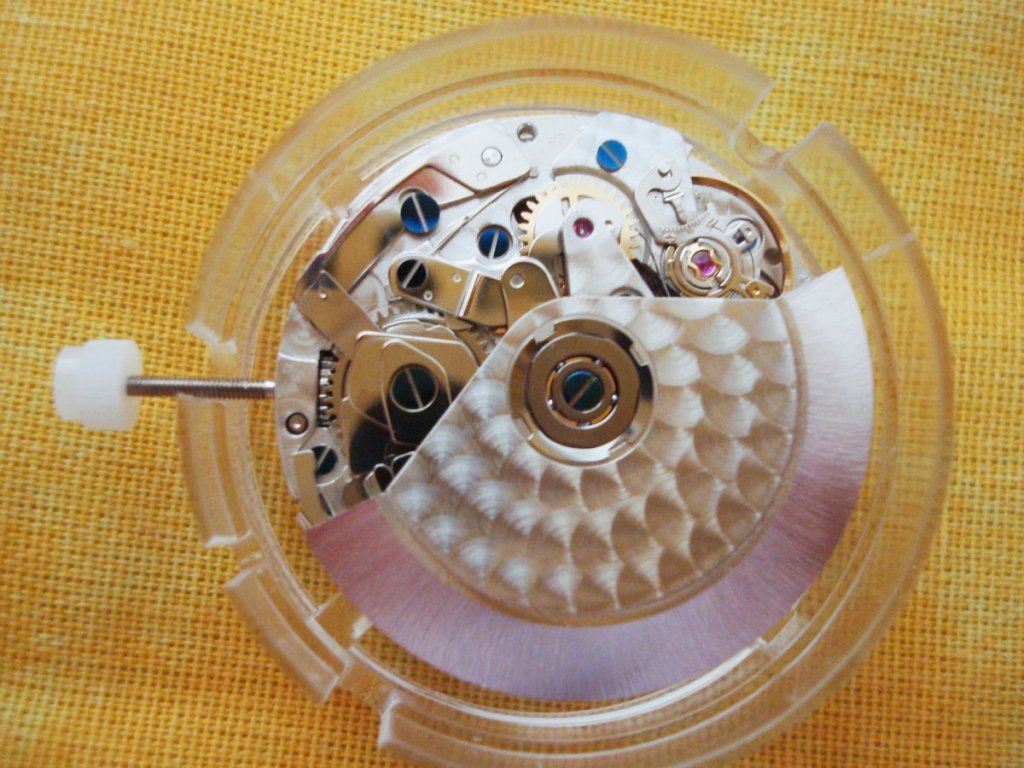
A caliber is a movement’s name. The word started as a size designation: in the old French system, a caliber was the diameter of a movement measured in lignes, so a watchmaker could ask for a 19-ligne caliber the way you would ask for a shoe size. Over time it stopped meaning size and started meaning the design itself. Today, when someone says a watch runs a Valjoux 7750 or an ETA 2824, they are naming the engine inside, the way a car person names an engine block. Learn the calibers and you can read the industry.

An ETA 2824 up close: the most common Swiss automatic movement ever made. Photo: Wikimedia Commons, CC BY-SA 2.0.
How calibers get their names
There is no single system, which tells you something about the industry. ETA numbers its movements sequentially: the 2824 is a three-hand automatic, the 7750 is a chronograph, and the numbers carry no meaning beyond filing order. Valjoux kept its own numbering before ETA absorbed it, which is why the 7750 still says Valjoux in everyone’s head. Manufactures name theirs after themselves: Rolex 3135, Patek Philippe 324, Zenith’s El Primero line. Seiko and Citizen use their own codes, 7S26 and 8215, which mean nothing until you learn them and then mean everything. The names are arbitrary. The reputations are earned.
The canon
If movements have a canon, these are in it. The ETA 2824 is the default Swiss automatic: a simple, tough three-hander that has powered thousands of watch models since the 1970s, and the movement most watchmakers learn to service first. The Valjoux 7750, born in 1973-74, is the automatic chronograph in everything: designer Edmond Capt replaced the traditional column wheel with a cheaper cam-switching system, had the movement simulated on a computer (a first), and when management ordered the tooling destroyed during the quartz crisis, he quietly disobeyed and saved it. The Zenith El Primero, unveiled January 10, 1969, was the first integrated automatic chronograph and beats at 36,000 vibrations per hour; of the three 1969 automatic chronographs, it is the only one still in production. The Lemania 2310, sold by Omega as the caliber 321, is the manual-wind chronograph that went to the Moon. The Seiko 7S26 and Miyota 8215 are the honest workhorses of the affordable end: rugged automatics inside millions of Seiko 5s and countless microbrand watches, respectively. The Rolex 3135 was Rolex’s date movement for decades, the definition of a movement designed to never be thought about. And the Patek Philippe 324 is the base automatic under half of modern Patek’s catalog, which tells you what Geneva thinks a proper movement looks like.

A Zenith El Primero: 36,000 beats per hour, in production since 1969. Photo: Wikimedia Commons, CC BY-SA 2.0.
Why it matters
Calibers matter because they are how the industry actually talks to itself. Collectors do not say “my watch has a nice automatic chronograph movement.” They say “it’s a 7750,” and everyone in the conversation instantly knows the beat rate, the rotor feel, the service cost, and roughly what the watch should sell for. A caliber name is a compressed file full of shared knowledge. Learn a dozen of them and the whole watch world starts making a different kind of sense, the kind where you can look at a spec sheet and hear the movement running.

The Valjoux 7750 inside a Guinand chronograph: the cam-switched workhorse that survived its own execution order. Photo: Wikimedia Commons, CC BY-SA 3.0.
Thanks for reading this.

