
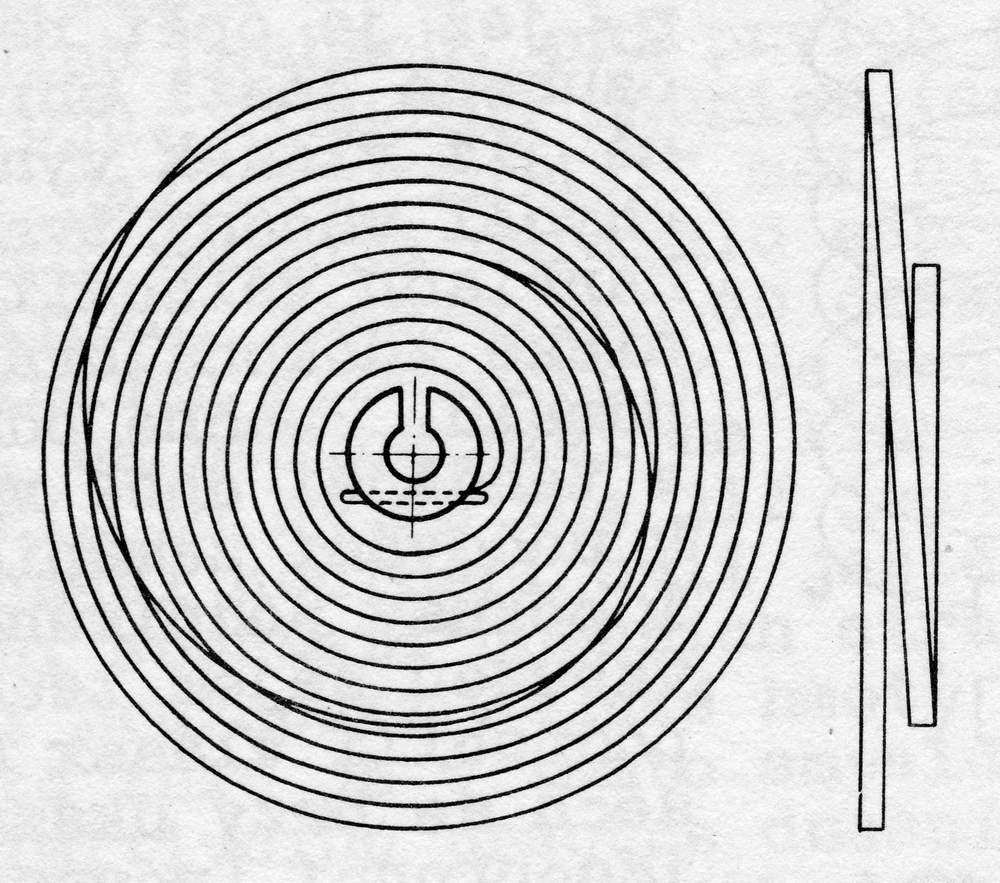
The hairspring is the spiral spring that pulls the balance back toward its center and, with the balance, sets the rate of a mechanical watch. It is a strip of metal or silicon a fraction of a millimeter wide and tall and a few centimeters long, and it has to behave as a perfect linear spring while the temperature changes, the watch moves, the spring itself winds and unwinds, and magnets pass nearby. The history of the hairspring is a list of those flaws in the order they were found: the lack of a restoring force, uneven breathing, temperature, magnetism, and the limits of hand shaping.

A Breguet overcoil: the raised outer curve keeps the spring breathing concentrically. Photo: Wikimedia Commons, CC BY-SA 4.0.
What the spring has to do
A spiral strip of length L, width b and thickness h, made of a material with Young’s modulus E, has a stiffness against twisting of about k = E b h³ / (12 L) so the restoring torque is M = kθ and the period of the balance is T = 2π√(I/k). Stiffness depends on the cube of thickness, so a change of a micrometer in a spring a few hundredths of a millimeter thick moves the rate by a measurable amount. It also scales directly with E, which means that anything that changes the modulus of the material changes the rate. Temperature acts through three terms. Expansion of the balance changes I, expansion of the spring changes its dimensions, and the modulus itself shifts with temperature. Writing e for the thermoelastic coefficient, the fractional change of the period per degree is ΔT/T = ½ (2αb − e − 3αs) Δt where αb and αs are the expansion coefficients of balance and spring. For steel, e is negative, so the modulus drops as the metal warms and the period grows: the uncompensated steel spring loses on the order of ten seconds a day for every degree of warming. A compensated spring is one whose e is set close to zero, or to a value that cancels the expansion terms.
Breathing and the problem of the center of gravity
As the balance swings, the spring winds and unwinds, and its coils expand and contract, an action called breathing. A spring that is fixed at its outer end cannot breathe symmetrically: its coils shift off the balance axis. The shift of the center of gravity is small. The larger problem is that uneven development puts a side force on the balance staff, which presses the pivots into their jewels, adds friction and wear, and makes the rate depend on amplitude, which is isochronism. The target is a spring whose reaction on the staff is as close as possible to a pure torque.
The first springs and the end curve
Christiaan Huygens described a spiral spring on the balance in 1675, which gave the oscillator its own restoring force. The flat spiral was first pinned at both ends in an arrangement that breathed unevenly. Makers addressed the problem by hand. Gourdain’s courbes tâtées, shaped by trial and feel, reshaped the outer turns. John Arnold put end curves on cylindrical springs, and Abraham-Louis Breguet adapted the idea to flat springs around 1795. His overcoil raises the last turn into a plane above the others and bends it toward the outer pinning point, so that the spring can breathe about the balance axis. These early curves were made by adjustment, without a rigorous theory.
Phillips and the theory of terminal curves
In 1860 Edouard Phillips published a memoir that treated the problem as mechanics. He assumed that uneven development produces a side force on the pivot and derived the conditions for canceling it. The center of gravity of the terminal curve must lie on a radius perpendicular to the line joining the center of gravity of the spiral and the point where the curve leaves the spiral, and its distance from the spiral’s center of gravity must equal the square of the spiral’s radius divided by the length of the curve: d = R² / L. The condition does not fix a single shape. A circular arc, two arcs, or two arcs joined by a straight line can all satisfy it, which is why makers’ overcoils differ in outline. Phillips also showed that the overcoil works better on large springs. Jules Grossmann of Le Locle carried the theory to the inner end of flat springs, designing an inner curve to cancel the side pressure from the innermost coils against the collet. Phillips visited him in 1871 and they remained in contact until Phillips’s death in 1889. The shape is hard to form accurately, and the benefit has been questioned.
Alloys against temperature
Compensation by shape was never enough, because the modulus of steel kept moving. The next step was a change of alloy. Invar, introduced by Guillaume, had low expansion. In the 1920s Guillaume and Perret worked on Elinvar, an iron-nickel-chromium alloy whose modulus is nearly independent of temperature, which cured the temperature error and the middle temperature error of the bimetallic balance. Its weakness was drift and rust. The next generation was an alloy that could be drawn, hardened and aged to a stable, non-magnetic spring. Reinhard Straumann’s Swiss patent of 1932 led to Nivarox in 1934, and the alloy was improved as Nivarox-FAR in 1984. Nivarox is largely resistant to magnetism and became the default hairspring material of the Swiss industry. Later steps were SPRON 610 from Seiko in 2009 and Nivachron in 2018, intended to resist magnetic fields more fully while keeping the temperature behavior of Nivarox.
Silicon
A silicon spring is not wound or drawn. It is etched from a wafer by deep reactive-ion etching, which gives a shape accurate to the micrometer, with an integral collet and terminal curve designed as a single piece. Silicon is non-magnetic, stiff, light and free of fatigue. Its modulus falls with temperature as steel’s does, and the usual fix is a thin oxide layer on the surface, because silicon dioxide has an opposite temperature coefficient of modulus. The chronology is short. Ulysse Nardin’s Freak of 2001 introduced a silicon escape wheel and, in 2002, a patented silicon spring. Patek Philippe’s Spiromax followed in 2006 and Omega’s silicon spring in 2008. Omega introduced Syloxi in 2014. A patent dispute over the technology was settled in 2013, and the patent expired in 2022.
The two shapes in use now
Modern watches use a flat spring with a Breguet overcoil, a flat spring with a Phillips-type terminal curve, or a cylindrical spring in chronometers. The flat spring is thin, and it can be made in a silicon wafer in a variety of curves that were impractical by hand. The spring is pinned to a collet at the center and to a stud on a bridge or cock at the outer end, and the part that touches the regulator is the outer coil, covered in the Regulators article.
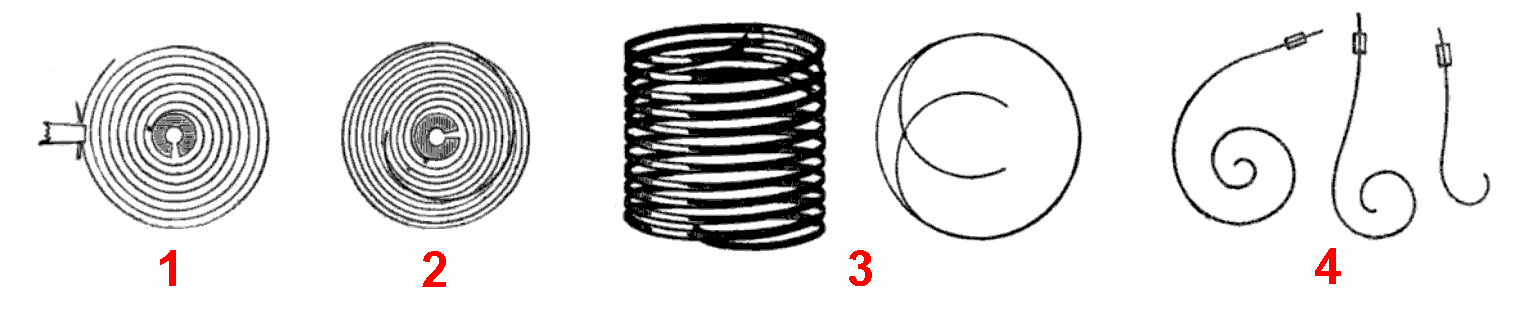
Hairspring varieties, from flat spirals to overcoils. Photo: Wikimedia Commons, public domain.
Sources
- “Insight: The Overcoil Hairspring, From Breguet to Phillips,” Watches by SJX
- “Invention of the Breguet balance-spring,” Breguet
- “Insight: Hairspring Materials and Evolution Part II,” Watches by SJX
- “20 Years of Watchmaking: The Silicon Revolution, Part 1,” Worldtempus
- “Balance Spring / Hairspring,” Horopedia
Thanks for reading this.