
An electro-mechanical watch replaces the mainspring with a battery and keeps a mechanical oscillator, or replaces the oscillator with a tuning fork and keeps the gear train. For about a decade, from 1957 to the early 1970s, the combination looked like the future of the wristwatch. Its through-line is the oscillator: a balance wheel nudged by a coil, then a tuning fork at 360 Hz, and then a quartz crystal, which ended the category.
What a battery changes
A mainspring stores energy in a form that declines as it unwinds, and its force varies. A battery supplies a nearly constant voltage. If a coil and magnet are used to give the balance a push at each swing, the push can be the same every time, which removes the variation in drive force that an escapement has to tolerate. The oscillator can then be a balance as before, or something stiffer and faster. The period of any oscillator is set by its stiffness and inertia, and the frequency of a tuning fork is determined by its arms in the same way as the frequency of a quartz crystal, only lower and with less stability.
A coil replaces the mainspring
Elgin released its first electrical watch, the Grade 725, in 1952. In 1957 Hamilton introduced what it called the world’s first electric-powered watches. The calibre 500 used magnets and an electromagnetic coil together with a gear train and a balance wheel, and it was later upgraded to the 505. It debuted in the Ventura, whose case was designed by the American industrial designer Richard Arbib, who was told by Hamilton to design freely, without regard for practicality. Elvis Presley bought his own Ventura and wore it on the set of Blue Hawaii in 1961. Hamilton revived the Ventura in 1988 and lists it today with quartz or mechanical movements.

A Hamilton Electric with the caliber 500 movement. Photo: Wikimedia Commons, CC BY-SA 3.0.
A fork in place of a balance
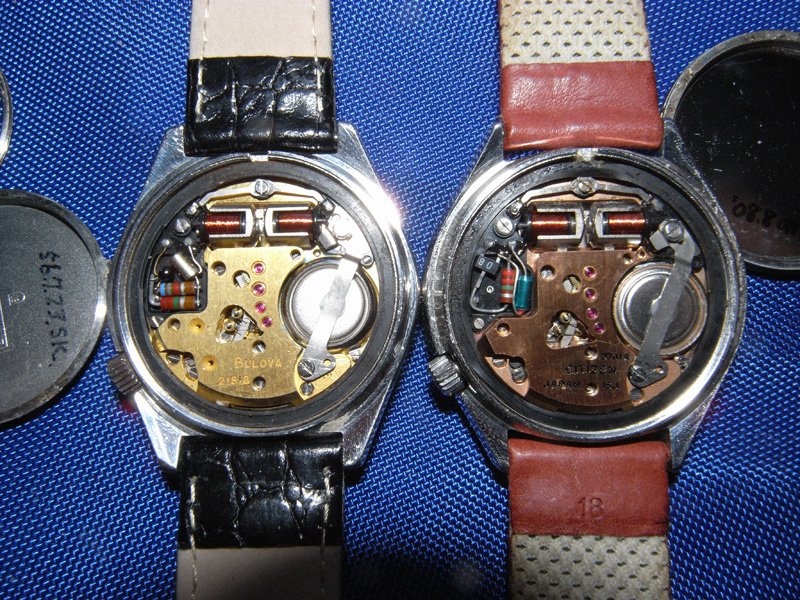
The Accutron began with the Swiss engineer Max Hetzel, who was recruited in Bienne in 1950 to lead the project for Bulova. He registered a patent on 19 June 1953 under number 312290, and the first prototype became operational in 1954, after which Hetzel built seven more. William O. Bennett developed the calibre 214, the first tuning fork movement, in 1959. Bulova launched the Accutron in October 1960 and sales began in 1961, with advertising that cited a precision of 99.9977 percent, which corresponds to about two seconds a day. The tuning fork vibrates at 360 Hz, about 90 times faster than a balance at 4 Hz, and the movement was accurate to about one minute a month. Two transistors surround the fork, which they keep vibrating, and the fork turns the gear train through a small indexing wheel. The Accutron was certified for American railroad staff in 1962. Gordon Cooper used his during the Faith 7 mission in 1963, and President Lyndon Johnson gave Accutrons as State gifts in 1964. The calibre 218 followed in 1965, 4.4 mm thick against 5.5 mm for the 214. In 1972 the calibre 219 began production with one transistor.

Diagram of the Accutron’s tuning-fork movement. Photo: Wikimedia Commons, CC BY-SA 4.0.
Switzerland follows
ESA, the Swiss movement maker, introduced the 9150 Dynotron in 1968 as its first electric movement. That year it also licensed tuning fork technology from Bulova, and in 1969 it began production of the 9162 (date) and 9164 (day and date) tuning fork movements. The Omega f300 and the Longines Ultronic used the 9162 and 9164. The ESA 9210 was a tuning fork chronograph, used by Omega in the Speedsonic and by Certina and Longines. The 9156 Dynotron of 1972 was used in the Certina Biostar Electronic, and the 9176 of 1975 in the Jaz-Derby Swissonic.

An Accutron Spaceview, the open-dial model that showed off the movement. Photo: Wikimedia Commons, CC BY-SA 2.0.
The end of the category
Quartz watches appeared in 1969. ESA ended production of the 9162 and 9164 in 1976, and Bulova released quartz Accutrons the same year. Tuning fork production ended in 1977 after more than five million pieces had been sold. Bulova issued 1,000 Astronaut reissues in 2007 with an ETA movement, 1,000 Spaceview replicas for the 50th anniversary in 2010, and the Accutron II in 2014, after Citizen took over Bulova in 2008.
Sources
- “Bulova Accutron: The Tuning Fork Revolution,” Watchonista
- “Watches You Should Know: Hamilton Ventura Electric,” Gear Patrol
- “Designing an Icon,” Hamilton
- “Electric Watches,” Electric Watches UK
Thanks for reading this.