
In 1943, the British Ministry of Defence invited twelve Swiss watch companies to make a wristwatch to a single specification, R.S./Prov/4373A. The watches were stamped W.W.W. on the caseback, which stood for “watches, wristlet, waterproof,” the British Army’s gloriously literal naming convention. The twelve brands were Buren, Cyma, Eterna, Grana, IWC, Jaeger-LeCoultre, Lemania, Longines, Omega, Record, Timor, and Vertex. Approximately 145,000 to 150,000 were delivered. Collectors later nicknamed them the “Dirty Dozen,” which is a fun name for twelve very boring-looking watches.
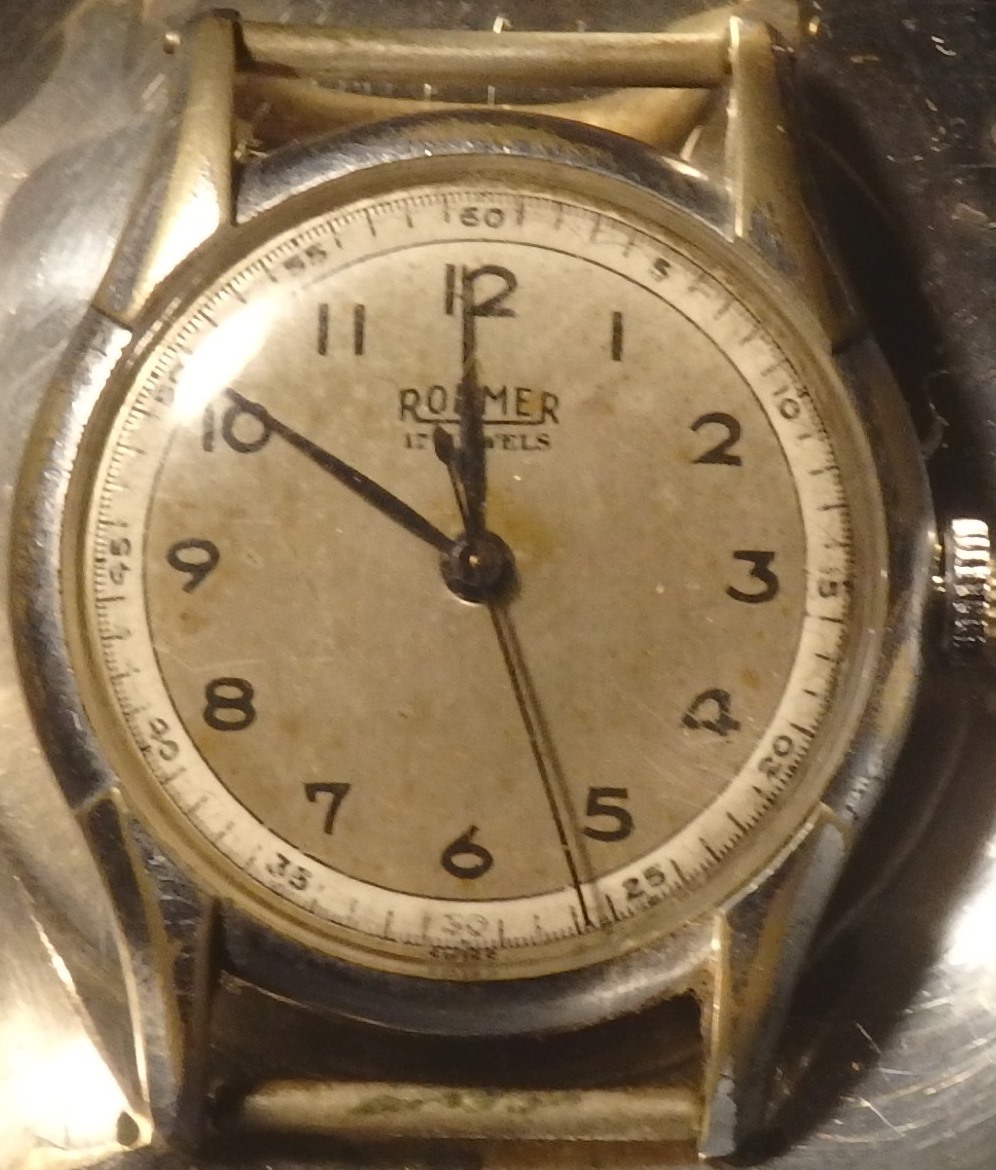
A Roamer watch used by a British airman with No. 159 Squadron RAF. British military watches of the era shared the Dirty Dozen’s black dial and Arabic numerals. Photo: Wikimedia Commons.
The spec was strict. A black dial, 36 to 37 millimeters across, Arabic numerals, small seconds at six o’clock, radium lume, a 15-jewel movement, and the broad arrow marking British government property. Omega made about 25,000, Record made about 25,000, Cyma made about 20,000, and the numbers trail down to Grana, which made somewhere between 1,000 and 5,000. Vertex was the only British company of the twelve, though even Vertex had its watches built in Swiss factories, because that is how the Swiss watch industry worked. Everyone’s watches were Swiss. The British just put their name on some of them.
The American approach: good enough, millions of times
The Americans had their own spec, and theirs was about volume. The A-11 was the standard US Army Air Forces navigator’s watch, built to spec 94-27834, and it was made by Elgin, Waltham, and Bulova starting in 1941. Black dial, white numerals (earlier ones had white dials, changed to black in 1942 for legibility), center seconds, a hacking function so you could synchronize with other crew members, 15 or 16 jewels, accurate to about 30 seconds a day. The case had a coin edge so you could grip it with gloves. The Navy got a version with more lume under a different spec number. Millions were made. The A-11 was a good-enough watch, made in staggering numbers, and it did the job. It was later superseded by the A-17, which nobody remembers, because the A-11 had already become the archetype.
There is a temptation to get romantic about military watches, and I am as susceptible as anyone, but the A-11 is worth understanding plainly. It was a procurement item. The US government needed something cheap, readable, and accurate enough to navigate by, and three American companies delivered. The fact that collectors now pay real money for them says more about us than about the watches.
The German approach: enormous, precise, and borrowed
The German Luftwaffe issued the Beobachtungsuhr, the B-Uhr, to navigators. These were 55 millimeters across, which is enormous by any standard, worn over a flight jacket on a long leather strap. They carried the FL 23883 designation and were made by five companies. A. Lange and Sohne, IWC, Laco, Stowa, and Wempe. The movements were large pocket-watch calibers, Lange’s cal. 48/1 being the most famous, with hacking seconds, Breguet hairsprings, and iron anti-magnetic cages. They had no shock protection, which seems like an oversight until you remember these were cockpit instruments that lived in padded boxes, not wristwatches in the modern sense. Each one was tested in six positions and at three temperatures to the standards of the Deutsche Seewarte, the German naval observatory. They were issued before a mission and returned afterward. They were equipment, not possessions.
Two dial types exist. Type A, made from 1940 to January 1941, has a simple triangle at twelve. Type B, from January 1941 onward, has the big minute track with the distinctive arrowhead hour markers that every modern flieger homage copies. If you have ever seen a modern pilot’s watch with that dial, it is copying the Type B. Most of them do not mention where the design comes from, which is probably for the best. These were navigation instruments made for the Luftwaffe. The engineering was excellent. The cause was not. Both of those things are true, and neither cancels the other.

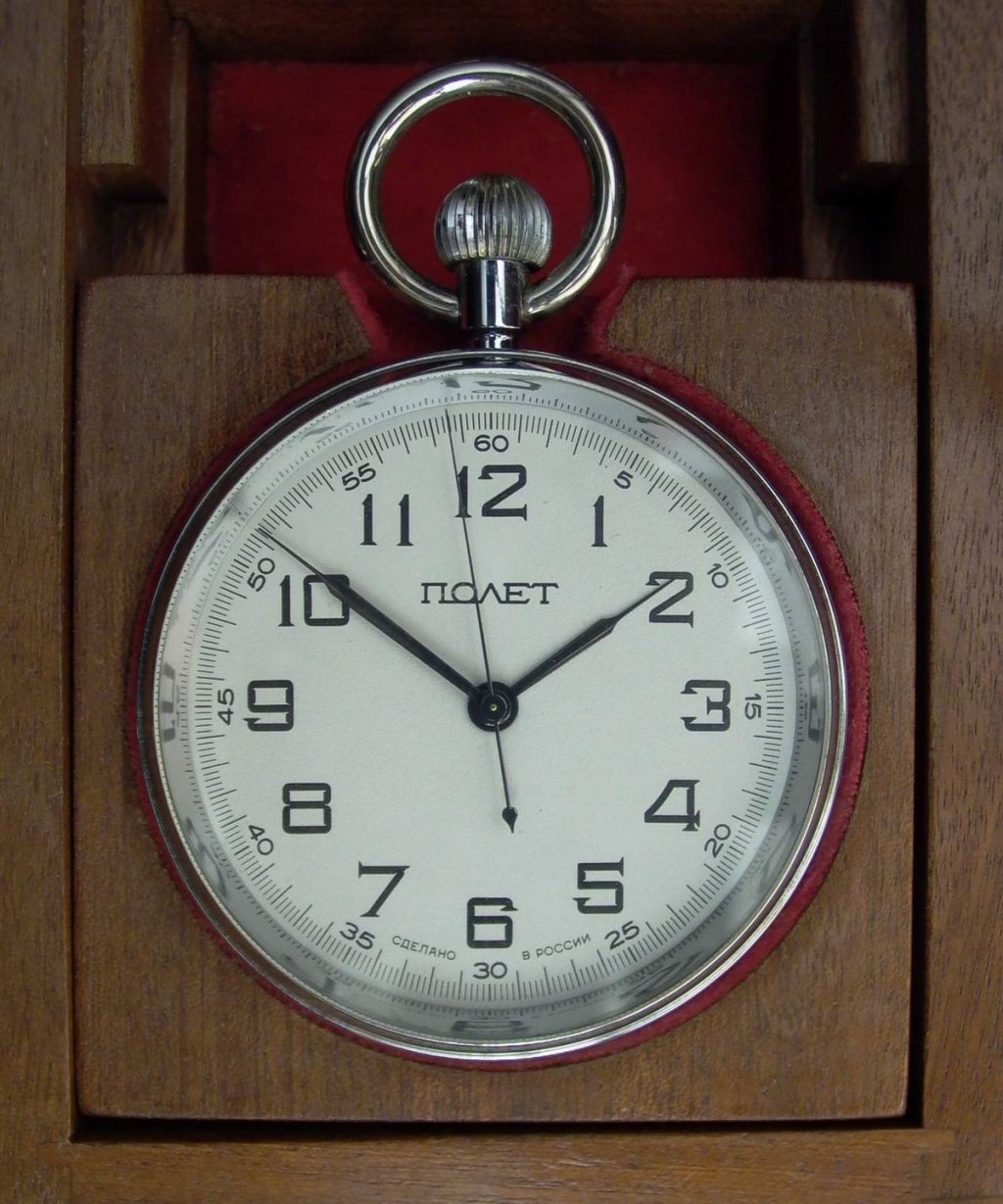
A later Poljot-made example of the B-Uhr pattern, with the Type B dial layout. Photo: Wikimedia Commons, CC BY-SA 3.0.
What the war did to the industry
Switzerland was neutral, which in watchmaking terms meant it sold to everyone. Swiss factories supplied the British MoD, the American military, and the German armed forces, sometimes simultaneously. That was what neutrality meant for an export industry. The Swiss made watches, and the war needed watches.
Germany’s watch industry fared worse. Glashutte, the Saxon town where Lange and others were based, ended up in the Soviet occupation zone. The Soviets dismantled the factories and shipped the equipment east as reparations. The original A. Lange and Sohne ended in 1948 when the company was nationalized. The East German state consolidated what was left into the VEB Glashutter Uhrenbetriebe, the GUB, in 1951, which kept making the old Lange cal. 48/1 design until 1971, because it was a good movement and the tooling existed. The Lange name would not return until Walter Lange revived it in 1990, after reunification. That is a forty-year gap, which gives you some sense of what the war cost German watchmaking.
Why it matters
The military watches of the Second World War set the template for the tool watch, the entire category of watches designed to do a job. The Dirty Dozen’s black dial and Arabic numerals became the field watch. The A-11’s legibility-at-a-glance became the pilot’s watch. The B-Uhr’s oversized clarity became the flieger. When you buy a modern watch marketed as tough, legible, or mission-ready, you are buying a descendant of these specs, whether the marketing mentions it or not. The war also proved something the industry already suspected. A watch does not have to be beautiful to matter. It has to work, every time, under conditions you would not wish on anyone. That is a higher standard than luxury, and it is the standard the best tool watches are still judged against.
Thanks for reading this.

