
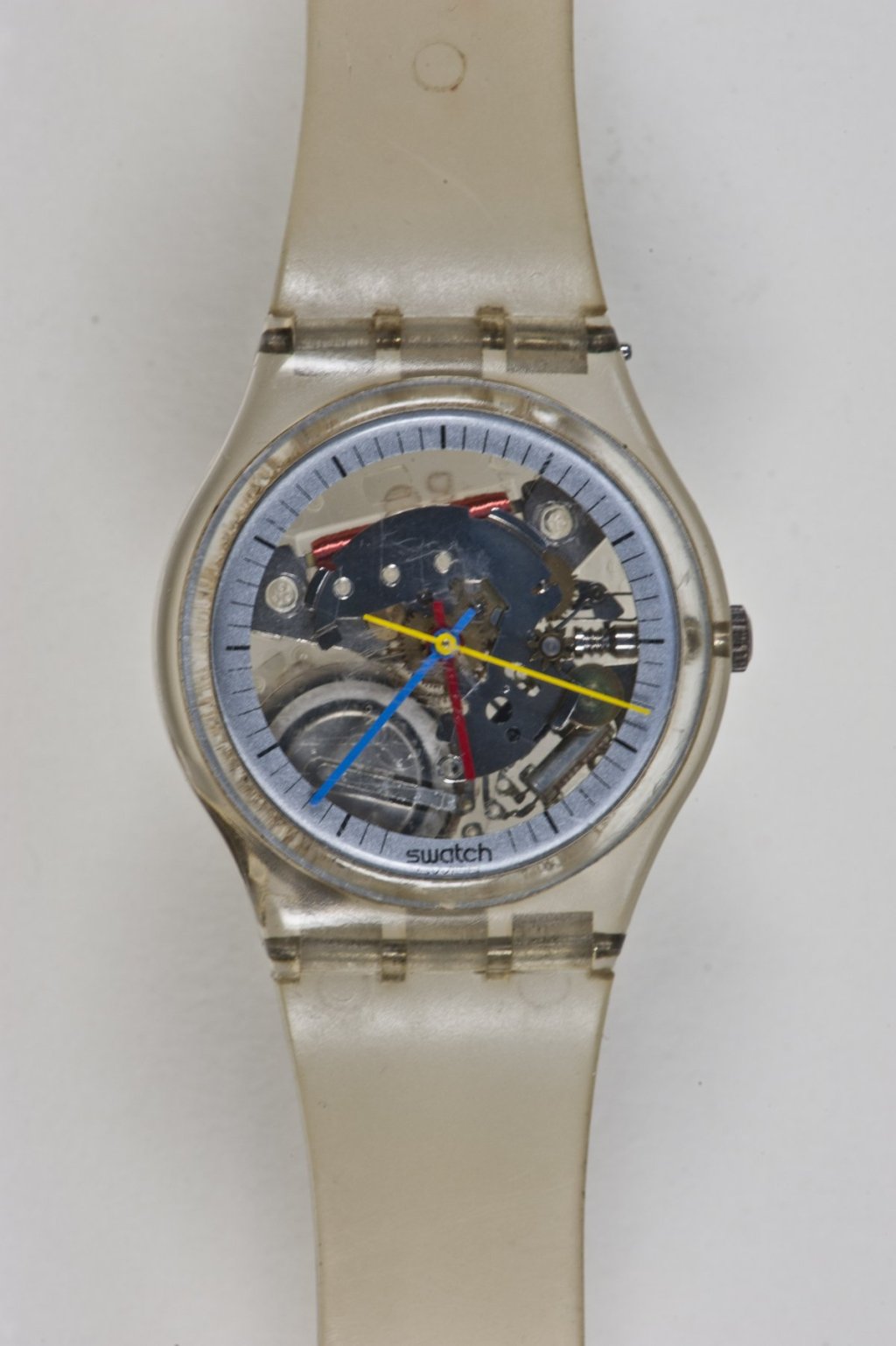
Between 1970 and 1988, employment in the Swiss watch industry fell from roughly 90,000 people to roughly 28,000. The number of watchmaking firms dropped from about 1,600 to 600 in just thirteen years. Switzerland had held more than half of the world watch market through the 1960s; by 1978 that share was down to a quarter. These are the numbers. The rest is interpretation.
The thing everyone gets wrong
The standard telling is that the Swiss, fat and arrogant, ignored quartz, and the Japanese ate their lunch. It is a great story, and it is only half true. The Swiss did not ignore quartz. In 1962, about twenty Swiss manufacturers jointly funded the Centre Electronique Horloger, a research lab in Neuchâtel, specifically to develop a Swiss quartz watch. The Ebauches SA Beta 21, a Swiss-made quartz analog movement, arrived at the Basel Fair in 1970, barely months after Seiko’s Astron. The Swiss could build quartz. The problem was that they could not, or would not, sell it the way it needed to be sold.

The heart of the quartz watch: a tuning-fork-shaped crystal vibrating 32,768 times per second. Photo: Wikimedia Commons, CC BY-SA 4.0.
Here is the mechanical watch’s problem, stated without romance. A balance wheel swings maybe five times a second. It wears, expands with heat, and slows as the mainspring unwinds. A quartz crystal, cut into a tiny tuning fork, vibrates 32,768 times a second when current runs through it, and it barely cares about any of that. Once the technology fit on a wrist, the old product had lost its only measurable advantage.
How the numbers fell
Seiko’s Astron, the first commercial quartz wristwatch, appeared on Christmas Day 1969. It cost 450,000 yen, about the price of a Toyota Corolla, so it was not exactly a mass-market product. But prices fell with terrifying speed: an LED quartz watch went from $125 in 1974 to $20 in 1976 to $9.95 in 1977. By 1978, quartz watches overtook mechanical watches in popularity worldwide, and Hong Kong, not Switzerland or Japan, was exporting the most electronic watches on earth.
Swiss production tells the story in units: a record 96 million watches in 1974, 45 million by 1983. The American industry, already weakened, nearly vanished entirely, with Hamilton, Bulova, and the rest absorbed or sold off. Meanwhile Japan, which surpassed Switzerland as the world’s largest watch producer by volume in 1980, just kept scaling.
The real causes
Quartz accuracy and price were the engine, but the collapse had four other causes the quartz-panic narrative tends to skip. First, the strong franc, which kept climbing through the 1970s and made Swiss watches more expensive abroad every year for reasons that had nothing to do with watchmaking. Second, a bad decade to have a bad decade: the oil shocks and stagflation of the 1970s hit a luxury export industry hard. Third, the Swiss industry barely marketed anything. Watches were sold by wholesalers and agents, and when quartz arrived, the Swiss had no marketing muscle with which to fight back.
Fourth, and maybe most important, was conglomerate inertia. The Swiss industry was organized as a sprawling maze of hundreds of small firms, many of them state-protected, most of them doing their own marketing, research, and assembly. Hayek would later describe ASUAG as owning more than a hundred separate companies, each running its own show. It was a structure built for a stable monopoly, and mechanical watchmaking was a point of national pride. Plenty of Swiss executives looked at a quartz movement and saw not the future but an insult.
The forced merger
By the early 1980s, the two big Swiss groups, SSIH and ASUAG, were dying in public, and a group of Swiss banks found themselves holding the wreckage. The famous story is that the banks hired Hayek, a Beirut-born management consultant who had founded Hayek Engineering in Zurich in 1963, to oversee an orderly liquidation: sell off the brands, maybe to the Japanese, and end it cleanly.
In March 1983, SSIH and ASUAG merged rather than died. The combined group was renamed SMH (Société Suisse de Microélectronique et d’Horlogerie) in 1986, and the Swatch Group in 1998. Hayek’s bet, a cheap plastic Swiss quartz watch with 51 parts called the Swatch, launched the same year as the merger and sold more than 2.5 million units in under two years.
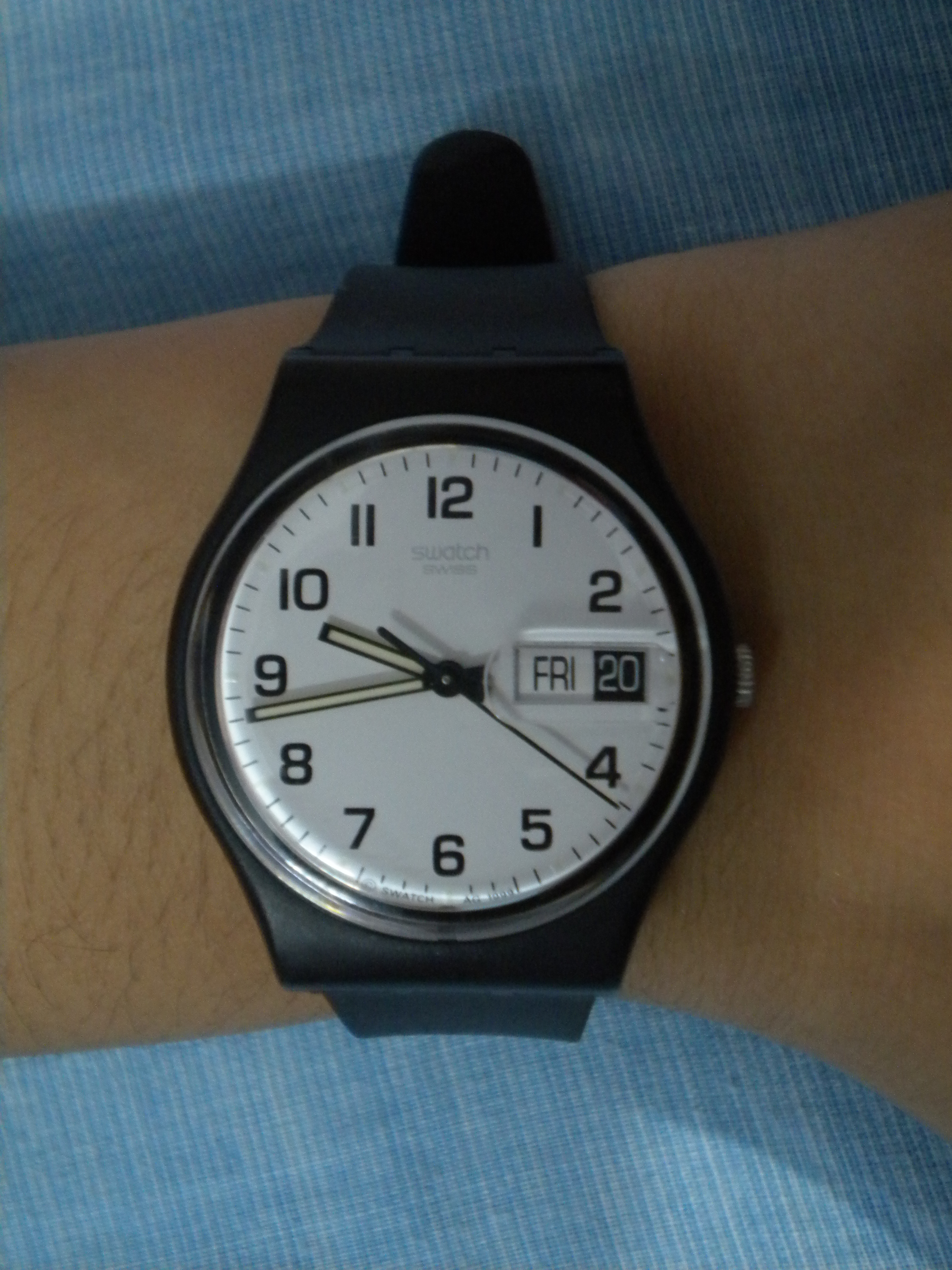
The Swatch “Once Again”: the cheap plastic watch that arrived just in time. Photo: Wikimedia Commons, CC BY-SA 4.0.
What quartz did not do
Here is the part that deserves care, because the quartz crisis story usually ends with the wrong moral. Quartz did not kill the mechanical watch. It killed the mechanical watch as a tool. Once accurate time cost ten dollars, nobody needed a mechanical watch to know the time, and that turned out to be a liberation. The mechanical watch, freed from having to be useful, became an object of craft, beauty, and status, valued for the centuries-old human skill that quartz had made unnecessary.
The numbers are brutal: 90,000 jobs to 28,000, 1,600 firms to 600, half the world market to a quarter. But there is no reason to sneer at quartz for it. Quartz put accurate time in the hands of everyone on earth, one of the quieter democratizations of the twentieth century. The Swiss industry did not die. It shrank, consolidated, and eventually learned to sell something quartz could never make: the feeling of a tiny machine, built by hand, that keeps time badly by modern standards and beautifully by every other one. That story starts with a plastic watch in 1983.
Why it matters
Every collector alive today is living in the quartz crisis’s aftermath. The mechanical watch only exists as a luxury object because quartz took its job away, and “Swiss Made” carries its weight because the industry that survived changed what a watch is for. Start here and the rest makes sense.
Thanks for reading this.

