
On Christmas Day 1969, Seiko unveiled the Astron, the world’s first commercial quartz wristwatch. It cost 450,000 yen, roughly the price of a Toyota Corolla. It was a luxury product built on a technology that would, within a decade, make luxury timekeeping irrelevant. Japan’s takeover of the mass watch market came from three very different companies, three very different strategies, and one decision that might be the shrewdest patent move in industrial history.
Seiko: the vertical empire
Seiko’s advantage started decades before the Astron. The company, founded as a Tokyo clock shop in 1881, had spent the twentieth century building itself into something the Swiss industry was not: vertically integrated. Seiko did not buy movements from suppliers and cases from someone else. It made the movements, the dials, the cases, the crystals, the lubricants, eventually even the quartz crystals themselves and the integrated circuits that drove them.
This mattered enormously when quartz arrived. Seiko had been developing quartz technology through the 1960s, including the portable Crystal Chronometer QC-951 used at the 1964 Tokyo Olympics, and its prototypes faced the Swiss at the Neuchâtel Observatory competitions of 1966 and 1967. The race was genuine, and Seiko crossed the line first on December 25, 1969.

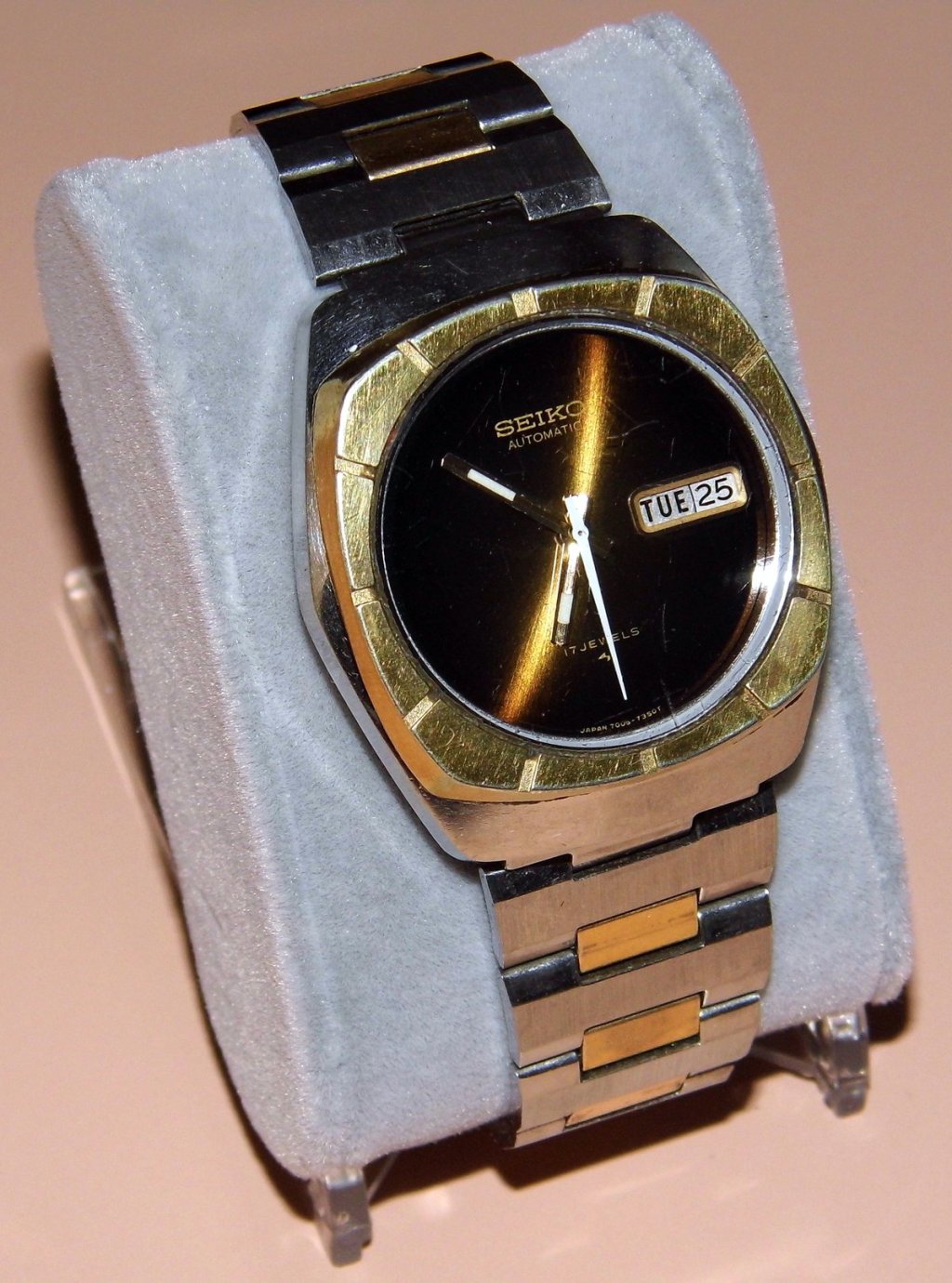
Seiko’s bread and butter: a mass-market automatic that Switzerland never matched on price. Photo: Wikimedia Commons, CC BY-SA 4.0.
Then Seiko did the strange thing. It opened its key quartz patents to the world. The Seiko Museum in Ginza states this plainly: the company made its patents available so quartz would become the de facto standard. Read one way, this is idealism. Read another way, it is ruthless. Because Seiko designed its own integrated circuits, grew its own quartz crystals, made its own batteries, and assembled everything under one roof, it could ride a collapsing cost curve faster than any competitor who bought components from outside. A standard built on your architecture is worth more than a monopoly nobody else can join. The price tells the story: from 450,000 yen in 1969 to a ten-dollar quartz watch within a decade.
Citizen: the quiet giant and the Miyota business
Citizen is the company enthusiasts underestimate, which is funny, because it has been enormous for long stretches. Founded in 1918 and incorporated as Citizen Watch in 1930, the company built its quartz strategy on out-Seikoing Seiko at accuracy. In 1975 it released the Crystron Mega, then the world’s most accurate wristwatch at plus or minus 3 seconds a year. In 1976 it released the Crystron Solar Cell, the world’s first analog solar-powered quartz wristwatch, and in 1995 it launched Eco-Drive, the light-powered system that now drives the bulk of the company’s output.
But Citizen’s real strategic masterstroke was Miyota: its movement-making operations sell quartz and mechanical movements to watch manufacturers all over the world. While Seiko fought the brand war, Citizen built the ammunition factory. And in 2008, in a twist the old American industry could not have imagined, Citizen bought Bulova, one of the grand names of American watchmaking, and kept it alive.
Casio: the digital wave
Casio was never a watch company. That was the point. Casio made calculators, and it approached the watch the way a calculator company would: as a plastic rectangle that tells time and does tricks. The digital wave it rode through the 1970s and 1980s shocked the Swiss. It made the watch a disposable consumer electronic.
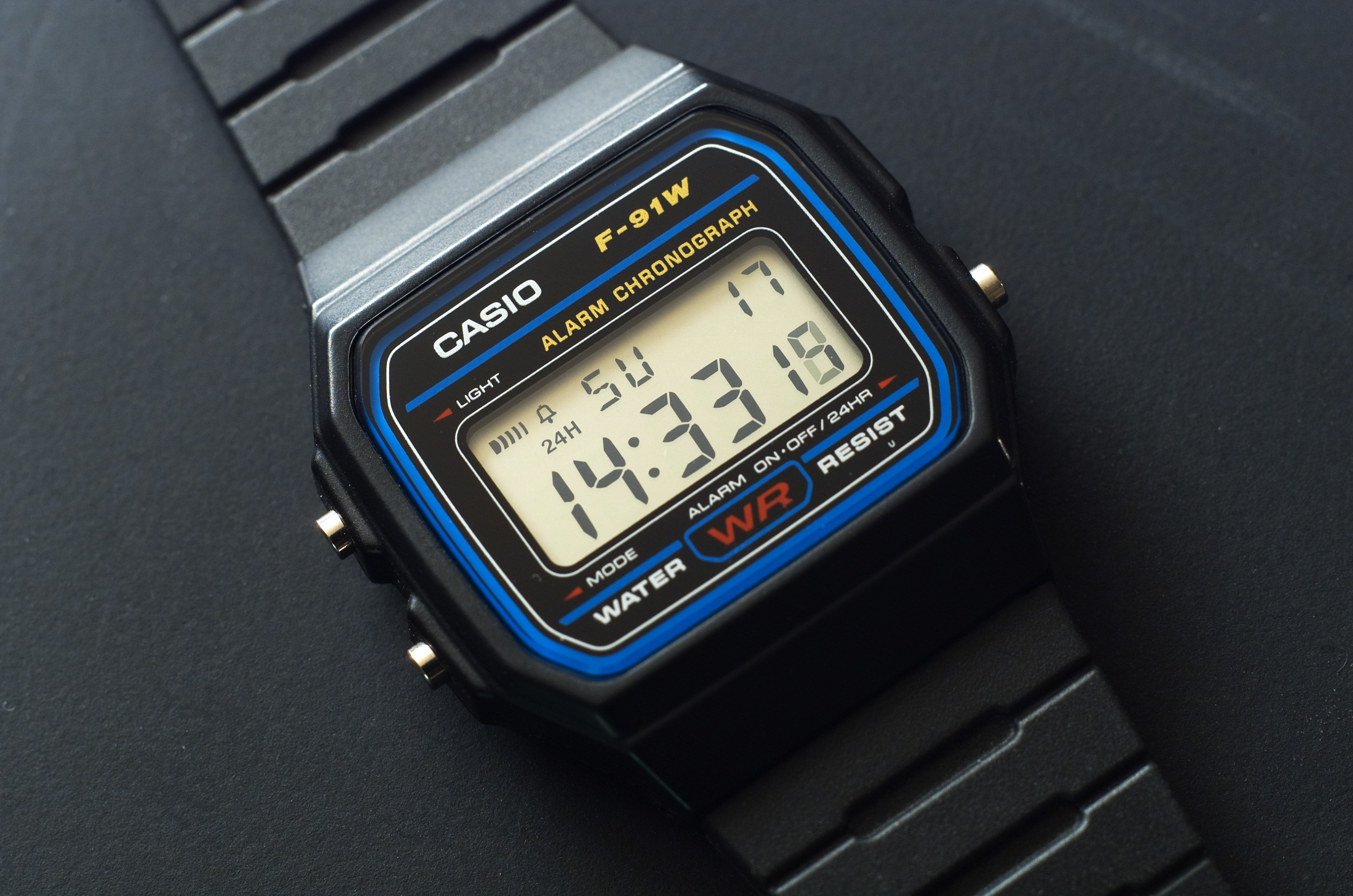
The Casio F-91W: launched in 1989, still in production, accurate enough to shame almost any mechanical watch ever made. Photo: Wikimedia Commons, CC BY-SA 4.0.
The emblem of this era is the F-91W, launched in 1989. Seven-segment LCD display, stopwatch, alarm, water resistant, a battery that lasts seven years, and a price that has hovered around ten to twenty dollars for most of its life. It is the best-selling digital watch in history and it keeps time to within seconds a month. Casio later built the G-Shock into a genuine cultural phenomenon, proving that a quartz watch could have personality and a devoted following without a single gear in it.
How Japan won
Japan won on three things at once: price, accuracy, and manufacturing scale. But the deeper story is organizational. The Swiss industry was hundreds of small firms sharing a culture; the Japanese industry was a handful of giants sharing nothing but ambition. Seiko’s vertical integration meant it could push costs down faster than anyone. Citizen’s movement business meant Japanese calibers powered the world’s cheap watches. Casio’s electronics DNA meant it could treat the watch as a gadget.
And timing helped. The American semiconductor companies did the early work of mass-producing cheap digital watches, then abandoned the watch market entirely when margins collapsed. By 1978 Hong Kong was exporting more electronic watches than any country on earth, most of them built on Japanese or American quartz technology. Japan surpassed Switzerland as the world’s largest watch producer by volume in 1980.
There is a temptation to frame this as a morality tale about innovation versus complacency. It is not. The Swiss consortium had quartz working at the same time. The difference was that Seiko opened its patents and built a standard, while the Swiss treated quartz as a curiosity to be sold at luxury prices. The market disagreed. Accuracy stopped being a privilege and became a utility. That was manufactured in Japan, and then given away.
Why it matters
Almost every watch you can buy for under a thousand dollars exists because of what Japan did in the 1970s and 1980s. The Miyota movement in your microbrand diver, the Eco-Drive solar cell that means you never change a battery, the F-91W still ticking on some kid’s wrist right now: all of it traces back to this period. The Japanese expansion did not destroy the mechanical watch. It set the terms on which the mechanical watch would survive.
Thanks for reading this.

