
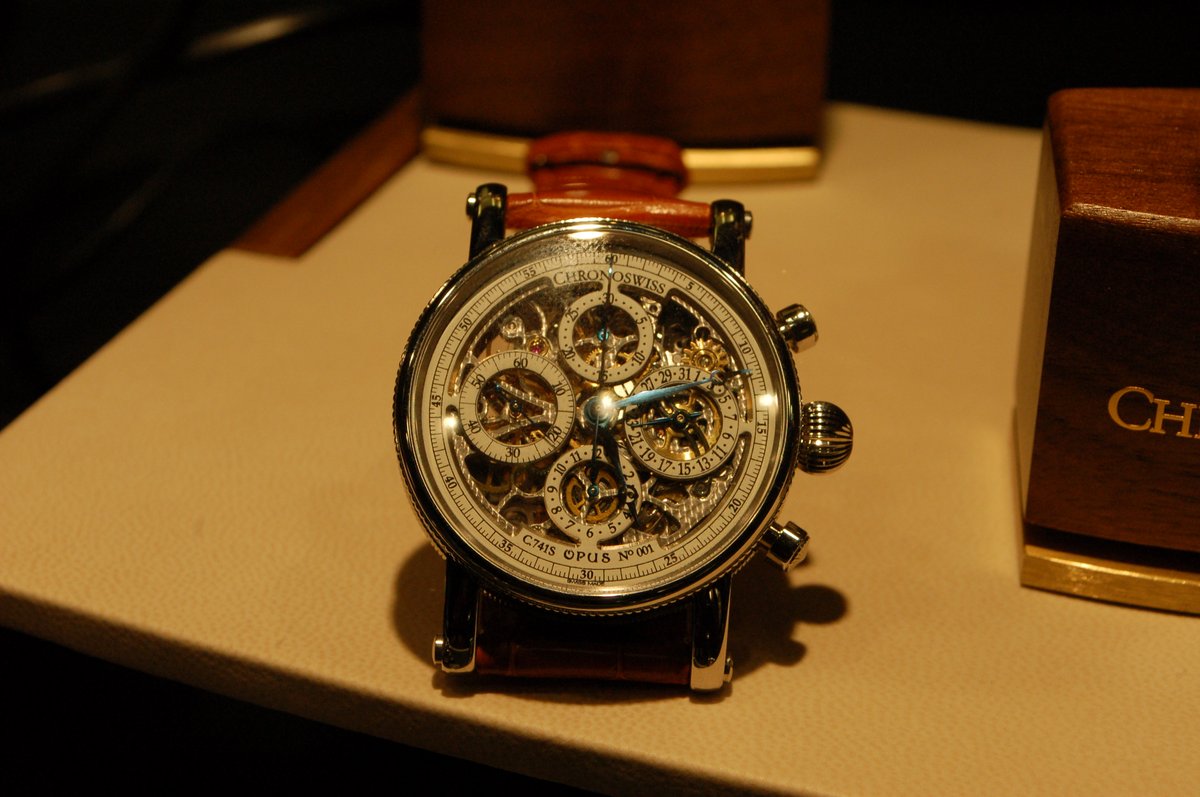
A skeleton watch is a mechanical watch whose moving parts are visible, usually through the front where a conventional dial would be, and often through the back as well. Skeletonization, in the strict sense, goes further than removing the dial. It means trimming away non-essential metal from the bridges, plates, and wheel train of the movement, leaving only the minimum structure the movement needs in order to run. The parts that remain are then finished, and often engraved, by hand. A skeleton dial, in other words, is not really a dial at all. It is what replaces the dial when the movement itself becomes the face of the watch.
Because the dial is gone, the work a dial normally does has to be done by something else. Somebody still has to tell the wearer the time, so the design effort moves to whatever remains: a slim chapter ring around the edge of the opening, applied indices mounted on a sapphire disc, or the brand signature etched on the crystal. Cartier’s skeleton watches take this approach with Roman numerals set over the movement, so the watch still reads as a Cartier with no dial in place. On less expensive skeletons the solution is simpler, sometimes printed markers on the inside of the crystal. Either way, every element added back into the opening blocks part of the view the construction was created to provide, so the dial work on a skeleton watch is an exercise in restraint.

How it works
Skeletonization is structural work before it is decoration. A bridge that has been pierced and thinned still has to hold its jewels in alignment under the load of the gear train. Removing metal from the wrong place, or removing too much of it, leaves a part that flexes or fails, so the watchmaker has to know exactly how much material can come out of each bridge and plate, and where the remaining material must stay. The skeleton that results is the movement’s load-bearing structure with everything else cut away.
Once the cutting is done, the remaining surfaces receive the full finishing treatment: beveling, polishing, and engraving, sometimes including black polishing on the edges. This is where the cost of a traditionally made skeleton watch sits. The decoration is not applied to the movement as a surface treatment. The movement itself is the decoration, and every cut in it has to be mechanically sound and finished to the same standard as the visible surfaces of any other finely made movement.
Not every watch sold as a skeleton is built this way. Many inexpensive skeleton watches take a standard automatic movement and cut decorative holes in its plates. That produces the open look without re-engineering the movement for openness, and the engraving and the view do most of the work. The distinction matters when comparing watches across prices: a pierced movement and a movement designed and cut down to its structural minimum share a silhouette, but the amount of structural design and hand finishing behind them is different in kind.
Two related designs are regularly confused with skeletonization, and the industry uses the terms distinctly. A semi-skeleton has a partial cutaway in the dial that shows part of the movement underneath, while the rest of the dial remains in place. An open heart has a small, usually circular window in an otherwise complete dial, positioned in almost all cases to show the balance wheel oscillating. Frederique Constant popularized the open heart layout in the 1990s with its Heart Beat line, and the format has been widely copied since. Open heart is a dial design choice; skeletonization is a movement construction choice. A watch can be one, the other, both, or neither.
History
The idea of exposing a movement is old. The French clockmaker André-Charles Caron made skeleton watches in the 1760s, at a point when the problem was simply whether a movement could be cut down and still run while open to view. Patek Philippe made skeleton pocket watches for exhibition in the mid-1800s, treating the exposed movement as a display of workmanship, and began manufacturing skeleton watches in the 1970s. Each stage widened what the form was for: first a demonstration that it could be done, then an exhibition piece, then a manufactured product line.
The modern market covers the full price range. At the top are Breguet’s Classique skeleton watches, Cartier’s Santos and Tank skeleton executions, and Audemars Piguet’s openworked Royal Oaks, which the brand calls openworked rather than skeletonized. In the middle, Hamilton, Tissot, and Frederique Constant sell open hearts and partial skeletons at lower prices. At the bottom are no-name skeleton automatics with Chinese movements, priced as decorative watches, and makers such as Sea-Gull sit in that affordable tier, where a standard movement is opened up decoratively rather than engineered down to a skeleton.
Where it stands now
Skeletonization now spans the whole market, from inexpensive automatics to six-figure haute horlogerie, and the difference between the tiers is visible in the metal itself. Comparing the bridge work of an inexpensive skeleton with that of a watch whose movement was re-engineered for openness shows where the money goes: the depth and finish of the cutting, the hand work on the remaining surfaces, and the structural design underneath. For the movements being cut away, see Movements; for the time display that remains, see Chapter rings; and for the full dial that skeletonization replaces, see Dials.
Sources
- Wikipedia, Skeleton watch
- Swiss Watch Expo, Skeleton Dial Watches 101
- Chrono24, The Magic of Skeleton Watches
- Teddy Baldassarre, Best Skeleton Watches
Thanks for reading this.