
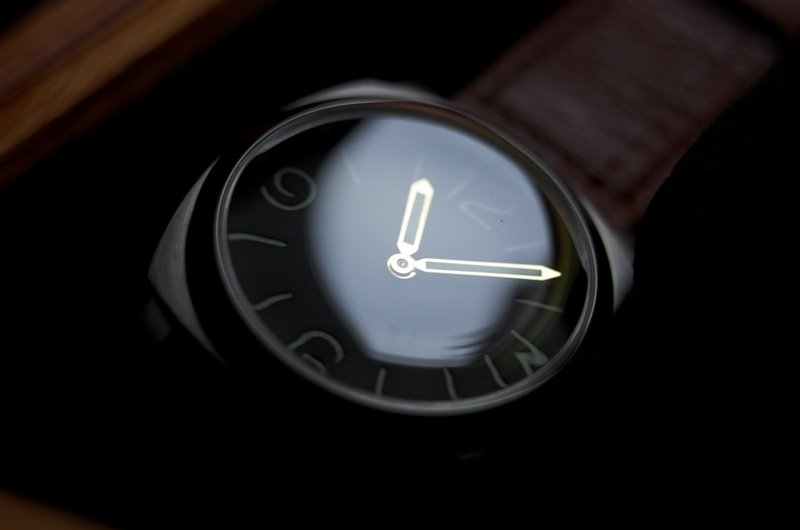
A sandwich dial is a watch dial built in two layers. The lower layer is a solid disc coated with luminous material. The upper layer is the visible face of the watch, and its hour indices and numerals are cut all the way through it, the way letters are cut through a stencil. When the two discs are stacked together, the luminous material sits in recesses below the dial surface and shines up through the cutouts. The construction is most closely associated with Panerai, where it was developed for military dive watches in the 1930s and 1940s, and it remains a defining feature of the brand’s watches today.
The two-layer layout is what separates a sandwich dial from an ordinary luminous dial. On a conventional dial, luminous material is applied onto a flat surface as a printed or painted film, and the thickness of that film is limited by the surface it sits on. In a sandwich dial, the luminous material has its own dedicated disc underneath, so it can be laid down as a much thicker bed. The upper disc then acts as a mask: it covers everything except the shapes the wearer needs to read, and those shapes are openings rather than markings. The indices are not drawn on the dial. They are holes in the dial, filled from below with light.

How it works
The glow of a sandwich dial comes down to two properties of the construction: volume and area. Volume comes first. Because the lower disc exists only to carry luminous material, it can hold a thick layer of it, far thicker than a film printed onto a finished dial face. A thicker layer of luminous material stores and releases more light, so the indices glow more strongly and for longer. Historically that material was a radium-based paste; in modern production it is Super-LumiNova.
Area is the second property. The cutouts in the upper disc are not fine lines. They are the broad Arabic numerals and baton indices that define the Panerai style, and each one exposes an uninterrupted field of the luminous disc beneath it. Nothing crosses or breaks up the glowing shapes, so each numeral reads as a single solid block of light. The recess matters visually as well. Because the luminous material sits in wells below the surface of the upper disc, the indices have visible depth in ordinary light. The dial face has a three-dimensional quality that a printed dial, where everything sits on one plane, does not reproduce.
The two discs also divide the work of the dial between them. The upper disc carries the design: the shape and position of the numerals, the proportions of the indices, the surface finish the wearer sees. The lower disc carries only the luminous material and has no design role at all. Each disc can therefore be made for a single purpose, and the luminous layer never has to compromise with the printing, brushing, or finishing applied to the visible face.
History
The sandwich dial exists because of a legibility problem. Panerai’s first Radiomir appeared in 1936, a 47mm cushion-cased watch developed for the Royal Italian Navy’s combat divers. The divers worked underwater, in dark water, and needed to read the time there. A thin film of luminous material printed on a flat dial was not enough for that work, so the problem became how to get more luminous material onto the dial and keep it readable. The sandwich construction was the answer: move the luminous material onto its own disc, load that disc heavily, and let it show through cutouts in the dial above.
The luminous material itself came before the watch. The name Radiomir comes from the radium-based luminous compound Panerai patented in 1916. Legibility in the dark was the entire point of the watch that later took the compound’s name, and the existence of the Radiomir was kept secret for decades. Panerai did not sell watches to the public until the mid-1990s.
The watches of that era were a collaboration, whether or not it was described that way at the time. Chrono24’s history of the brand reports that Rolex designed and produced Panerai’s watches in that period, using pocket watch movements to fill the oversized cases. Panerai was the instrument maker, holding the Navy contract and the luminous compound patent. Rolex was the watchmaker. The sandwich dial was Panerai’s contribution; the watch around it was Swiss. The construction evolved into its classic form around 1940, alongside a more robust case with integrated lugs.
The next problem was the luminous material itself. Radium gave way after the war to Panerai’s tritium-based compound, Luminor, patented in the post-war years and adopted as a name in 1965. That is where the Luminor model line takes its name. The sandwich construction carried through the change of material unchanged, because the construction and the compound solve different parts of the same problem: the compound produces the light, and the two-disc layout determines how much of it the dial can hold and how cleanly it shows.
When Panerai began selling to the public in the 1990s, the sandwich dial came with it, and it has been a core part of the lineup ever since across both the Radiomir and Luminor lines. Fratello’s coverage of modern references describes current production following the same recipe as the originals: a lower disc carrying the luminous material, an upper disc with the indices cut through, and the lume sitting in wells below the dial surface. Panerai has also extended the underlying idea at the extreme end of its range with the Submersible Elux, which puts LEDs under the dial, a development the brand itself described as bringing new meaning to the sandwich.
Where it stands now
The sandwich dial is now a brand signature first and a military solution second. It remains in production across Panerai’s Radiomir and Luminor lines, built the same way as the originals, with Super-LumiNova in place of the radium and tritium compounds of the early watches. The recessed, glowing numerals are recognizable at a distance, and no other major brand builds dials this way, which keeps the construction tied to Panerai alone. For readers following the materials further, the luminous compounds themselves are covered under Luminescence, and dial construction generally under Dials.
Sources
- Chrono24, Buyer’s Guide: Panerai Radiomir
- Chrono24, Panerai: Italian Design, Swiss Watchmaking
- Fratello, Panerai Luminor Tre Giorni PAM01628
- Mostra Store, Officine Panerai: The Watch of the First Military Combat Swimmers
Thanks for reading this.