
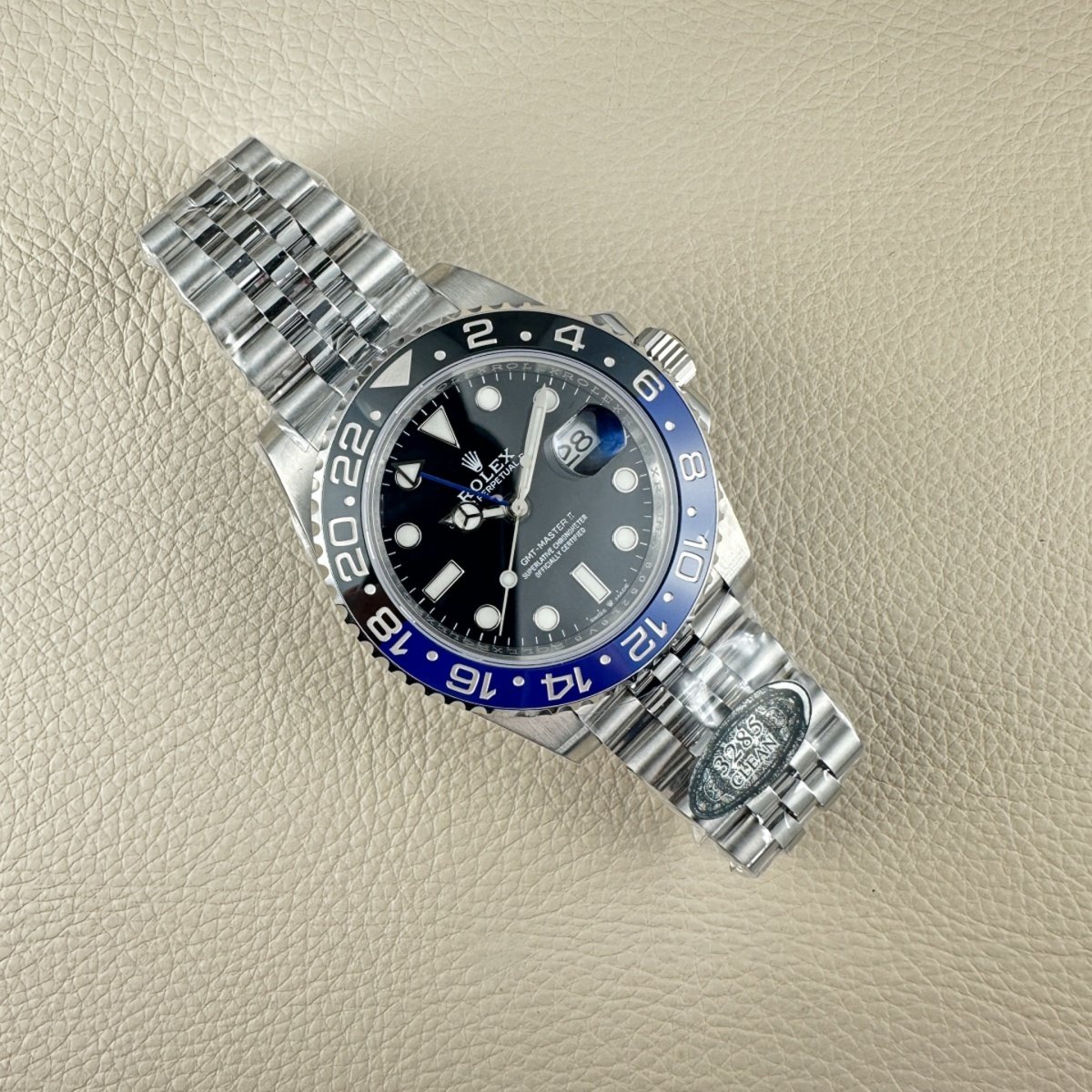
The rehaut, pronounced “ruh-OH” with no hard T at the end, is the French word for flange. In a watch it means the inner ring between the edge of the dial and the crystal: the vertical or sloped wall visible at the very perimeter of the dial, filling the gap where the round dial meets the round case. Not every watch has a visible one. Where it is present, the rehaut is doing structural work first, locating and spacing the parts around it, and on some watches it has been developed into a surface for engraving, scales, and other functions in its own right.
Because the ring sits directly in the line of sight whenever the dial is looked at, makers have repeatedly found uses for it beyond spacing. This article covers the structural job the part exists to do, the best documented example of it becoming a design and security feature, and the range of scales and markings that other makers place on it.

How it works
A watch movement does not fill its case by itself. The dial is wider than the movement, and the crystal sits above both. Something has to locate the dial assembly, hold it at the right height, and space the crystal off the hands so that nothing touches. The rehaut does that locating and spacing. It is often part of the case itself, or a separate ring pressed into the case. On many watches the edge of the dial disappears under it, which hides the raw cut edge of the dial blank in the same way a picture frame hides the edge of a canvas. The part is a spacer, and its finished appearance follows from that function.
The same ring can carry information. Because the eye reads the dial and the flange around it as one continuous instrument, a scale placed on the rehaut is read alongside the dial’s own markings. That is the principle behind every functional rehaut: the dial is full, the flange is available, and the two surfaces sit close enough together to be used as a pair.
One distinction is worth fixing, because the terms are often interchanged. The working distinction used by collectors is that a chapter ring carries time-telling graduations, while a rehaut is the flange, which may or may not carry any graduations. A rehaut pressed into service as a minute track is doing chapter ring duty. The terms overlap because the parts overlap, and a single ring can be both the structural flange and the carrier of a scale.
History
For most watches the rehaut stayed in its structural role. The change that made it prominent came from Rolex. Starting around 2004, first on the Turn-O-Graph and then on the GMT-Master II in 2005, with the rest of the range following through 2008, Rolex began engraving the rehaut with the word ROLEX repeated around the circumference, interrupted by the coronet at 12 o’clock and the watch’s serial number at 6 o’clock.
The serial number is the functional part of that change. Before it, the serial lived between the lugs at 6 o’clock, where reading it required removing the bracelet. Moving it to the rehaut made it visible through the crystal, which was convenient for owners. It also served a security purpose, since engraving a serial into the flange under the crystal is much harder to reproduce convincingly than stamping one between the lugs. The engraving had to be aligned precisely, and the pattern carries an alignment detail of its own: on the left side of the dial the R in ROLEX lines up with the minute markers, while on the right side it is the X that lines up. The engraved rehaut has since become one of the first features buyers check when authenticating a modern Rolex.
Other makers took the flange in a functional rather than decorative direction. Breitling’s Navitimer puts its circular slide rule, the pilot’s calculation scale, on a rotating rehaut working against a fixed scale on the dial. Compressor-style dive watches such as the Longines Legend Diver place a rotating 60-minute scale on an inner ring turned by a second crown. Chronographs park tachymeter scales on the ring. In each case the mechanism differs, a rotating ring against a fixed scale, or a fixed scale read against the dial, but the reason for using the space is the same: the dial had no room left, and the flange was available.
Where it stands now
The rehaut now exists at two extremes of visibility. At one end are the engraved and scaled versions described above, where the ring is a deliberate feature carrying a serial number, a brand name repeated around its circumference, or a working scale. At the other end are slim dress watches, where the dial runs nearly to the case and the flange shrinks to a thin line between dial and case that is barely noticeable. In that form the part does its structural job and nothing more, which suits a dial designed to read as an uninterrupted disc.
Between those extremes, the ring’s use follows the type of watch. Watches with crowded dials, chronographs, slide rule watches, and dive watches with internal scales, have a use for the extra surface and tend to use it. Watches with open dials and few markings have no such need, and their rehauts stay plain. In all cases the structural function is unchanged and comes first: the dial assembly has to be located, the crystal has to be spaced off the hands, and the edge of the dial has to be covered. The engraving and scales are additions to a part that would have to exist, in some form, without them.
Sources
- Teddy Baldassarre, Rehaut
- DuMaurier Watches, Rolex engraved rehaut
- RWG Forum, Rehaut vs chapter ring: what is the difference
Thanks for reading this.