
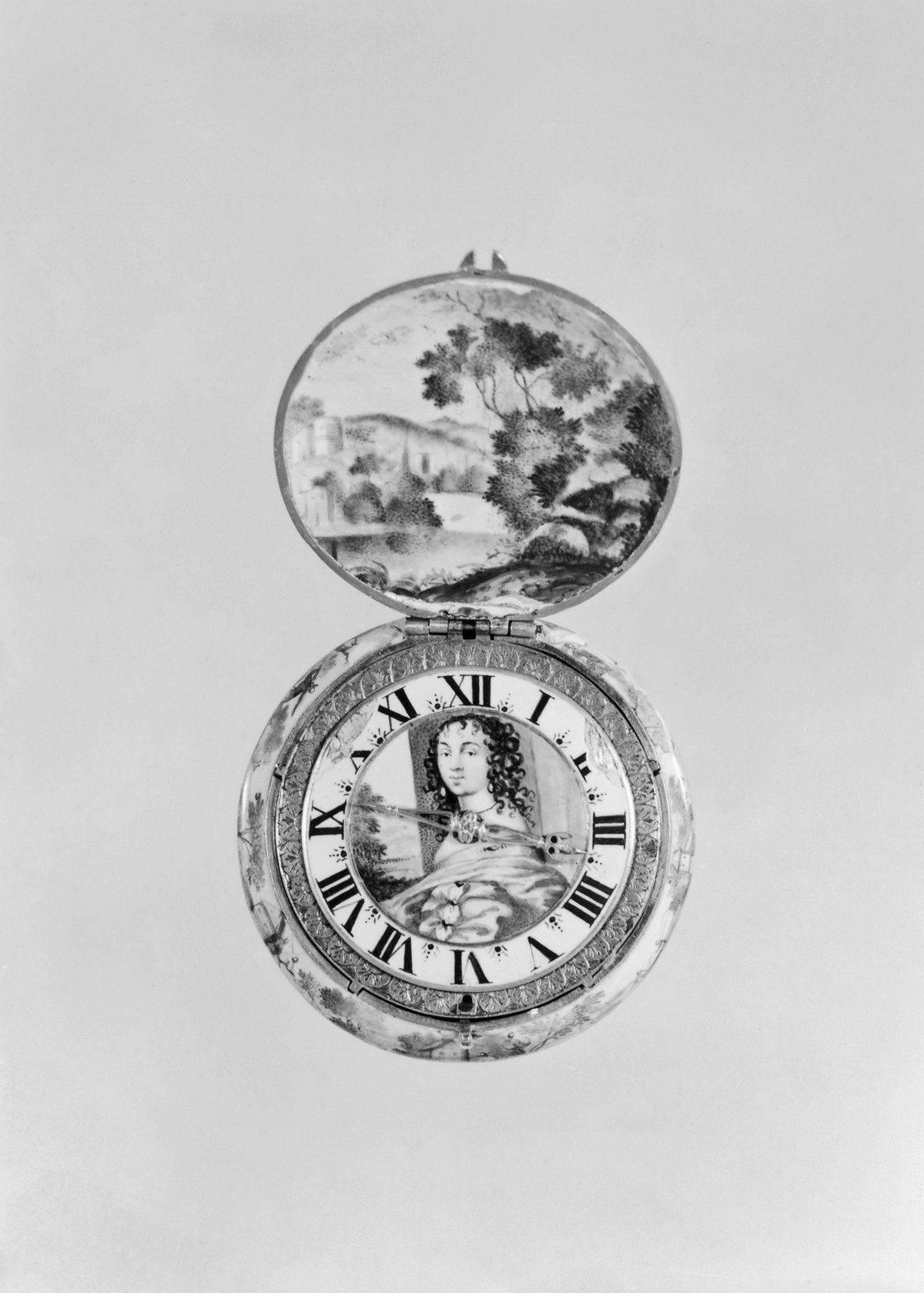
A hand-painted dial is a watch dial decorated by an artist working by hand with a brush, applying the image in small strokes. In the high-end form of the craft, the painting is done in enamel pigments on an enamel-coated dial, and the dial is fired in a kiln between layers so that each layer of painting is fused into the surface. The finished image is therefore held in fired enamel rather than sitting on the dial as surface paint.
The technique is called miniature painting on enamel, and it belongs to the same wider group of decorative crafts, the métiers d’art, as cloisonné, grisaille, and flinqué. Those techniques are sometimes combined on a single piece, but hand painting is defined by the brush work itself: the picture is built up touch by touch, at the scale of a watch dial.

How it works
The artist works on a dial that has already been coated with enamel. The image is built in small touches with enamel pigments ground finer than normal, so that the pigment can hold fine detail. Between layers, the dial goes into the kiln at 780 to 840 degrees Celsius, so that each layer melts and fuses before the next is applied.
The number of firings is the measure of the commitment. Patek Philippe’s own figures, as given in the source material, put a single miniature-painted dial at an average of around 15 firings, with complex scenes needing more. The Kilimanjaro pocket watch from the 2023 Rare Handcrafts collection, painted with 18 base colors, went through 32 firings at 800 to 830 degrees.
Every firing carries the same risks that run through all enamel work. The enamel can crack, bubble, or shift color, and the artist cannot undo a mistake once it has been fired. Work that took many layers to build can be lost at a late stage, in which case the process starts again.
Related techniques sit under the same roof and are sometimes combined with painting on one piece. Cloisonné builds the design from fine gold wire fixed to the dial to form cells, then fills the cells with enamel. Grisaille, also called enamel au blanc de Limoges, paints in white over a dark grand feu base to make monochrome scenes. Flinqué lays translucent enamel over hand guilloché so that the engraving shows through the color.
Patek Philippe’s 2026 Rare Handcrafts collection gives a current example of the combination: its racing-themed Calatravas combine grand feu cloisonné with miniature painting, with 12 firings at around 820 degrees for the racing scenes alone. The painting and the enamel structure are planned together, because each firing acts on every technique present on the dial at once.
History
Miniature painting on enamel is a Genevan specialty that the source material dates to the 17th century. The first problem it solved was scale: how to put a detailed picture onto an object as small as a watch case or dial. Grinding the pigments finer than normal and building the image in fused layers made that detail possible on a very small surface.
The Huaud family of Geneva were leading practitioners of the technique in that period. Jean-Pierre Huaud painted enamel watch cases and dials with a fineness that the source material notes still reads clearly under magnification, and surviving pieces are held in museums including the Walters in Baltimore. Their work shows the technique already established as a specialty with named masters, rather than as an anonymous workshop practice.
The next problem was survival. A craft practiced by few people can disappear when demand falls, and the source material describes the technique shrinking to a handful of practitioners while never fully dying out in Geneva. The large houses kept those practitioners employed, which carried the skills through the period when few such dials were being made.
In the current period the technique has returned to prominence as part of the métiers d’art, the decorative arts that brands present as evidence of their craft. Patek Philippe’s Rare Handcrafts collections are annual groups of unique and limited pieces shown at its Grand Exhibitions, and the 2023 edition ran to 64 pieces. The Kilimanjaro pocket watch from that 2023 collection, with its 32 firings, shows the older Genevan process still being worked at full complexity.
Where it stands now
Patek Philippe’s Rare Handcrafts is the most visible current program in the source material, with annual collections of unique and limited pieces. Vacheron Constantin runs its Métiers d’Art and Les Cabinotiers lines on the same principle, commissioning one-off artistic pieces. Cartier has a long métiers d’art practice that includes enamel and marquetry dials, and Van Cleef and Arpels builds entire collections around pictorial dials.
In these watches the dial is the point of the piece. The source material notes that the movement inside is usually a capable but deliberately unremarkable caliber, because the watch is bought for the dial work rather than for the timekeeping. Production is limited to small numbers, and a single dial can absorb weeks of an enameler’s working life, plus kiln time, plus the risk that a late firing destroys the work.
These pieces function as halo watches for the houses that make them. They exist in the source material’s account to keep rare skills in use by paying for them, to demonstrate the craft the brand can support, and to give collectors pieces produced in very small numbers. The technique’s position follows from that arrangement: as long as the houses fund the work and collectors buy the results, a Genevan craft documented since the 17th century continues to be practiced on current watches.
Sources
- The Hour Glass, Patek Philippe Rare Handcrafts enamelling
- SwissWatches Magazine, Patek Philippe Rare Handcrafts 2025
- High Time Reviews, Patek Philippe 2023 Rare Handcrafts
- Cortina Watch, Patek Philippe Rare Handcrafts 2026
Thanks for reading this.