
A tide complication tells you when the water is coming in and going out. Tides are mostly the moon’s doing, with the sun pitching in, and the whole cycle runs on a rhythm slightly longer than our 24-hour day: the average interval between high tides is about 12 hours and 24 minutes. A mechanical tide display is usually geared off the moonphase train, since the moon drives the tides, and it is one of the rarest complications in wristwatches. It sits at the edge of a larger family of astronomical displays, sunrise and sunset, sidereal time, star charts, that all do the same thing: they put the sky on your wrist.

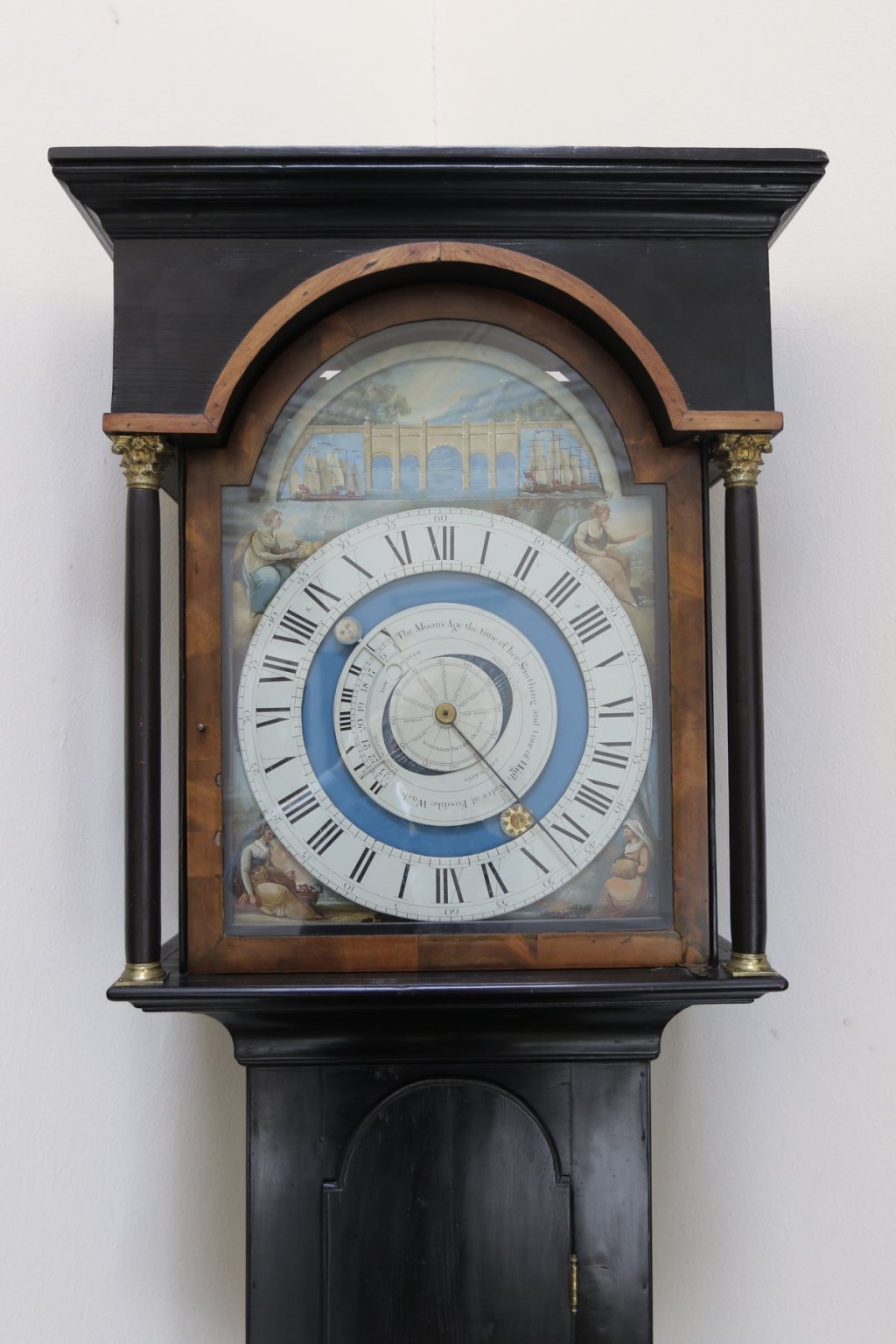
An antique tide clock dial. Tide indicators started in clocks long before they reached the wrist. Photo: Wikimedia Commons, public domain.
Tide clocks and their limits
Tide indicators have a long history in clocks, where a dedicated tide hand was driven by gearing from the rest of the movement. The usual gearing gives a tidal interval of exactly 12 hours and 25 minutes, which is 37 seconds longer than the real average of 12 hours, 24 minutes, and 23 seconds. That sounds trivial until you multiply it: the hand loses about half an hour per lunar month, so a tide clock needs its hand reset at least monthly, ideally at full or new moon, when the sun lines up with the moon and the big spring tides arrive. The solar component complicates things further, since the sun’s pull advances or retards the tides around the quarter moons, producing the smaller neap tides. A tide display is therefore always an approximation, good enough to tell you whether the water is rising or falling, not good enough to plan a harbor entry by. Mechanical tide watches inherit all of this, which is one reason so few of them exist.
The mareoscope
The most ambitious tide display ever put in a wristwatch belongs to Vacheron Constantin’s Les Cabinotiers Celestia Astronomical Grand Complication 3600, unveiled in 2017. The mareoscope sits at 11 o’clock on the front dial and combines a tide level indicator with a three-dimensional representation of the Earth-Moon-Sun alignment, because that alignment is what controls tidal amplitude: when the three bodies line up at new moon and full moon, you get the big spring tides, and when they form a right angle, the neaps. The whole watch runs on what Vacheron calls a tropical gear train, one that simulates the Earth’s elliptical orbit around the sun, since nearly all of its 23 complications are astronomical. The calibre has 514 components, six barrels, and a three-week power reserve, all in a case 13.6 mm thick. It took five years to develop, and it remains the reference point for what a tide complication can be when money is no object.

A moonphase wristwatch. Tides follow the moon, so most mechanical tide displays are geared from the moonphase train. Photo: Wikimedia Commons, CC BY-SA 4.0.
The wider sky
Tides are only one way to wear astronomy. The same Celestia 3600 packs in a running equation of time, sunrise and sunset times, the length of day and night, the seasons, solstices, equinoxes, and the zodiac, plus sidereal time (which runs about four minutes fast per day against civil time) and a sky chart of the northern hemisphere with the Milky Way, the ecliptic, and the celestial equator on the reverse. Jaeger-LeCoultre’s Reverso Grande Complication à Triptyque of 2006 took a similar maximalist approach with its zodiacal calendar and sky map. At the everyday end of the spectrum, quartz tide watches from surf brands do the same basic job with a sensor and a battery, and they are arguably more accurate. The mechanical versions are not competing with those. They are competing with the idea that a watch should know where the moon is.
Why it matters
Tide and astronomical complications matter because they connect the watch to something bigger than the wearer’s schedule. A calendar tells you what humans decided; a mareoscope tells you what the moon is doing whether you care or not. Almost nobody needs a mechanical tide indicator, and the people who do need tide information use instruments, not wristwatches. But there is a quiet pleasure in glancing down and knowing the state of the water three hundred miles away, delivered by gears. It is the watch as a small planetarium, and it only asks that you find the sky interesting.
Thanks for reading this.

