
A retrograde display is a hand that travels across an arc, a scale for the date or the hours or the seconds, and then, when it reaches the end, snaps back to the start in an instant and begins again. Instead of going around in a circle like a normal hand, it goes out and back, out and back, all day. Abraham-Louis Breguet was one of the first watchmakers to develop it, and he fitted it to some of his most famous pieces, which is probably why two centuries later it still reads as the classiest way to make a watch do something unexpected.

A Maurice Lacroix Masterpiece Double Retrograde GMT, with two hands sweeping arcs instead of circles. Photo: Wikimedia Commons, CC BY-SA 3.0.
The snail cam
Most retrograde displays run on a snail cam, a small spiral disc shaped, as the name suggests, like a snail shell. A lever rides against the cam’s edge, and as the cam turns, its growing radius pushes the hand steadily forward across the arc. Then the lever reaches the cliff edge, the sudden drop where the spiral ends, and it falls off. A spring takes over and whips the hand back to zero in a fraction of a second. The whole drama, the slow build and the instant snap, is the appeal. It does the same job as a rotating hand with considerably more moving parts, which in watchmaking has always counted as a feature.
Breguet’s invention, everyone else’s signature
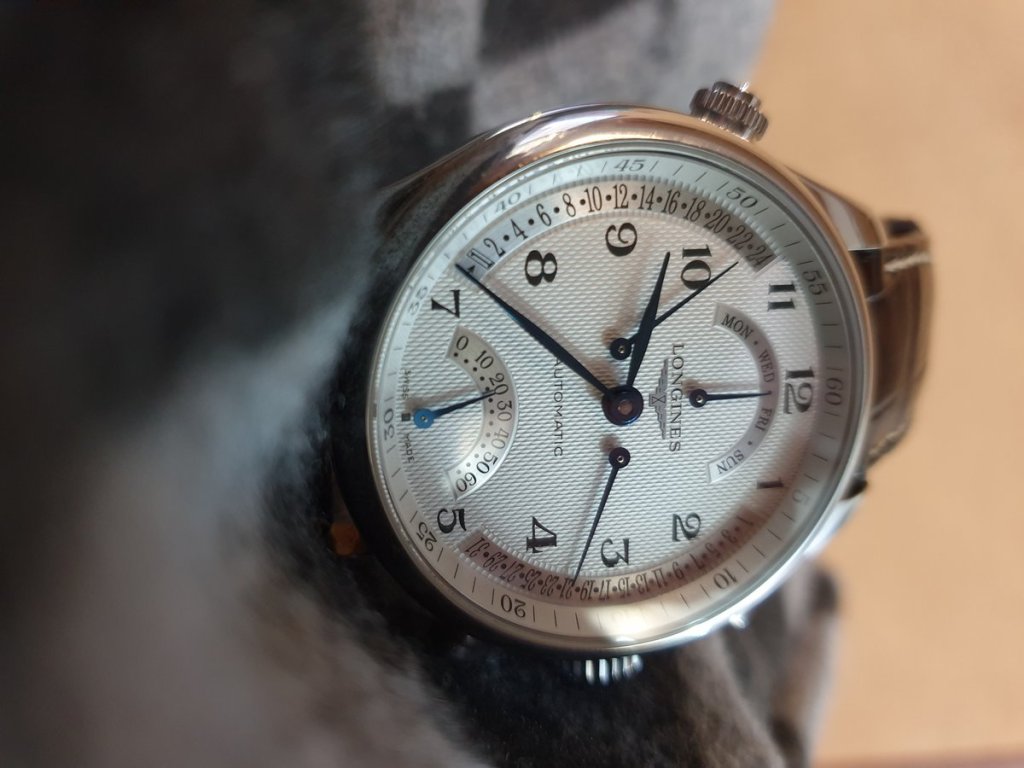
Retrograde hands were among the first complications Breguet developed, and they appear on some of the great pocket watches of the late eighteenth and early nineteenth centuries. The modern house of Breguet has kept the flame burning: the Tradition Seconde Rétrograde 7097 carries a retrograde seconds hand arcing over the open movement, the Tradition Quantième Rétrograde 7597 (2020) sweeps its retrograde date along a long arc from 3 to 9 o’clock, and the Classique 5207 pairs a retrograde date with a tourbillon. But Breguet no longer owns the idea. Longines has made retrograde displays something of a house specialty, and its Master Collection Retrograde Moon Phase stacks four of them on one dial. Vacheron Constantin’s Patrimony Retrograde Day-Date keeps the treatment restrained and classical, while Franck Muller went the other way with the Cintrée Curvex Double Retrograde Hour, which tells the time with two arcs, one for daytime hours and one for the night.

A Longines Master Collection Retrograde, one of the most accessible ways into the complication. Photo: Wikimedia Commons, CC BY-SA 4.0.
How far the idea can stretch
Because a retrograde hand can display almost anything, watchmakers have spent decades finding new things to point it at. H. Moser & Cie built the Pioneer Retrograde Seconds with a 30-second retrograde counter, which means the hand snaps back twice a minute, and put the double-sided snail cam on the dial at 6 o’clock so you can watch the mechanism work. Urwerk took it further with the UR-210, which pairs rotating hour modules with a retrograde minute hand that flashes back at the end of every hour. None of these is more useful than a plain hand going around in a circle. That has never been the point. The point is the snap, that small controlled violence at the end of every cycle, which is the most fun a watch can have while still telling the time.
Why it matters
The retrograde display matters because it is watchmaking’s purest piece of theater: it adds complexity to subtract nothing, trading the circle for the arc purely so you get to watch the hand fly home. Every other complication on this site exists to show more information. This one exists to show the same information more dramatically. There is something admirable about a mechanism whose only real job is to be watched, and about a craft that will build an entire snail cam just to make a date hand interesting.
Thanks for reading this.

