
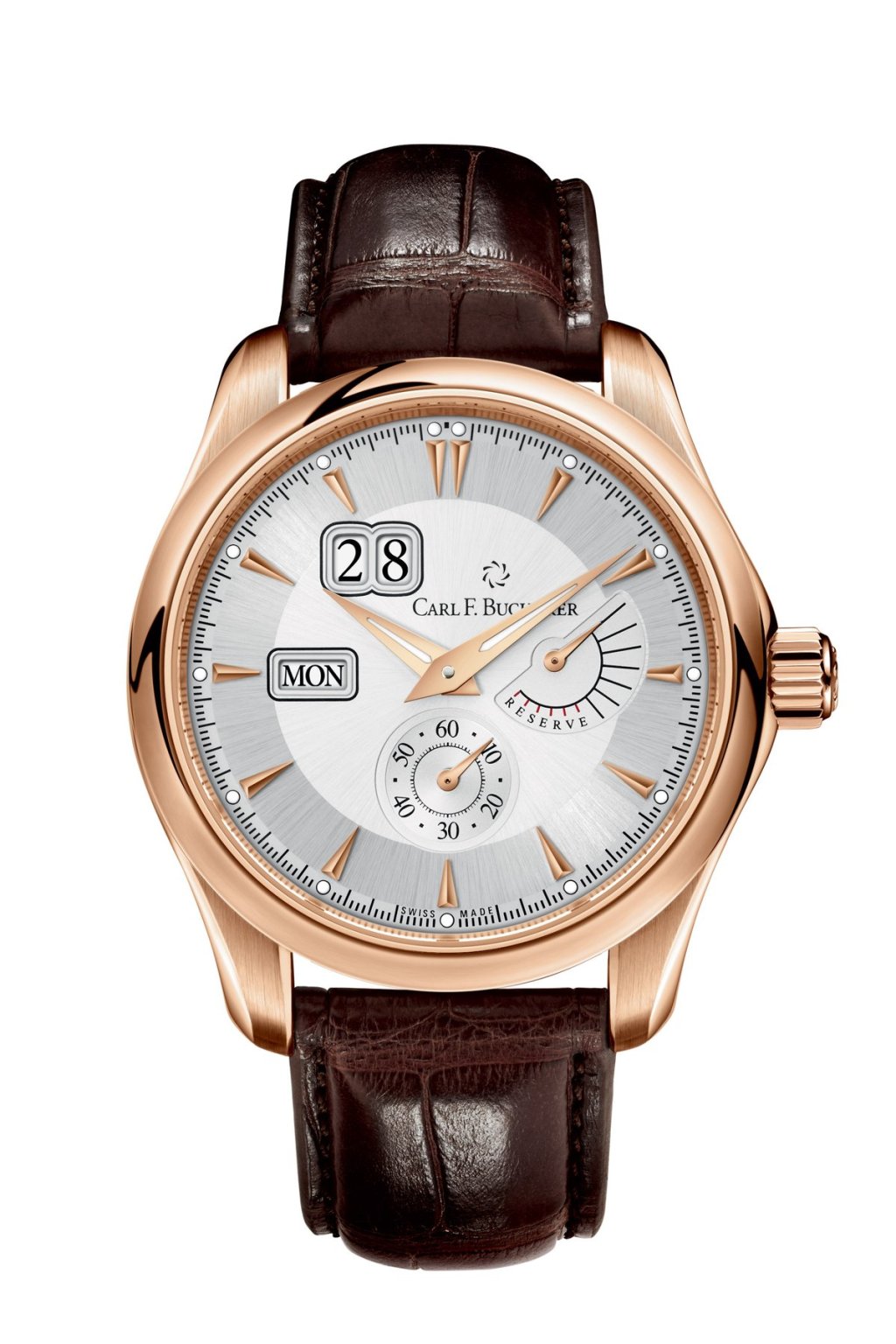
A power reserve indicator is the fuel gauge of a mechanical watch. It shows how much energy is left in the mainspring: how many hours of running time remain before the watch needs winding again. On a hand-wound watch, it tells you when to reach for the crown. On an automatic, it tells you whether wearing it all day actually charged it up. The idea is older than the wristwatch: marine chronometers and railroad-grade pocket watches carried power reserve dials, often labeled “up-down,” long before anyone put one on a wrist.

A vintage LeCoultre Powermatic of the 1950s, one of the first wristwatches with a production power reserve indicator. Photo: Wikimedia Commons, CC BY-SA 2.0.
Breguet’s prototype, JLC’s production
The first wristwatch with a power reserve indicator was built by Breguet in 1933, but it was a prototype: a single watch was assembled and it never went into production. The first production power reserve wristwatch came from Jaeger-LeCoultre in 1948, in a line called the Powermatic, powered by the calibre 481. The Powermatic is also recorded as the first automatic wristwatch with a power reserve indicator, which made it doubly useful: an automatic keeps itself wound only if you wear it enough, and the indicator finally let you see whether that was actually happening. JLC followed it with the Futurematic in 1951, whose calibre 497 carried a power reserve indicator alongside small seconds in the unusual position of three o’clock. From there, the power reserve went from a tool-watch convenience to a design feature in its own right, the little arc or aperture that has been sitting at twelve or six o’clock on dress watches for the last seventy years.
How it works
The mechanism is beautifully simple in concept. A special train of gears, connected to the ratchet wheel or the barrel arbor, drives the indicator hand: as you wind the crown or the rotor turns, this gearing advances the hand toward the “full” end of the scale. But the barrel’s teeth, which turn as the mainspring unwinds, feed into the same gearing from the other side, pushing the hand back toward “empty.” The trick is a differential, the same kind of mechanism that lets a car’s wheels turn at different speeds: it compares the winding input and the unwinding output and displays the difference, which is exactly the energy remaining. The gear ratios are set so that the full sweep of the hand matches the full capacity of the mainspring, whether that is 38 hours or eight days. Modern versions sometimes use a rotating disc seen through an aperture, or a linear scale, but the differential principle is the same.

A modern power reserve indicator at twelve o’clock on a Christopher Ward C8. Photo: Wikimedia Commons, CC BY 2.0.
Why it is genuinely useful
Most complications are theater. The power reserve is one of the few that is actually practical, especially on a hand-wound watch. A mechanical watch runs best when its mainspring is reasonably wound; let it run down toward empty and the amplitude drops and the rate wanders. The indicator turns winding from a guess into a glance: full arc in the morning, wind it; sitting near empty, wind it now. It is also quietly honest about automatics. An automatic owner who takes the watch off Friday and finds it dead Monday learns something about their wear habits, and the indicator shows exactly what happened. Of all the things watch marketing tells you that you need, the little hand that says “wind me” is one of the few that tells the truth.
The power reserve is the complication that admits what a mechanical watch is: a machine that runs on stored energy and needs feeding. Every other complication adds something the watch can do; this one just shows you what the watch has left. It is modest, useful, and completely without pretension, which in this industry makes it practically a miracle.
Thanks for reading this.

