
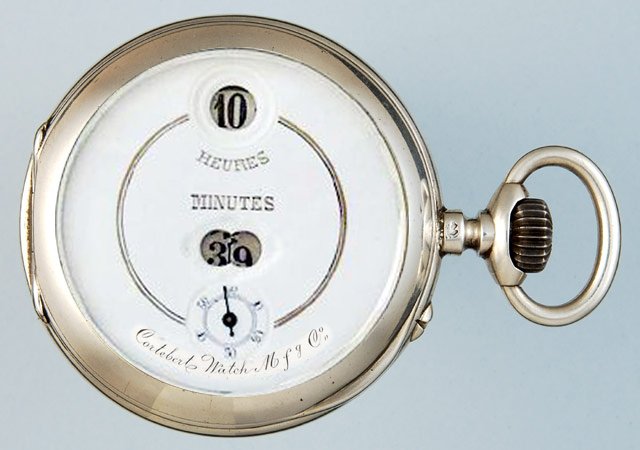
A jumping hour watch shows the hour as a numeral that snaps forward the instant the hour changes, instead of a hand that creeps around the dial. No sweeping, no dragging, just a crisp digital jump. The idea is far older than the quartz digital watches of the 1970s: jumping-hour pocket watches were being made in the early 19th century, and the true digital watch, with jumping hours and minutes shown through windows, was patented in 1883 by the Austrian engineer Josef Pallweber. He licensed the design to several brands, but the one history remembers is IWC, which became synonymous with the Pallweber display.

A Pallweber-style pocket watch with jumping hour and minute discs behind windows. Photo: Wikimedia Commons, CC BY-SA 3.0.
The Pallweber era
Before Pallweber, digital timekeeping was a clockmaker’s curiosity. The famous five-minute clock above the stage of the Semperoper in Dresden, built in the 1840s by Johannes Christian Friedrich Gutkaes, Ferdinand Adolph Lange’s mentor and father-in-law, displayed the time in jumping five-minute numerals and proved the concept at monumental scale. Pallweber’s 1883 patent shrank it to pocket size: hour and minute discs rotating behind two windows in the dial, advancing in jumps rather than creeping. The mechanism distinguishes jumping displays from the older “dragging” discs, which just replaced hands with slowly rotating dials. Pallweber pocket watches were made in real numbers and turn up at auction regularly, and IWC’s versions, produced under license, are the most collected. The display was a genuine alternative to hands for about two decades, until the conventional dial reasserted itself and the jumping hour slept for most of the 20th century.
The great digital revival
The jumping digital display came roaring back in the 2000s, this time as haute horlogerie rather than a practical alternative. The first to be announced was the Harry Winston Opus 3, which took almost a decade to complete. Then, in 2009, A. Lange & Söhne unveiled the Zeitwerk: the first mechanical wristwatch with jumping numerals for both hours and minutes, presented on oversized discs through two apertures, with a patented jumping mechanism that switches the numerals 1,440 times a day. The Zeitwerk spawned its own family: the Zeitwerk Striking Time in 2009, the Zeitwerk Minute Repeater in 2015 (the first decimal repeater, chiming in ten-minute intervals to match the display), and the Zeitwerk Date in 2019. F.P. Journe answered with the Vagabondage II in 2010 and the Vagabondage III in 2017. And in 2018, IWC closed the circle for its 150th anniversary with a Pallweber wristwatch and pocket watch, powered by the modern calibre 94200, keeping the 1883 dial layout over entirely new engineering.

A 1970s Sicura Jump Hour wristwatch, from the era when mechanical digitals briefly went mainstream. Photo: Wikimedia Commons, CC BY 4.0.
How it works, and the energy problem
The engineering challenge of a jumping display is energy. A conventional hand glides; a jumping disc has to be kicked forward against spring tension in a fraction of a second, and that kick takes a disproportionate gulp of power. Pallweber’s 19th-century versions struggled with exactly this: the jumps drained the mainspring faster than the going train liked. The Zeitwerk solves it with a patented constant-force escapement, a remontoir that releases a precisely measured pulse of energy every sixty seconds, just enough to fire the numeral discs, while keeping the balance wheel’s power supply perfectly even so the rate stays stable. Twin mainspring barrels supply the muscle. It is a remarkable solution to a problem that is, strictly speaking, self-inflicted: nobody needed the numerals to jump, the engineers just decided that if the numerals were going to jump, they would jump perfectly.
Why it matters
The jumping hour matters because it is mechanical watchmaking’s answer to the digital age, built with gears instead of circuits. Long before anyone had seen an LED, Pallweber was selling pocket watches with digital displays, and the Zeitwerk proved that a jumping numeral can be the hardest complication in the room rather than the cheapest. It is the complication for people who find hands insufficiently decisive. The hour does not approach. It arrives.
Thanks for reading this.

