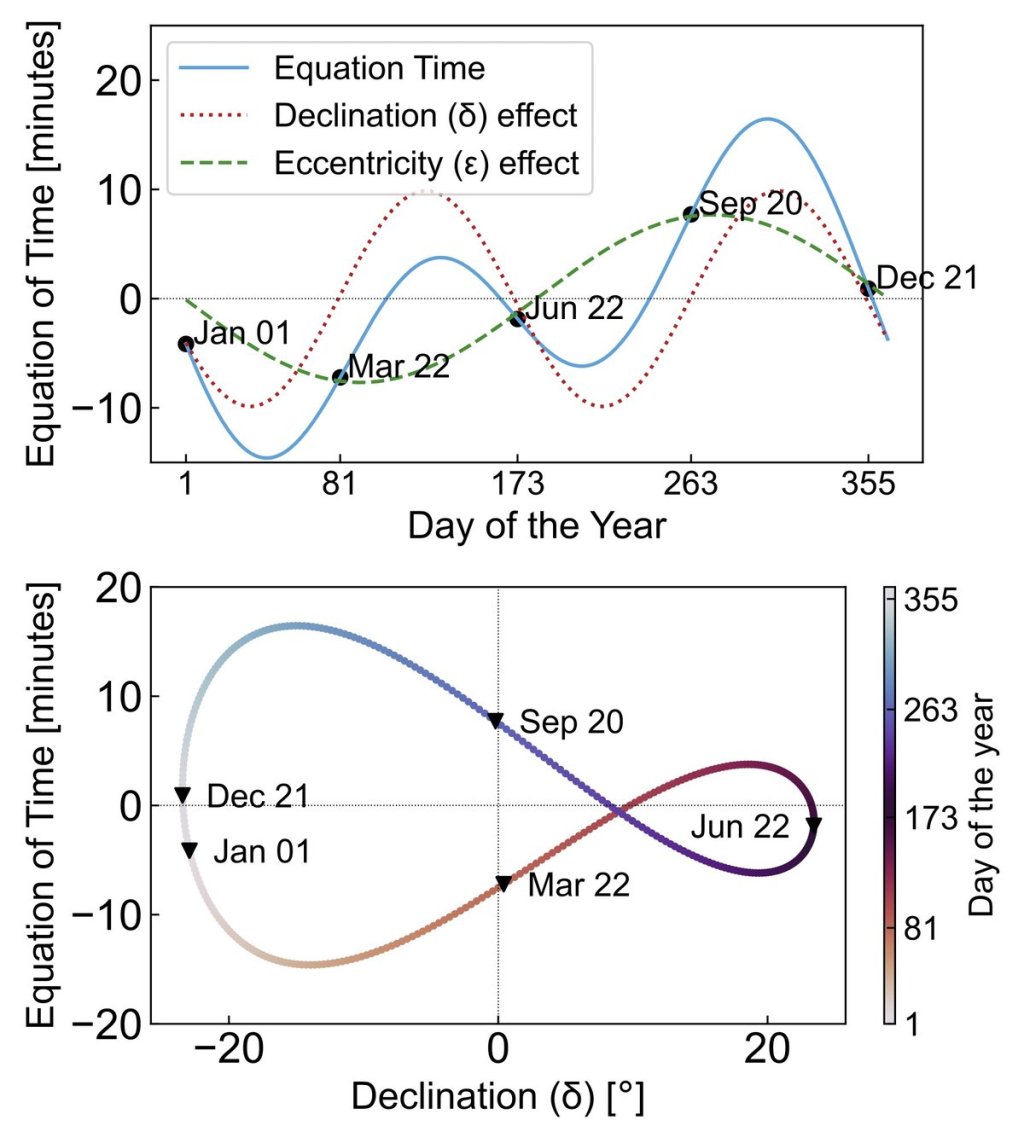
The equation of time is the difference between what a sundial says and what your watch says. The Earth’s orbit is slightly elliptical and its axis is tilted about 23.5 degrees, so a true solar day, measured from one noon to the next, is not a constant 24 hours. It runs as much as 16 minutes ahead of clock time and 14 minutes behind over the course of the year, and the two only agree on four days, around April 15, June 13, September 1, and December 25, give or take a day depending on the source. An equation of time watch displays that daily difference on the dial, usually as a hand showing true solar time or a scale reading plus or minus a few minutes. Nobody schedules meetings by it. It exists because the discrepancy is real, it is calculable, and a few watchmakers could not resist mechanizing it.

A Jaeger-LeCoultre Reverso. The line’s Grande Complication à Triptyque carried an equation of time among its 18 complications. Photo: Wikimedia Commons, CC BY-SA 4.0.
A cam shaped like a potato
The heart of the complication is a cam, an irregular disc often described as potato-shaped, that completes one revolution per year. Its wobbling outline physically encodes the year’s worth of discrepancies between solar and mean time. A lever rides against the cam’s edge, and as the cam turns, the lever’s follower rises and falls with the contour, pushing a hand that reads the difference. Some watches show it directly: a second minute hand tipped with a little sun that displays true solar time next to the ordinary minute hand, so the gap between them is the equation. Others show a scale, and you read something like +11 or -6 and do the arithmetic yourself. The most elaborate versions add sunrise and sunset times for a specific location, which need cams calculated for the owner’s own latitude and longitude. Jaeger-LeCoultre’s Reverso Grande Complication à Triptyque (2006) was regulated that way, with a cam made for where its buyer lived.
From Breguet to the Henry Graves
Translating the equation into clockwork took centuries. Early attempts are credited to mathematicians like Nikolaus Mercator in the seventeenth century, and in the late eighteenth Abraham-Louis Breguet took up the challenge, with work continued by his son. The famous Marie-Antoinette pocket watch, No. 160, commissioned in 1783 and finished in 1827, four years after Breguet’s death, carries the equation of time at 10 o’clock on a scale running from +15 to -15. The complication stayed rare enough that its appearances read like a hall of fame: Patek Philippe’s Henry Graves Supercomplication of 1933 includes it among its 24 complications, and George Daniels’ Space Traveller I, made in 1982, has it too. In the modern era it became a favorite of the grand complication builders: the JLC triptyque in 2006, Greubel Forsey’s Quantième Perpétuel à Équation in 2015, and Vacheron Constantin’s Celestia 3600 in 2017, which went one further with a running equation of time, an extra sun-tipped minute hand showing solar time in real time.
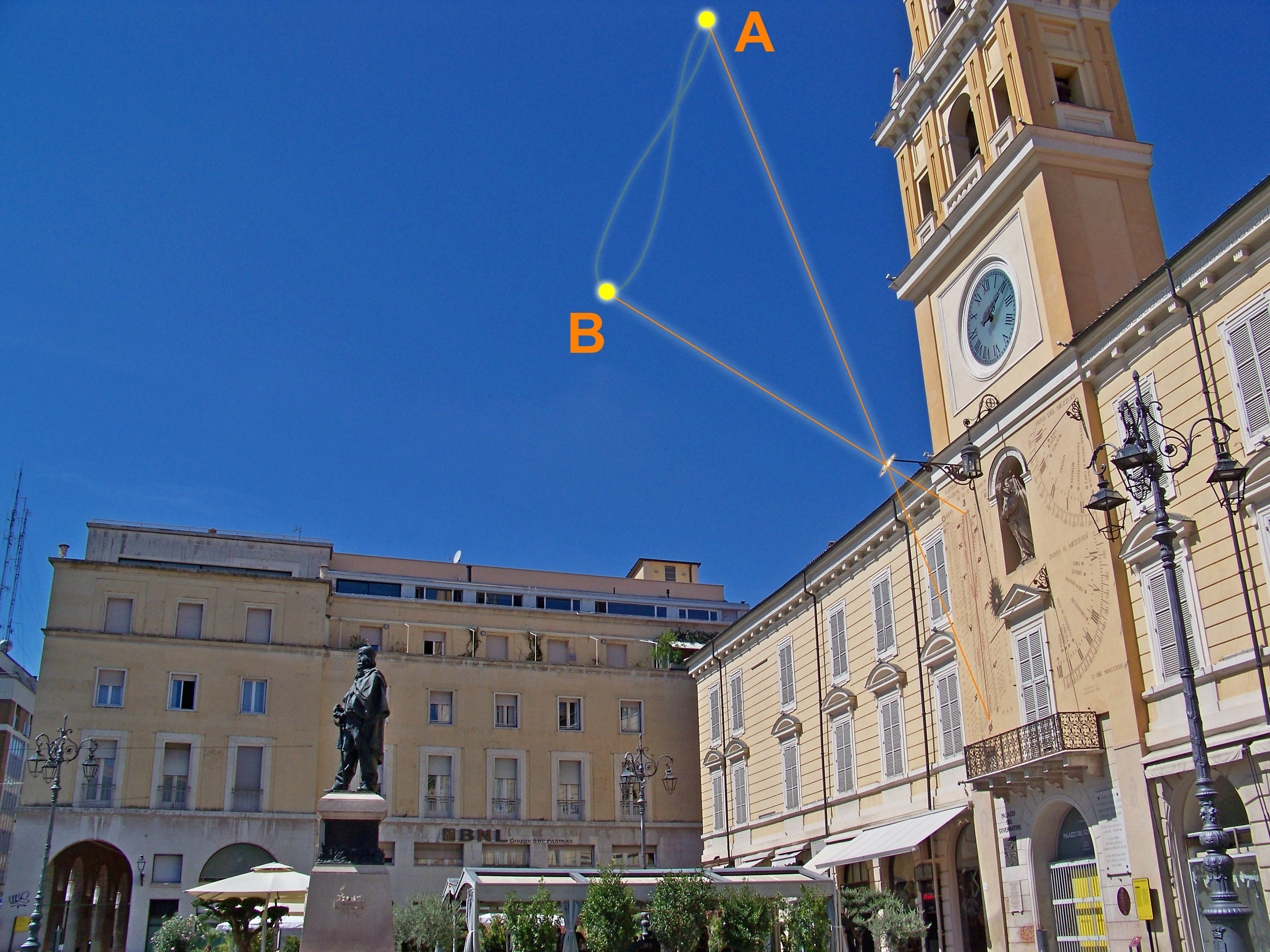
An analemma traced on a sundial: the figure-eight path the sun’s position makes through the year, which is what the equation of time measures. Photo: Wikimedia Commons, CC BY-SA 4.0.
The catch
Here is the thing about this complication: it is the display of a correction to a problem that clocks solved by ignoring it. Mean time won. The entire world runs on averaged-out hours, and the sun’s daily wobble is something you can live your whole life without noticing. An equation of time watch does not help you catch a train or time an egg. It tells you, to the minute, how wrong the sun is today, which is a piece of information with exactly zero practical value and considerable poetic value. That is why it keeps showing up in the most complicated watches ever made. It is a complication for people who find the sky interesting, built by people who found it interesting enough to cut a potato-shaped cam for it.
Why it matters
The equation of time matters because it is watchmaking looking up. Most complications are about human schedules: calendars, alarms, second time zones. This one is about the Earth’s actual motion, the tilt and the ellipse that make the sun run early and late. It is the complication that admits our tidy 24-hour day is a fiction we all agreed on, and then builds a tiny machine to keep track of the difference. Useless, beautiful, and honest about being both.
Thanks for reading this.

