
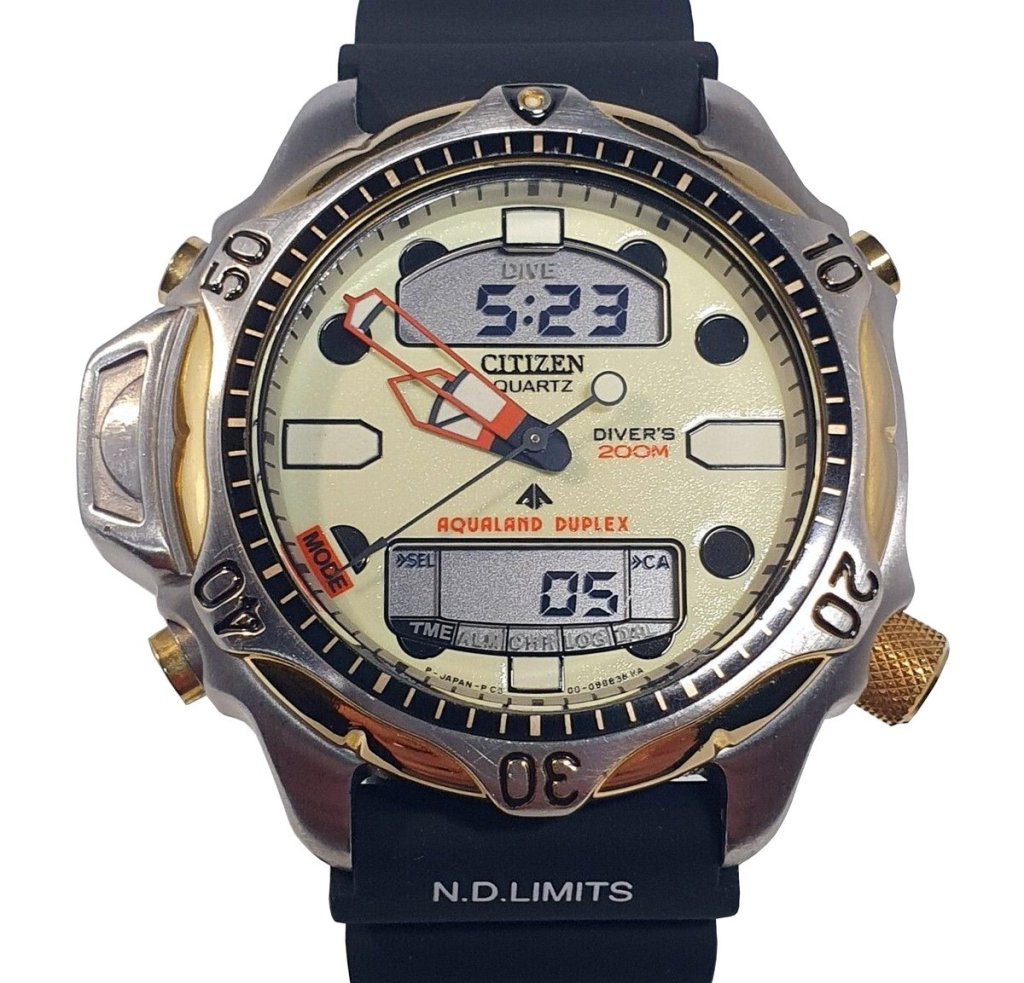
A depth gauge watch tells you how far underwater you are, mechanically, with no battery and no sensor chip. Water pressure rises predictably with depth, about one atmosphere every ten meters, so a mechanism that feels pressure can be calibrated to read depth directly. It is a complication built for divers, from the era when a watch was a legitimate piece of dive instrumentation, and it survives today as one of the most charmingly single-purpose things you can strap to your wrist.

The Oris Aquis Depth Gauge, whose depth gauge has no moving parts at all. Photo: Wikimedia Commons, CC BY-SA 3.0.
Favre-Leuba and the aneroid idea
The story starts with Favre-Leuba, the old Le Locle manufacture that spent the 1960s turning itself into an instrument maker. First came the Bivouac in the early 1960s, a wristwatch with a mechanical altimeter built on the aneroid barometer principle: a sealed metal capsule that flexes as air pressure changes, driving a hand. Then the brand applied the same idea to water. The Bathy, sources disagree on whether it arrived in 1966 or 1968, was among the first wristwatches to display the diver’s current depth mechanically, with a depth-gauge hand driven by pressure on a membrane. It was a genuine tool, made when Favre-Leuba’s divers like the Deep Blue (1963/1964) were serious professional equipment. The quartz crisis and the dive computer eventually made the whole category obsolete as instrumentation, which is why the surviving examples are so interesting: they are tools from a world that does not exist anymore.
How they work
There are two main approaches. The classic one is the pressure membrane or aneroid capsule: water pressure squeezes a sealed chamber, the chamber’s deformation moves a lever, and the lever drives a hand against a depth scale. It is the same principle as the Bivouac’s altimeter, running in reverse. The other approach is Oris’s, and it is brilliantly weird. The Aquis Depth Gauge, launched in 2013 from a patent filed in 2012, deliberately lets water into the watch through a small hole at 12 o’clock, into a channel milled around the outer edge of the extra-thick sapphire crystal. As the diver descends, water pressure compresses the air trapped in the channel, following Boyle’s law, and the advancing watermark reads against a yellow meter scale on the dial edge. It is the first depth gauge watch with no moving parts in the gauge itself. The gauge reads to 100 meters on a watch rated to 500, which Oris presumably figured was enough, since past 100 meters you have bigger concerns than your wrist.

An IWC Aquatimer. IWC’s Aquatimer Deep series of the 2010s carried mechanical depth gauges in the classic membrane style. Photo: Wikimedia Commons, CC BY 2.0.
The modern revival
The complication came back in the 2010s as a heritage flex. IWC’s Aquatimer Deep Two and Deep Three carried mechanical depth gauges in the traditional membrane style, aimed at the kind of buyer who dives on vacation and appreciates overengineering. The Oris Aquis Depth Gauge, in its 46 mm case with 500 meters of water resistance, became the most famous modern example precisely because its solution is so visibly clever: you can watch the waterline creep around the crystal on the way down. Favre-Leuba itself, relaunched and back in business, has revisited the Bathy idea in its modern Deep Raider line. None of these will outperform a fifty-dollar dive computer, and the brands know it. They are selling the romance of the mechanical instrument, the idea that your watch could keep you alive, even if you will never ask it to.
Why it matters
The depth gauge matters because it is the last true instrument complication: a watch function designed for an environment that can kill you. Moonphases and retrogrades are for looking at; a depth gauge was for trusting. The fact that it survives as a luxury feature, on watches whose owners mostly encounter water in swimming pools, does not diminish it. It just moves the pleasure from use to appreciation. Every time you look at that yellow scale, you are looking at a small machine that knows exactly how much ocean is above it, and that is a fine thing for a watch to know.
Thanks for reading this.

