
Deadbeat seconds is the complication that makes a mechanical watch tick like a quartz one. Instead of the smooth, slightly jittery sweep you expect from a mechanical seconds hand, the hand jumps forward in crisp one-second steps: tick, tick, tick. The French call it seconde morte, the dead second, and it was once a badge of serious precision, because a hand that lands exactly on each second marker is a hand you can read to the exact second. Then quartz arrived and made every cheap watch on earth tick the same way, and the deadbeat went from cutting-edge to curiosity overnight.

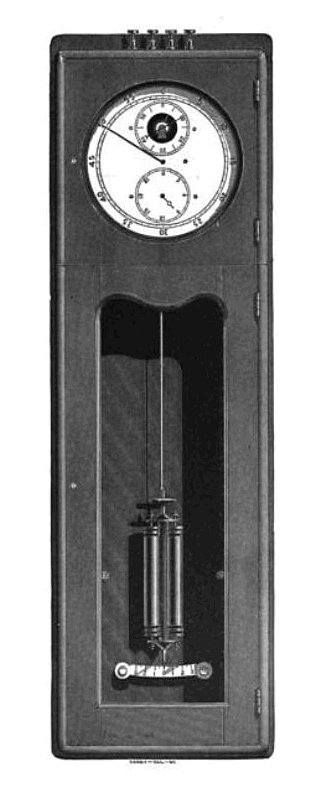
An astronomical regulator clock, the kind of precision instrument where deadbeat timekeeping was born. Photo: Wikimedia Commons, public domain.
Born in the observatory
The deadbeat effect comes from the deadbeat escapement, designed around 1675 by the astronomer Richard Towneley, first implemented in precision clocks by Thomas Tompion, and refined and popularized by George Graham around 1715. In a normal anchor escapement the escape wheel recoils slightly with each beat, nudging the pendulum back and forth and disturbing its rhythm. The deadbeat’s pallet faces are shaped so the wheel locks dead still between beats, with no recoil at all, which made it the escapement of choice for observatory regulator clocks: Graham’s mentor Thomas Tompion built two of them for the new Greenwich Observatory in 1676. In the eighteenth and nineteenth centuries the same idea crossed into pocket watches, and seconde morte watches by makers like Graham, Jean-Moise Pouzait, and Breguet were prized by astronomers, navigators, and scientists who needed to read seconds cleanly for their calculations.
How a watch ticks without quartz
A mechanical balance wheel naturally oscillates several times per second, so getting a hand to move once per second takes extra machinery. The classic approach is a separate seconds wheel that is locked, released, and re-locked every second, stealing a little energy from the going train each time. The modern trick is to do this without robbing the escapement of the power it needs to keep time. Jaeger-LeCoultre’s Calibre 770, the movement in the Jaeger-LeCoultre Geophysic True Second, handles it with a star wheel on the escapement wheel’s axis and a whip-like lever that releases the dead-second wheel once per second, in a compact arrangement that keeps play in the gear train to a minimum. Grönefeld went further with the One Hertz, giving the dead seconds its own entirely independent gear train and power supply, so the ticking mechanism never touches the timing train at all. The true-second display needs its own additional gear train and spring, which tells you how much engineering goes into faking a three-dollar quartz movement’s party trick.

George Graham, who put the deadbeat escapement into the world’s precision clocks around 1715. Photo: Wikimedia Commons, public domain.
The modern deadbeats
Today the complication survives as a deliberate anachronism, and the examples are worth knowing. The Jaeger-LeCoultre Geophysic True Second revives a name from 1958, when the original Geophysic was made for scientists working in the magnetic fields of the North Pole during the International Geophysical Year; the modern version pairs the true second with JLC’s Gyrolab balance. Arnold & Son’s DSTB puts the whole deadbeat mechanism on the dial side, an anchor-shaped lever and three bridges on display at 11 o’clock, which is the horological equivalent of showing your work. Jaquet Droz made the Grande Seconde Morte, Habring2 makes a jumping-seconds watch with a switchable mechanism, and Omega’s Synchrobeat, a manually wound calibre 372 with deadbeat central seconds made from 1952 to 1954, is a genuine rarity that collectors still argue about. Each one is a mechanical watch doing an impression of the technology that nearly killed mechanical watches, which is either a joke or a flex depending on how you look at it.
Why it matters
Deadbeat seconds matters because it is the only complication whose entire meaning changed under it. In 1715 it meant precision, the stillest possible beat for the finest clocks in the world. In 2026 it means nostalgia, a mechanical watch remembering what it felt like to be the most accurate thing in the room. Nobody needs a hand that ticks instead of sweeps. But the fact that watchmakers spent two centuries perfecting the tick, lost it to quartz in a decade, and then rebuilt it anyway, just for the pleasure of it, says something true about why this craft is still here.
Thanks for reading this.

