
The alarm complication makes a wristwatch buzz, ring, or rattle at a preset time. The trick is not building an alarm, which is old clock technology, but building one small enough to fit in a watch and loud enough to be heard. The first successful attempt was the Vulcain Cricket, released in 1947. It used a double caseback that acted as a resonance chamber, amplifying the buzz like the body of a guitar. The mechanism was reportedly modeled on the cricket insect’s natural resonance, which is where the name came from. Jaeger-LeCoultre answered in 1950 with the Memovox, which used a different solution: a hammer that strikes a post welded directly to the caseback. Both designs are still the foundation of every mechanical alarm watch made today.

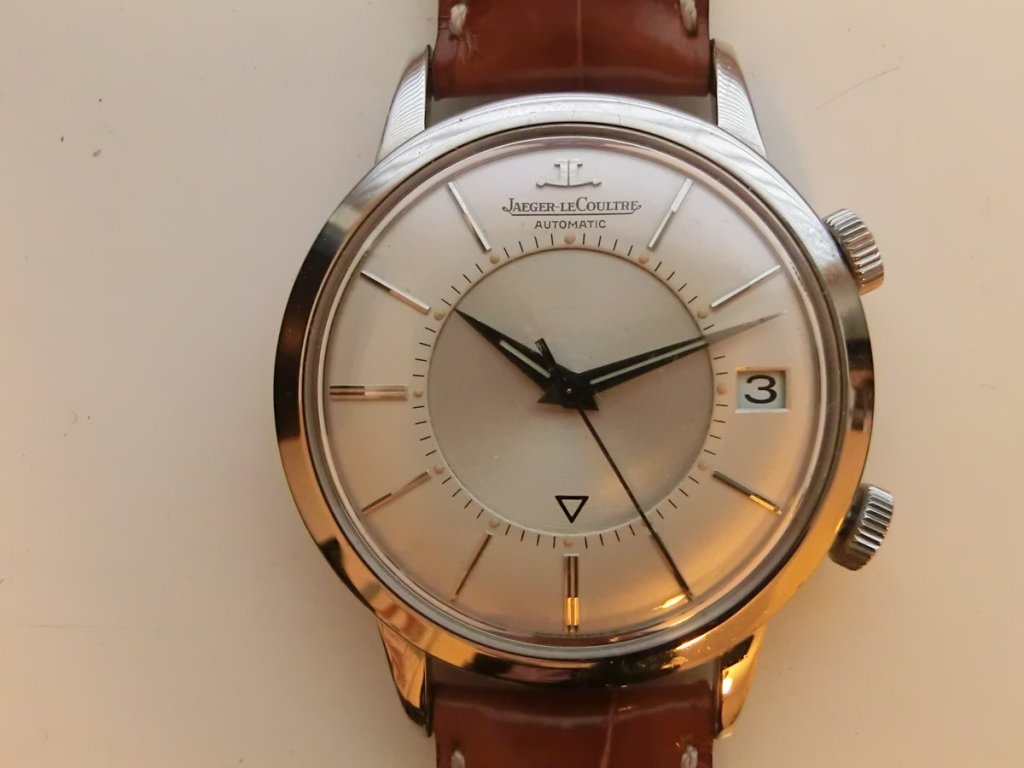
A Jaeger-LeCoultre Memovox E855, the automatic alarm watch introduced in 1956. Photo: Wikimedia Commons, CC BY-SA 3.0.
The Cricket: first out of the gate
Vulcain’s 1947 Cricket is generally credited as the first true mechanical wristwatch alarm. Its calibre Vulcain 120 solved the volume problem with that double caseback: an inner caseback and an outer one, with the space between them turning the whole watch into a little drum. The alarm disc is set by a second crown, the alarm mainspring is wound separately from the timekeeping mainspring, and at the set time the hammer goes to work for around twenty seconds. The Cricket earned the nickname “the President’s watch” because American presidents kept wearing them: Truman, Eisenhower, Lyndon Johnson, and Nixon all owned one, which was about the best advertising a Swiss brand could get in 1950s America.
How an alarm watch works
Every mechanical alarm needs its own energy supply. Winding up the timekeeping mainspring and then asking it to also drive a hammer for twenty seconds would drag the watch’s accuracy down, so alarm watches carry a separate, smaller mainspring dedicated to the alarm. On the Cricket and the Memovox, the alarm is wound and set with a second crown, the one at 2 o’clock, which also rotates an alarm-setting disc on the dial so you can see when the alarm is armed. When the alarm time arrives, a release lets the hammer strike repeatedly, and the case itself becomes the speaker: the Cricket’s resonant double back, or the Memovox’s hammer striking a post fused to the caseback, which uses the whole back as a soundboard. An alarm watch needs two crowns because there are genuinely two mechanisms inside that need independent winding and setting.
Memovox, Deep Sea, and the dive alarms
The Memovox, introduced by Jaeger-LeCoultre in 1950/51 with the manually wound calibre 489, took the Cricket’s idea and refined it. The name is a compound of Latin roots roughly meaning “the voice of memory,” which is a bit much for a buzzing watch, but the watch itself earned the name: it became one of the most recognizable alarm watches ever made. The Memovox went automatic with the E855 in 1956, and then JLC took the alarm underwater. The Deep Sea Alarm of 1959 was the first automatic wrist alarm built for diving, rated to 200 meters, followed by the Polaris in 1968 with its perforated caseback for better acoustics. Vulcain answered with the Cricket Nautical in 1961. The alarm complication was never about waking up on time, not really; it was about the fact that your watch could make a noise at all. In an era when everything else on your wrist was silent, that was genuinely delightful.

The Memovox E855 from another angle; note the two crowns, one each for time and alarm. Photo: Wikimedia Commons, CC BY-SA 3.0.
Why it matters
The alarm matters because it is the one complication that talks back. Every other complication on this site is something you look at; the alarm is something you hear, a mechanical device on your wrist that announces itself without being asked. It is completely redundant now, and it always was a little bit of a toy, but there is something wonderful about a tiny hammer inside a watch working away for twenty seconds just to remind you of something. The Cricket and the Memovox turned that toy into two of the most beloved postwar watch designs.
Thanks for reading this.

