
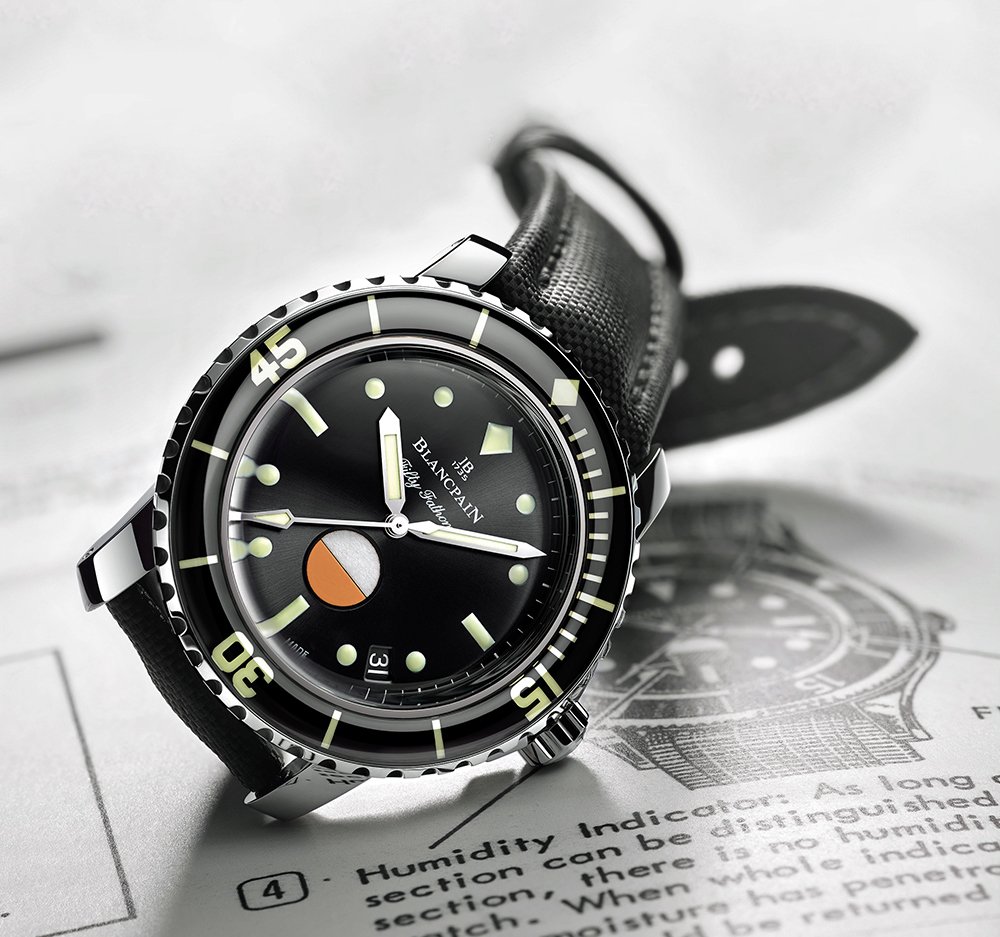
The rotating bezel is the part of the watch you are actually meant to touch. It turns, it clicks, and it does a job: measuring elapsed time. Every dive watch, GMT, and countdown timer you have ever handled gets its personality from this one ring, and the story of how it got here involves two brands, one year, and an argument that has been running for more than seventy years.
Start with the dive bezel, because it is the template for everything else. In 1953, both Blancpain and Rolex released a purpose-built dive watch: the Fifty Fathoms and the Submariner reference 6204. Both had a rotating 60-minute bezel for timing dives. Both came out in the same year. The brands have been arguing about who was first ever since.
As far as the public record allows, Blancpain’s Fifty Fathoms emerged in 1953 from the convergence of Jean-Jacques Fiechter’s own diving experience and the requirements of the French Navy’s combat swimmers, officers Bob Maloubier and Claude Riffaud. Rolex also dates the Submariner’s launch to 1953, with its public presentation following at the 1954 Basel fair. Both companies have spent decades polishing their version of the story. My read is that the argument itself is the product at this point. They both built a real dive watch in 1953, and the rest is marketing departments doing what marketing departments do.

The Rolex Submariner. Its rotating 60-minute bezel became the template for every dive watch after it. Photo: Wikimedia Commons (Eternalsleeper), CC BY-SA 3.0.
The early dive bezels turned both ways, which seems fine until you think about what happens if the bezel gets knocked mid-dive. If it rotates forward, it shows less elapsed time than the real amount, and the diver thinks they have more air left than they actually do. That is the dangerous direction. The fix was the unidirectional bezel: it only turns counterclockwise, so any accidental knock can only add to the displayed time, never subtract from it. You surface early instead of late.
The click itself comes from a simple mechanism hiding under the ring: a spring-loaded ball bearing or a ratchet spring engaging teeth cut into the underside of the bezel. Most dive bezels give you 60 or 120 clicks per rotation, one or two per minute. That sound is not an accident of engineering. It is feedback, telling your gloved, half-numb fingers that the bezel actually moved one notch. Cheap bezels feel mushy and vague. Good ones feel like a well-made light switch.
At the 12 o’clock position sits the bezel pip, the little dot or triangle filled with luminous material. Old ones used tritium, which glows on its own but fades over a decade or so. Modern ones use Super-LumiNova or similar, which needs charging from light but stays bright far longer. The pip is what you actually watch in the dark: line it up with the minute hand when you start, and read elapsed minutes off the bezel.
The GMT bezel is the rotating bezel’s second great act. The original GMT-Master reference 6542, from 1955, had a 24-hour bezel made of bakelite, a brittle early plastic that cracked if you looked at it wrong. Rolex replaced it with metal inserts, then aluminum, and eventually ceramic. The GMT bezel turns both directions because the safety logic of diving does not apply: you are tracking a second time zone, not your air supply. The red-and-blue “Pepsi” coloring was there to separate day hours from night hours at a glance, which made it useful for airline crews tracking home time and local time on intercontinental flights.

A Rolex GMT-Master II with its red-and-blue 24-hour bezel, rotated to read a second time zone. Photo: Wikimedia Commons (Qubeek), CC0.
Then there are countdown bezels, the less common sibling. Instead of measuring time that has passed, you set the marker to the moment you are counting down to, like the start of a yacht race, and watch the minutes drain away. They turn up on regatta timers and some pilot’s watches.
One footnote worth knowing: Rolex’s first rotating bezel was not on a dive watch at all. The Turn-O-Graph, introduced in 1953, was a Datejust with a rotating timing bezel, and it was the direct ancestor of the Submariner’s. The idea of turning a ring to mark time started as a convenience for everyday timing and only later became life-support equipment.
Why it matters
The rotating bezel is the rare watch feature that is both genuinely useful and genuinely fun to fidget with, and those two qualities explain why it survived the quartz crisis, the smartphone, and every prediction that mechanical watches were finished. It asks for your participation. You turn it, it clicks, it holds your place in time like a finger on a page. When you are choosing a watch, pay attention to how the bezel feels, because you will touch it more than any other part except the crown. And if anyone at a meetup tries to start the Fifty Fathoms versus Submariner argument, you now know enough to smile, order another coffee, and let them have it.
Thanks for reading this.

