
The sandwich that won
Almost every watch you will ever handle is built as a three part sandwich: a middle case in the center, a bezel on top holding the crystal, and a caseback closing the bottom. The movement drops into the middle case from the back, the back goes on, and the whole thing is sealed with gaskets squeezed between the parts. It is simple, it works, and it is why the multi piece case beat every rival design. Serviceability won. Manufacturing simplicity won. The sandwich won.
There is nothing flashy about this. It is the plain white t-shirt of watchmaking: not interesting to look at on its own, but everything else depends on it. A watchmaker can pop a snap off back in seconds, lift the movement out, service it, and close the watch up again. Try that with a one piece case and you will be removing the crystal and swearing. The three piece case respects the person who has to fix the watch in twenty years, and that is a bigger deal than it sounds.

The standard three part sandwich: middle case, bezel, and caseback, working together. Photo: Wikimedia Commons, CC BY-SA 4.0.
How the parts seal together
The parts of the sandwich meet at compressed gaskets, usually rubber O-rings sitting in machined grooves. A screw down caseback threads into the middle case and crushes its gasket evenly as it tightens, which is why it is the choice for dive watches. A snap off back is held by friction against a thin knife edge, simpler and cheaper, good enough for a dress watch that will never see a pool. Screw fixed backs use small screws around the perimeter, common on vintage military pieces and some modern tool watches.
The crystal seals the same way, pressed into the bezel against a gasket or, on older and cheaper watches, glued in. The crown gets its own tiny gasket inside the tube. Every one of these is a separate maintenance item. Gaskets dry out, harden, and crack, which is why a water resistance rating has a shelf life. A watch that was waterproof in 1985 is a rumor of a waterproof watch today unless the gaskets have been replaced, and that is true no matter what the caseback says.
Variants and complications of the formula
The basic sandwich comes with options. Rotating bezels, the kind on dive watches, add a whole bezel assembly: a ratchet ring, a spring, sometimes a separate bezel insert with the markings. That is several more parts and several more places for grit to get in, which is why a dive bezel eventually gets crunchy if you actually dive with it.
Lugs vary too. On most watches they are machined as part of the middle case, which is strong and simple. On others, especially vintage pieces and some dress watches, the lugs are soldered or screwed on separately, which allows fancier shapes but adds a joint that can fail. And some watches complicate the back itself: a display back swaps the solid metal for a sapphire window set into a metal ring, which is still a multi piece case, just one with a hole in the bottom.

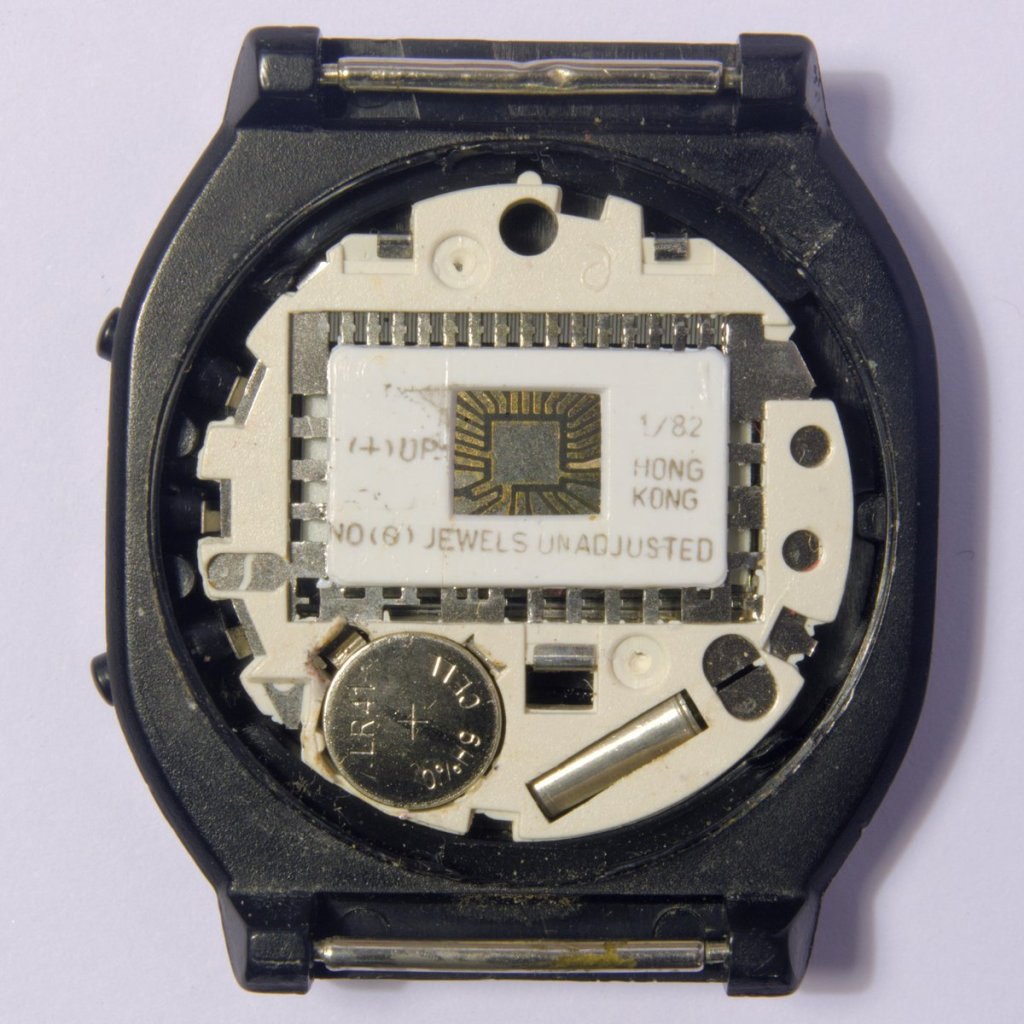
One layer of the sandwich: a screw-down caseback with its gasket seat doing the quiet work. Photo: Wikimedia Commons, CC BY-SA 4.0.
Why it beat the alternatives
One piece cases seal better. Two piece cases with hinged backs are charming. But the three piece sandwich is the one that let the industry scale. Each part is simple to machine, each part can be replaced without scrapping the watch, and a watchmaker anywhere in the world can open it with standard tools. When the Swiss industry industrialized in the middle of the twentieth century, it standardized on the architecture that made watches buildable, fixable, and affordable at volume.
The landmark that proved it was the dive watch. Many of the influential professional dive watches of the 1950s and 1960s used conventional multi-piece cases with screw-down crowns and casebacks. Later designs such as the Omega Ploprof and Seiko Professional Diver demonstrated that monocoque construction offered a different way to achieve formidable water resistance. The sandwich did not just win on convenience. It won under pressure, literally.
Why it matters
Knowing the sandwich is inside your watch tells you how to think about it. A snap off back means easy, cheap servicing and modest water resistance. A screw down back means serious sealing and a watchmaker with the right case wrench. A display back means the sandwich has a window, with all the trade-offs that come with it. None of these are better in the abstract. They are better or worse at specific jobs, and the case architecture is the first clue about which job your watch was built for.
Thanks for reading this.

