
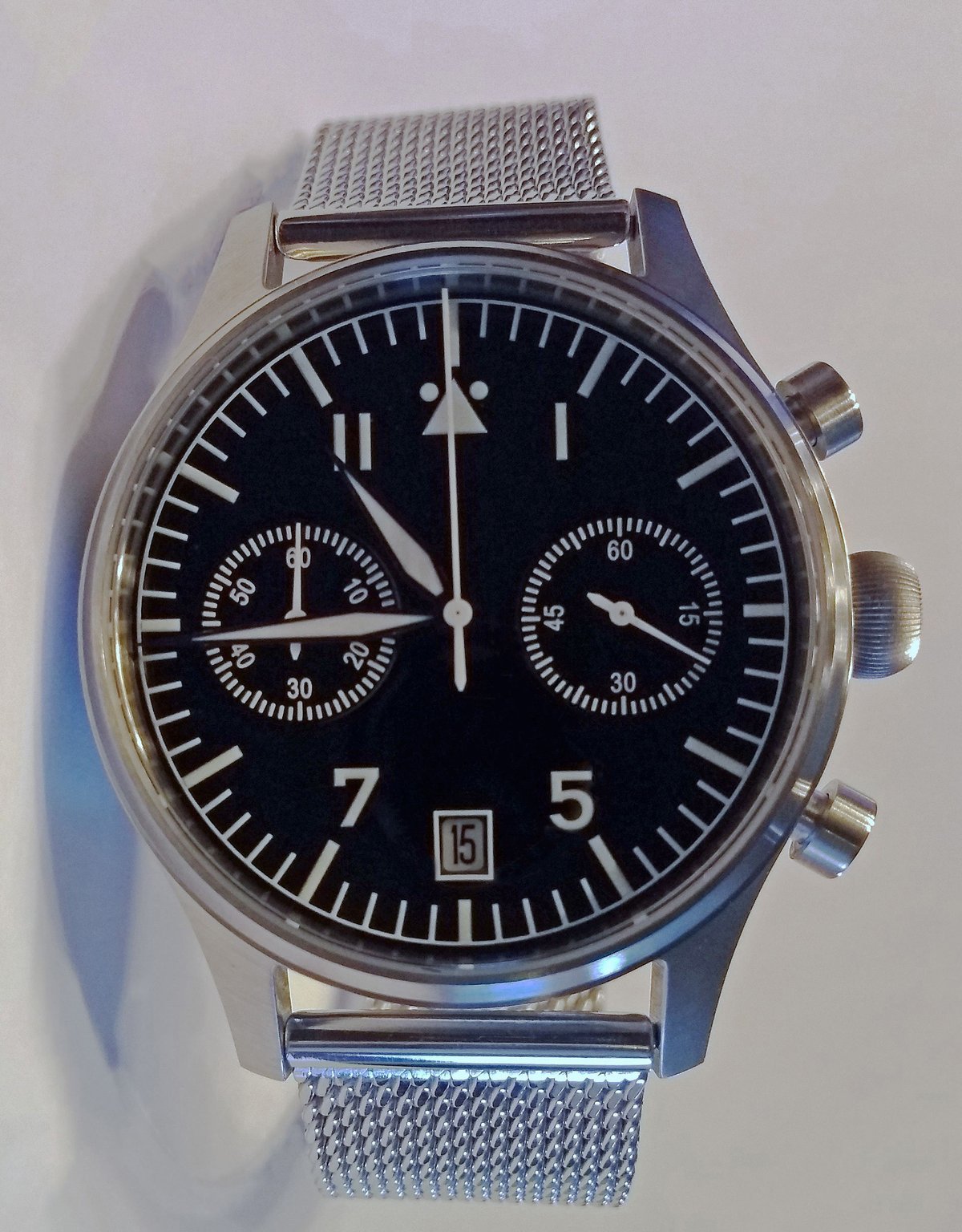
Lugs are the projections at the top and bottom of a watch case that hold the strap or bracelet. Most watches have four, some have two, and a few hide them so well that they seem to have none. They began as wire loops added to pocket watch cases in the first decades of wristwatches, grew into sculpted parts of the case, and now decide how a watch sits on the wrist more than the diameter on the spec sheet does.

A WWI-era trench watch, with simple wire lugs soldered to a converted pocket watch case. Photo: Wikimedia Commons, CC BY 3.0.
How it works
A lug is a cantilever. The strap pulls on a spring bar between the lug tips, and the load goes into the lug as a bending moment at its root, so a long, thin lug carries the same load with more stress and more flex than a short, thick one. The moment grows with the lug length, and stress with the moment divided by the square of the thickness. Weight and strap tension are small, and the real design loads are knocks and the pull of a strap caught on something.
The spring bar is a small spring-loaded pin that sits between a pair of lugs, with its tips seated in holes on the inside faces. A spring inside the tube pushes the tips outward, and compressing them lets a strap be fitted and removed. Where the holes sit determines how easy a strap change is. Drilled lugs have holes that go through the lug to the outside, so the end of the spring bar can be pressed in with a pointed tool from the front. Watches without drilled holes need a forked tool worked in from the underside, which is slower and more likely to mark the lug. Lug width, the distance between the lugs, sets which straps fit. Widths of 18, 20 and 22 mm have a large aftermarket, while odd sizes such as 19 or 21 mm tend to limit an owner to the original strap or a short list of alternatives.
Lug-to-lug is the distance from the tip of one lug to the tip of the opposite lug. It sets the watch’s footprint on the wrist more than case diameter does, because a longer span reaches further across the wrist. If the lugs overhang the edges of the wrist, the watch overhangs with them. Shape matters as much as length. Lugs that curve down conform to the wrist, lower the watch’s center of gravity and reduce sliding, so a thick case feels slimmer. Flat lugs sit on top of the wrist, leave a bigger gap and can make a watch feel top-heavy on a small or rounded wrist. Rounded tips and edges reduce pressure points, and scalloped undersides cut skin contact.
History as a chain of problems
Before the First World War, most wristwatches were converted pocket watches. Makers took a small pocket watch case and attached lugs to it, in many cases by welding or soldering wire loops onto the sides, just enough to thread a strap through. The method fixed the strap problem without changing the case, which is why many early examples carry the crown at 12 o’clock or at an odd offset. Wristlets moved from novelty to issue equipment between 1914 and 1916, when armed forces began supplying them to officers, and by 1917 a British trade journal could note one on nearly every man in uniform. Some trench watches added a metal cage over the crystal as protection. By 1930 wristwatches outnumbered pocket watches by about 50 to 1.
A loop can only take a strap that is threaded through it. The spring bar changed that. A patent for the spring bar in the form still used was granted to Isidor Dintsman in 1929, and brass pins later gave way to stainless steel.
Wire lugs did not disappear. Early Panerai Radiomir prototypes, made for the Italian Navy in the late 1930s with hand-wound movements supplied by Rolex, had welded wire lugs, and in the 1940s these gave way to fixed, squared lugs. Other makers made lugs a feature in their own right. Teardrop lugs appeared in the Art Deco period of the 1930s. Universal Genève used twisted lugs on watches such as the Polerouter in the 1950s, and the Omega Speedmaster reference 105.012-063 of 1964 helped to popularize them. Soldered lugs, as on the Breguet Classique, remain an artisanal, high-end method, while most cases today mill the lugs from the same piece of metal as the case.
Where it stands now
The Royal Oak of 1972 and the Nautilus of 1976, both drawn by Gérald Genta, helped popularize integrated sports watches, in which the case and bracelet flow into each other. The bracelet’s first links are cut to meet the case, so there is no ordinary lug gap to hold a standard strap, and the attachment points are part of the design.
Cartier’s Tank takes the opposite route and hides the attachment. Louis Cartier drew the design in 1917, taking the overhead view of a Renault FT tank as a starting point, with the treads as the side rails and the turret as the dial. Those rails are the brancards, two flat vertical bars on either side of the case that do the structural work of lugs while keeping the strap in line with the case outline.

The lugs of a Rolex Daytona doing their quiet job: short, polished, and holding the strap in line with the case. Photo: Wikimedia Commons, CC BY-SA 4.0.
Sources
- “Everything About Watch Lugs: From Wristlets to the Most Expressive Designs,” Monochrome Watches
- “Watch Lugs: Ergonomic Geometry and Mechanical Interface,” Hourstriker
- “A Wristed Development: What Stopped the Pocket Watch?” TAG Heuer Magazine
- “Case Comparison of the Panerai Radiomir and Radiomir 1940,” Everest Bands
- “Cartier Tank Has Survived a Century of Style,” WatchMaxx
Thanks for reading this.